

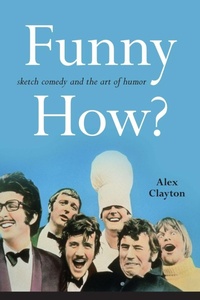
Funny How?
Sketch Comedy and the Art of Humor
Published on 2. January 2021
Book
Paperback/Softback
162 pages
978-1-4384-7828-9 (ISBN)
Description
Uses comedy skits, from Monty Python to Key and Peele, to probe how humor works.
What makes something funny? This book shows how humor can be analyzed without killing the joke. Alex Clayton argues that the brevity of a sketch or skit and its typical rejection of narrative development make it comedy-concentrate, providing a rich field for exploring how humor works. Focusing on a dozen or so skits and scenes, Clayton shows precisely how sketch comedy appeals to the funny bone and engages our philosophical imagination. He suggests that since humor is about persuading an audience to laugh, it can be understood as a form of rhetoric. Through vivid, highly readable analyses of individual sketches, Clayton illustrates that Aristotle's three forms of appeal-logos, the appeal to reason; ethos, the appeal to communality; and pathos, the appeal to emotion-can form the basis for illuminating the inner workings of humor. Drawing on both popular and lesser-known examples from the United States, United Kingdom, and elsewhere-Monty Python's Flying Circus, Key and Peele, Saturday Night Live, Airplane!, and Smack the Pony-Clayton reveals the techniques and resonances of humor.
What makes something funny? This book shows how humor can be analyzed without killing the joke. Alex Clayton argues that the brevity of a sketch or skit and its typical rejection of narrative development make it comedy-concentrate, providing a rich field for exploring how humor works. Focusing on a dozen or so skits and scenes, Clayton shows precisely how sketch comedy appeals to the funny bone and engages our philosophical imagination. He suggests that since humor is about persuading an audience to laugh, it can be understood as a form of rhetoric. Through vivid, highly readable analyses of individual sketches, Clayton illustrates that Aristotle's three forms of appeal-logos, the appeal to reason; ethos, the appeal to communality; and pathos, the appeal to emotion-can form the basis for illuminating the inner workings of humor. Drawing on both popular and lesser-known examples from the United States, United Kingdom, and elsewhere-Monty Python's Flying Circus, Key and Peele, Saturday Night Live, Airplane!, and Smack the Pony-Clayton reveals the techniques and resonances of humor.
Reviews / Votes
"This book tackles head-on the assumption that to examine comedy is to destroy it. Clayton isn't out to make the reader laugh all over again at these sketches and extended comic riffs. His point is that comedy, like any other kind of artistic performance, should be amenable to aesthetic redescription by an attentive critic. I know of no other book that contends with the assumptions and claims of comedy theories in the way this one does. There is nothing else like it out there." - Brenda Austin-Smith, coeditor of The Gendered Screen: Canadian Women FilmmakersMore details
Series
Language
English
Place of publication
Albany, NY
United States
Target group
Professional and scholarly
US School Grade: College Graduate Student and over
Product notice
Paperback (trade)
Illustrations
35 Illustrations, black and white
Dimensions
Height: 229 mm
Width: 152 mm
Thickness: 9 mm
Weight
245 gr
ISBN-13
978-1-4384-7828-9 (9781438478289)
Copyright in bibliographic data and cover images is held by Nielsen Book Services Limited or by the publishers or by their respective licensors: all rights reserved.
Schweitzer Classification
Other editions
Additional editions
E-Book
05/2020
1st Edition
De Gruyter
from
€81.99
Available for download
Person
Alex Clayton is Senior Lecturer in Film and Television at the University of Bristol, United Kingdom, and the author of The Body in Hollywood Slapstick.
Content
List of Illustrations
Preface
Acknowledgments
Introduction
1. The Trouble with Comic Theory
2. Takeoffs
3. Thought Experiments
4. Prime Numbers
5. Pitched Battles
Conclusion: The Rhetoric of Humor
Works Cited
Index
Preface
Acknowledgments
Introduction
1. The Trouble with Comic Theory
2. Takeoffs
3. Thought Experiments
4. Prime Numbers
5. Pitched Battles
Conclusion: The Rhetoric of Humor
Works Cited
Index