

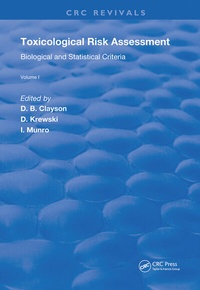
Toxicological Risk Assessment
Biological and Statistical Criteria
1st Edition
Published on 27. February 2021
Book
Paperback/Softback
244 pages
978-0-367-25805-4 (ISBN)
Description
First Published in 1986, this two-volume set explores the methods of toxicological risk assessment. Carefully compiled and filled with a vast repertoire of notes, diagrams, and references this book serves as a useful reference for toxicologists and other practitioners in their respective fields.
More details
Series
Language
English
Place of publication
London
United Kingdom
Publishing group
Taylor & Francis Ltd
Target group
Professional and scholarly
Dimensions
Height: 254 mm
Width: 178 mm
Weight
430 gr
ISBN-13
978-0-367-25805-4 (9780367258054)
Copyright in bibliographic data and cover images is held by Nielsen Book Services Limited or by the publishers or by their respective licensors: all rights reserved.
Schweitzer Classification
Other editions
Additional editions
David B. Clayson | Daniel R. Krewski | Ian C. Munro
Toxicological Risk Assessment
Biological and Statistical Criteria
Book
08/2019
1st Edition
CRC Press
€185.70
Withdrawn from sale
Persons
D. B. Clayson, D. Krewski, I. Munro
Content
Volume I.
SECTION A - BIOLOGICAL CRITERIA.
1. Interspecies Exploration of Drug and Genetic Toxicity Data. 2. Pharmacokinetic Differences Between Species. 3. Differences in Metabolism at Different Dose Levels. 4. Toxicological Effects on Carcinogenesis. 5. Problems in Interspecies Exploration.
SECTION B - STATISTICAL CRITERIA.
6. Statistical Design and Analysis of the Long-Term Carcinogenicity Bioassay. 7. Statistical Analysis of Rodent Tumorigenicity Experiments. 8. Use of the Hartley-Sielken Model in Low-Dose Extrapolation. 9. A Review of Methods for Calculating Statistical Confidence Limits in Low-Dose Extrapolation. 10. Incorporation of Pharmacokinetics in Low-Dose Risk Estimation. Index.
Volume II.
SECTION A - GENERAL CRITERIA.
1. Epidemiological Methods for the Assessment of Human Cancer at Risk. 2. Assessment of Human Exposure to Environmental Contaminants with Special Reference. 3. The Influence of Nutrition, Immunologic Status, and Other Factors on the Development of Cancer. 4. The Significance of Benefits in Regulatory Decision Making. 5. Measuring Health Benefits. 6. Food Safety Regulations.
SECTION B - CASE STUDIES
7. Case Study - Asbestos. 8. Vinyl Chloride - A Cancer Case Study. 9. An Integrated Approach to the Study of Formaldehyde Carcinogenicity in Rats and Mice. 10. Determination of Human Risk in Regulating Polychlorinated Biphenyls (PCBs) - A Case Study. 11. Saccharin - A Bitter Sweet Case. Index.
SECTION A - BIOLOGICAL CRITERIA.
1. Interspecies Exploration of Drug and Genetic Toxicity Data. 2. Pharmacokinetic Differences Between Species. 3. Differences in Metabolism at Different Dose Levels. 4. Toxicological Effects on Carcinogenesis. 5. Problems in Interspecies Exploration.
SECTION B - STATISTICAL CRITERIA.
6. Statistical Design and Analysis of the Long-Term Carcinogenicity Bioassay. 7. Statistical Analysis of Rodent Tumorigenicity Experiments. 8. Use of the Hartley-Sielken Model in Low-Dose Extrapolation. 9. A Review of Methods for Calculating Statistical Confidence Limits in Low-Dose Extrapolation. 10. Incorporation of Pharmacokinetics in Low-Dose Risk Estimation. Index.
Volume II.
SECTION A - GENERAL CRITERIA.
1. Epidemiological Methods for the Assessment of Human Cancer at Risk. 2. Assessment of Human Exposure to Environmental Contaminants with Special Reference. 3. The Influence of Nutrition, Immunologic Status, and Other Factors on the Development of Cancer. 4. The Significance of Benefits in Regulatory Decision Making. 5. Measuring Health Benefits. 6. Food Safety Regulations.
SECTION B - CASE STUDIES
7. Case Study - Asbestos. 8. Vinyl Chloride - A Cancer Case Study. 9. An Integrated Approach to the Study of Formaldehyde Carcinogenicity in Rats and Mice. 10. Determination of Human Risk in Regulating Polychlorinated Biphenyls (PCBs) - A Case Study. 11. Saccharin - A Bitter Sweet Case. Index.