

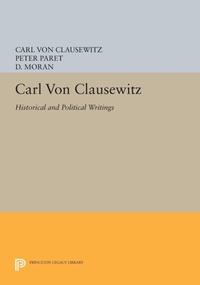
Carl von Clausewitz
Historical and Political Writings
Published on 14. July 2014
Book
Paperback/Softback
416 pages
978-0-691-60201-1 (ISBN)
Description
Carl von Clausewitz's major theoretical work, On War, has retained its freshness and relevance since it first appeared 160 years ago. Clausewitz was also a wide-ranging, innovative historian--his acerbic history of Prussia before 1806 became an underground classic long before it could be published--and a combative political essayist, whose observations on the affairs of Germany and Europe combine social egalitarianism with a nearly Bismarckian Realpolitik. In this companion volume to On War, the editors bring together Clausewitz's political writings and a selection of his historical works--material that is fascinating in its own right, important as a commentary on his theories of war, and a valuable source for understanding European ideas and attitudes during and after the Napoleonic era. None of these works has previously appeared in English, with one exception, which was published in a corrupt, censored text that has now been restored to its original form. The editors have contributed introductions for the historical and for the political parts of the volume, as well as brief introductions to the individual selections.
Their analyses and the texts themselves reveal Clausewitz to be an exceptionally independent observer both of the past and of his own times, whose outlook is distinguished by an unideological pragmatism and a keen sense of the possibilities and shortcomings of state power. Originally published in 1992. The Princeton Legacy Library uses the latest print-on-demand technology to again make available previously out-of-print books from the distinguished backlist of Princeton University Press. These editions preserve the original texts of these important books while presenting them in durable paperback and hardcover editions. The goal of the Princeton Legacy Library is to vastly increase access to the rich scholarly heritage found in the thousands of books published by Princeton University Press since its founding in 1905.
Their analyses and the texts themselves reveal Clausewitz to be an exceptionally independent observer both of the past and of his own times, whose outlook is distinguished by an unideological pragmatism and a keen sense of the possibilities and shortcomings of state power. Originally published in 1992. The Princeton Legacy Library uses the latest print-on-demand technology to again make available previously out-of-print books from the distinguished backlist of Princeton University Press. These editions preserve the original texts of these important books while presenting them in durable paperback and hardcover editions. The goal of the Princeton Legacy Library is to vastly increase access to the rich scholarly heritage found in the thousands of books published by Princeton University Press since its founding in 1905.
Reviews / Votes
Finalist for the 1993 Translation Prize, PEN American Center "This is a splendid collection of Clausewitz's historical and political writings, superbly translated and brilliantly edited... No serious student of history, politics, and war should miss this admirable book."--InfantryMore details
Series
Language
English
Place of publication
New Jersey
United States
Target group
College/higher education
Professional and scholarly
Product notice
Paperback (trade)
Dimensions
Height: 254 mm
Width: 178 mm
Thickness: 23 mm
Weight
779 gr
ISBN-13
978-0-691-60201-1 (9780691602011)
Copyright in bibliographic data and cover images is held by Nielsen Book Services Limited or by the publishers or by their respective licensors: all rights reserved.
Schweitzer Classification
Other editions
Additional editions
Carl Von Clausewitz | Peter Paret | Daniel Moran
Carl von Clausewitz
Historical and Political Writings
E-Book
07/2014
1st Edition
Princeton University Press
€71.49
Available for download
Persons
Carl von Clausewitz (1780 - 1831) was a Prussian general and military theorist who stressed the "moral" (in modern terms, psychological) and political aspects of war. His most notable work, Vom Kriege (On War), was unfinished at his death. Clausewitz was a realist and, while in some respects a romantic, also drew heavily on the rationalist ideas of the European Enlightenment. He stressed the dialectical interaction of diverse factors, noting how unexpected developments unfolding under the "fog of war" (i.e., in the face of incomplete, dubious, and often completely erroneous information and high levels of fear, doubt, and excitement) call for rapid decisions by alert commanders. He saw history as a vital check on erudite abstractions that did not accord with experience. He argued that war could not be quantified or reduced to map-work, geometry, and graphs. Clausewitz had many aphorisms, of which the most famous is "War is the continuation of politics by other means."
Content
*FrontMatter, pg. i*CONTENTS, pg. vii*LIST OF MAPS, pg. ix*PREFACE, pg. xi*ACKNOWLEDGMENTS, pg. xv*LIST OF ABBREVIATIONS, pg. xvii*INTRODUCTION TO PART ONE, pg. 3*1. "Some Comments on the War of the Spanish Succession after Reading the Letters of Madame de Maintenon to the Princess des Ursins" (1826 or later), pg. 15*2. Observations on the Wars of the Austrian Succession" (early 1820s), pg. 19*3. From Observations on Prussia in Her Great Catastrophe (1823-1825), pg. 30*4. "On the Life and Character of Scharnhorst" (1817), pg. 85*5. From The Campaign of 1812 in Russia (1823-1825), pg. 110*6. From "Strategic Critique of the Campaign of 1814 in France" (early 1820s), pg. 205*INTRODUCTION TO PART TWO, pg. 223*7. Notes on History and Politics (1803-1807), pg. 237*8. "The Germans and the French" (1807), pg. 250*9. Notes on History and Politics (1807-1809), pg. 263*10. Letter to Fichte (1809), pg. 279*11. From the "Political Declaration" (1812), pg. 285*12. On the German Federal Army (1818), pg. 304*13. "Our Military Institutions" (1819) In, pg. 313*14. "On the Political Advantages and Disavantages of the Prussian Landwehr" (1819), pg. 329*15. "Agitation" (early 1820s), pg. 335*16. 'Europe since the Polish Partitions' (1831), pg. 369*17. "On the Basic Question of Germany's Existence" (1831), pg. 377*Index, pg. 385