

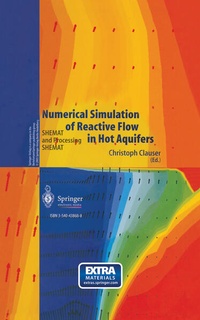
Numerical Simulation of Reactive Flow in Hot Aquifers
SHEMAT and Processing SHEMAT
Published on 12. April 2014
Book
Paperback/Softback
IX, 332 pages
978-3-642-62866-5 (ISBN)
Description
Christoph Clauser and Jom Bartels SHE MAT (Simulator for HEat and MAss Transport) is an easy-to-use, general- purpose reactive transport simulation code for a wide variety of thermal and hy- drogeological problems in two and three dimensions. Specifically, SHEMAT solves coupled problems involving fluid flow, heat transfer, species transport, and chemical water-rock interaction in fluid-saturated porous media. It can handle a wide range of time scales. Therefore, it is useful to address both technical and geo- logical processes. In particular, it offers special and attractive features for model- ing steady-state and transient processes in hydro-geothermal reservoirs. This makes it well suited to predict the long-term behavior of heat mining installations in hot aquifers with highly saline brines. SHEMA T in its present form evolved from a fully coupled flow and heat transport model (Clauser 1988) which had been developed from the isothermal USGS 3-D groundwater model of Trescott and Larson (Trescott 1975; Trescott and Larson 1977).
Transport of dissolved species, geochemical reactions between the solid and fluid phases, extended cou- pling between the individual processes (most notably between porosity and per- meability), and a convenient user interface (developed from Processing Modflow (Chiang and Kinzelbach 2001)) were added during several research projects funded by the German Science Foundation (DFG) under grant CL 12117 and the German Federal Ministries for Education, Science, Research, and Technology (BMBF) under grant 032 69 95A-D and for Economics and Technology (BMWi) under grant 0327095 (Bartels et al. 2002, Kuhn et al. 2002a).
Transport of dissolved species, geochemical reactions between the solid and fluid phases, extended cou- pling between the individual processes (most notably between porosity and per- meability), and a convenient user interface (developed from Processing Modflow (Chiang and Kinzelbach 2001)) were added during several research projects funded by the German Science Foundation (DFG) under grant CL 12117 and the German Federal Ministries for Education, Science, Research, and Technology (BMBF) under grant 032 69 95A-D and for Economics and Technology (BMWi) under grant 0327095 (Bartels et al. 2002, Kuhn et al. 2002a).
Reviews / Votes
From the reviews:
"The primary audience for this text consists of hydrogeologists and geophysicists. . It aims to provide a systematic introduction to the software SHEMAT . . Overall, the material is well presented. The philosophy of the book, to present the necessary mathematical background . is well thought through. It should be able to fill a dual role of being a user guide and an introduction into the modelling and simulation of flow in hot aquifers." (Ute Mueller, The Australian Geologist, Issue 128, 2003)
More details
Edition
2003 ed.
Language
English
Place of publication
Berlin
Germany
Publishing group
Springer Berlin
Target group
Professional and scholarly
Research
Illustrations
224 farbige Abbildungen, 33 s/w Abbildungen
IX, 332 p. 257 illus., 224 illus. in color.
Dimensions
Height: 235 mm
Width: 155 mm
Thickness: 19 mm
Weight
528 gr
ISBN-13
978-3-642-62866-5 (9783642628665)
DOI
10.1007/978-3-642-55684-5
Schweitzer Classification
Other editions
Additional editions
Book
11/2002
Springer
€106.99
Shipment within 10-15 days
Content
1 Introduction.- 2 Numerical Simulation of Reactive Flow using SHEMAT.- 2.1 General.- 2.2 Governing Equations.- 2.4 Input / Output.- 2.5 Practical Modeling: Remarks, Explanations and Instructions.- 2.6 Code Verification.- 3 Pre- and Post-Processing with "Processing SHEMAT".- 3.1 What is Processing SHEMAT?.- 3.2 Modeling Environment.- 3.3 Menu System.- 4 Advanced Features.- 4.1 Chemical Equilibrium Speciation for Brines at High Temperatures and Ionic Strength.- 4.2 Fractal Relation Between Porosity and Permeability: Theory and Verification.- 5 Tutorial for "Processing SHEMAT".- 5.1 Introduction.- 5.2 Creating a Fluid Flow, Heat Transfer, and Solute Transport Model.- 5.3 Using the Geochemical Reaction Module.- 5.4 Expanding the Model to Three Dimensions.- 6 Applications.- 6.1 Development of a Preferential Flow Path in an Anhydrite Cemented Sandstone: Numerical Simulation of a Core Flooding Experiment.- 6.2 Modeling Flooding of a Sandstone Core with Reactive Transport and Subsequent Changes in Porosity and Permeability.- 6.3 Injection Well with Reaction Kinetics.- 6.4 Magmatic Intrusions in Long Valley Caldera.- 6.5 Rhine Graben Cross Section.- 6.6 Thermal Transect of Continental Lithosphere in Canada.- 6.7 Waiwera Coastal Geothermal System.- References.