

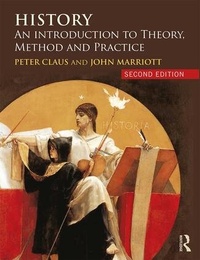
History
An Introduction to Theory, Method and Practice
2nd Edition
Published on 4. April 2017
Book
Paperback/Softback
498 pages
978-1-138-92399-7 (ISBN)
Description
Demystifying the subject with clarity and verve, History: An Introduction to Theory, Method and Practice familiarizes the reader with the varied spectrum of historical approaches in a balanced, comprehensive and engaging manner. Global in scope, and covering a wide range of topics from the ancient and medieval worlds to the twenty-first century, it explores historical perspectives not only from historiography itself, but from related areas such as literature, sociology, geography and anthropology.
Clearly written, accessible and student-friendly, this second edition is fully updated throughout to include:
An increased spread of case studies from beyond Europe, especially from American and imperial histories.
New chapters on important and growing areas of historical inquiry, such as environmental history and digital history
Expanded sections on political, cultural and social history
More discussion of non-traditional forms of historical representation and knowledge like film, fiction and video games.
Accompanied by a new companion website (www.routledge.com/cw/claus) containing valuable supporting material for students and instructors such as discussion questions, further reading and web links, this book is an essential introduction for all students of historical theory and method.
Clearly written, accessible and student-friendly, this second edition is fully updated throughout to include:
An increased spread of case studies from beyond Europe, especially from American and imperial histories.
New chapters on important and growing areas of historical inquiry, such as environmental history and digital history
Expanded sections on political, cultural and social history
More discussion of non-traditional forms of historical representation and knowledge like film, fiction and video games.
Accompanied by a new companion website (www.routledge.com/cw/claus) containing valuable supporting material for students and instructors such as discussion questions, further reading and web links, this book is an essential introduction for all students of historical theory and method.
Reviews / Votes
"Peter Claus and John Marriott's insightful book History: An Introduction to Theory, Method and Practice offers a most useful introduction to the study of history. The authors chart the development of the discipline from Herodotus to the present day in a clear, logical and concise manner, drawing on a wealth of fascinating illustrative material to map out key developments in the subject. This comprehensive and perceptive book is a must-read for students of history and should be made essential reading on any undergraduate or graduate theory and methods course."Robert James, University of Portsmouth, UK
"Claus and Marriott have produced an excellent textbook, impressively comprehensive in scope and detail, yet with a logical structure and short, easily manageable chapters, and written in a concise, accessible style aimed at the undergraduate reader. A must for historiography courses."
Sacha Davis, University of Newcastle, Australia
"A welcome revised and updated guide to the discipline of history, its variety, and practice. History is a comprehensive discussion of the development of the subject, different approaches of history, as well as a guide to techniques. It is an essential text for students that mixes historiography, theory, and methodology and is richly illustrated with examples."
Kevin Linch, University of Leeds, UK
Reviews for the first edition:
"A comprehensive introductory guide to the nature of historiography ... clearly written and set out ...it will be welcomed both by teachers and by their students."
Steve Rigby, University of Manchester, UK
"Students (and their teachers) will be grateful for this book. From Herodotus to postmodernism and internet History, Peter Claus and John Marriott's survey of how the human past has been studied and written about is impressive in both its range and its clarity. It can be dipped into when needed, while its totality provides a splendid overview of the richness and diversity that exist within the writing of History."
Bryan Ward-Perkins, Trinity College Oxford, UK
"Claus and Marriott introduce students to different aspects of historiography and methodology in a simple, appealing and engaging manner. This is a good book to support the study of History at university level."
Dr Xavier Guegan, Newcastle University, UK "Peter Claus and John Marriott's insightful book History: An Introduction to Theory, Method and Practice offers a most useful introduction to the study of history. The authors chart the development of the discipline from Herodotus to the present day in a clear, logical and concise manner, drawing on a wealth of fascinating illustrative material to map out key developments in the subject. This comprehensive and perceptive book is a must-read for students of history and should be made essential reading on any undergraduate or graduate theory and methods course."
Robert James, University of Portsmouth, UK
"Claus and Marriott have produced an excellent textbook, impressively comprehensive in scope and detail, yet with a logical structure and short, easily manageable chapters, and written in a concise, accessible style aimed at the undergraduate reader. A must for historiography courses."
Sacha Davis, University of Newcastle, Australia
"A welcome revised and updated guide to the discipline of history, its variety, and practice. History is a comprehensive discussion of the development of the subject, different approaches of history, as well as a guide to techniques. It is an essential text for students that mixes historiography, theory, and methodology and is richly illustrated with examples."
Kevin Linch, University of Leeds, UK
More details
Edition
2nd edition
Language
English
Place of publication
London
United Kingdom
Publishing group
Taylor & Francis Ltd
Target group
College/higher education
Illustrations
42 s/w Abbildungen, 2 s/w Tabellen
2 Tables, black and white; 42 Illustrations, black and white
Dimensions
Height: 246 mm
Width: 189 mm
Weight
929 gr
ISBN-13
978-1-138-92399-7 (9781138923997)
Copyright in bibliographic data and cover images is held by Nielsen Book Services Limited or by the publishers or by their respective licensors: all rights reserved.
Schweitzer Classification
Other editions
New editions
Book
07/2023
3rd Edition
Routledge
€59.40
Shipment within 15-20 days
Additional editions
Book
03/2017
2nd Edition
Routledge
€173.50
Article exhausted; check for reprint
Previous edition
Book
02/2012
1st Edition
Routledge
€50.99
Article exhausted; check for reprint
Persons
Dr Peter Claus is Access Fellow and Lecturer in History, Pembroke College, University of Oxford. His doctoral research on the Corporation of London was followed by work on the history of the City and East end of London, which developed into an interest in unofficial forms of urban social investigation in the metropolis along with a commitment to outreach, public history and the democratisation of the archive. This holistic approach to the study, practice and teaching of history has prompted an accessible and comprehensive introduction to historiography which draws on an engagement with diverse historical constituencies.
Professor John Marriott is Senior Associate, also at Pembroke College, Oxford. His research has focused on London and Empire with a particular emphasis on the nexus between East London and India since the eighteenth century. His numerous books include The Culture of Labourism: The East End between the Wars (1991, The Other Empire: Metropolis, India and Progress in the Colonial Imagination (2003), Beyond the Tower: a History of East London (2011) and The Ashgate Research Companion to Modern Imperial Histories (2012), co-edited with Professor Philippa Levine. He is now working on the origins of colonial land reform in the seventeenth century, and the demands of young twins.
Professor John Marriott is Senior Associate, also at Pembroke College, Oxford. His research has focused on London and Empire with a particular emphasis on the nexus between East London and India since the eighteenth century. His numerous books include The Culture of Labourism: The East End between the Wars (1991, The Other Empire: Metropolis, India and Progress in the Colonial Imagination (2003), Beyond the Tower: a History of East London (2011) and The Ashgate Research Companion to Modern Imperial Histories (2012), co-edited with Professor Philippa Levine. He is now working on the origins of colonial land reform in the seventeenth century, and the demands of young twins.
Content
List of figures
List of tables
Prologue: history matters
Acknowledgements
THEORY
Part 1 Perspectives
Chapter 1: Proof, objectivity and causality
History: science or art?
The status of historical knowledge
Evidence and interpretation
Causes in history
Chapter 2: Ordering of time
Time, history, modernity
Newton and the 'time reckoner'
Periodization
The shape of things to come
Part 2 Histories and Philosophies
Chapter 3: Ideas of History; from the ancients to the Christians
Herodotus and gold-digging ants
Thucydides and reason: an historian for our times?
What did the Romans ever do for history?
Christianity and the end of days
Chapter 4: From the Middle Ages to the Early Modern
European Christendom and the age of Bede
Peoples of the book: Jewish and Islamic conceptions of history
Renaissance humanism and rediscovery of the classics
The battle of books: Camden, Clarendon and English identity
Chapter 5: Enlightenment and Romanticism
The English Enlightenment?
Secular histories
Romanticism: Scott and Carlyle
Chapter 6: The English Tradition
Responses to the Enlightenment: Edmund Burke
Constitutionalism and the Whig interpretation of history
JH Plumb and the new Whigs
Chapter 7: The North American Tradition
America and the New Order of the Ages
The progressive or new historians
The consensus historians
The other America
Chapter 8: Histories of Revolutions; Revolutionary histories
Paine and the radical tradition
French and German Experiences
Germany, Hegel and the Spirit of History
Marx and 'historical materialism'
Marxism in the twentieth century
Chapter 9: Postmodernism and Postcolonialism
Modernity and the Enlightenment
Postmodernism
Postcolonialism and the West
METHOD
Part 3 Varieties
Chapter 10: Political History
Theories of the state
High and low politics: the case of the British Labour Party
Beyond state and party: political histories and civil society
Chapter 11: Economic History
Population and social change
Economic historians and the big historical questions
The business of business history
Chapter 12: Social History
The emergence of social history
Class and authority
The family in history
Chapter 13: Cultural History
What is cultural history?
The national character
The promise of cultural history: conflict and carnival
Chapter 14: Feminism, Gender and Women's History
Feminism and history
The attack on class
Gender and identity
Chapter 15: Public History
What is public about history?
Consumption of public history
Producing public history
Public history as contested knowledge
Chapter 16: Visual History
Visual histories
Ways of seeing: Paintings
Ways of seeing: Prints and photographs
Chapter 17: Global history
The challenges of global history
Origins of the global imagination
Enter 'new world history'
Chapter 18: Environmental history
The scope of environmental history
Historic precedents
European colonialism
Modern environmentalism
Part 4 History and Other Disciplines
Chapter 19: Archaeology
The lure of archaeology
The theoretical turn: Collingwood and Childe
Historical archaeology
Jerusalem and its layers
Chapter 20: Anthropology
Pens and pith helmets
Functionalism and structuralism
Historical myths: Jewish conspiracies and the 'blood libel'
The 'dying god': Captain Cook and ethnohistory
Microhistories: worms, night battles and ecstasies
Chapter 21: Literature
Literature as history
The new historicism: Text and context
The graphic novel
Writing the metropolis
Chapter 22: Geography
History, space and place
Geographies of empire
How to lie with maps
PRACTICE
Chapter 23: Archives in a Digital World
What is an archive?
'When we return as human beings again': archives and the ashes
Speaking for ourselves: state and community archives
Archives and the digital turn
Chapter 24: Oral History
Anthropologists of ourselves
Oral historiographies
The limits of memory: Arthur Harding and the East End underworld
The wider experience
Bibliography
Index
List of tables
Prologue: history matters
Acknowledgements
THEORY
Part 1 Perspectives
Chapter 1: Proof, objectivity and causality
History: science or art?
The status of historical knowledge
Evidence and interpretation
Causes in history
Chapter 2: Ordering of time
Time, history, modernity
Newton and the 'time reckoner'
Periodization
The shape of things to come
Part 2 Histories and Philosophies
Chapter 3: Ideas of History; from the ancients to the Christians
Herodotus and gold-digging ants
Thucydides and reason: an historian for our times?
What did the Romans ever do for history?
Christianity and the end of days
Chapter 4: From the Middle Ages to the Early Modern
European Christendom and the age of Bede
Peoples of the book: Jewish and Islamic conceptions of history
Renaissance humanism and rediscovery of the classics
The battle of books: Camden, Clarendon and English identity
Chapter 5: Enlightenment and Romanticism
The English Enlightenment?
Secular histories
Romanticism: Scott and Carlyle
Chapter 6: The English Tradition
Responses to the Enlightenment: Edmund Burke
Constitutionalism and the Whig interpretation of history
JH Plumb and the new Whigs
Chapter 7: The North American Tradition
America and the New Order of the Ages
The progressive or new historians
The consensus historians
The other America
Chapter 8: Histories of Revolutions; Revolutionary histories
Paine and the radical tradition
French and German Experiences
Germany, Hegel and the Spirit of History
Marx and 'historical materialism'
Marxism in the twentieth century
Chapter 9: Postmodernism and Postcolonialism
Modernity and the Enlightenment
Postmodernism
Postcolonialism and the West
METHOD
Part 3 Varieties
Chapter 10: Political History
Theories of the state
High and low politics: the case of the British Labour Party
Beyond state and party: political histories and civil society
Chapter 11: Economic History
Population and social change
Economic historians and the big historical questions
The business of business history
Chapter 12: Social History
The emergence of social history
Class and authority
The family in history
Chapter 13: Cultural History
What is cultural history?
The national character
The promise of cultural history: conflict and carnival
Chapter 14: Feminism, Gender and Women's History
Feminism and history
The attack on class
Gender and identity
Chapter 15: Public History
What is public about history?
Consumption of public history
Producing public history
Public history as contested knowledge
Chapter 16: Visual History
Visual histories
Ways of seeing: Paintings
Ways of seeing: Prints and photographs
Chapter 17: Global history
The challenges of global history
Origins of the global imagination
Enter 'new world history'
Chapter 18: Environmental history
The scope of environmental history
Historic precedents
European colonialism
Modern environmentalism
Part 4 History and Other Disciplines
Chapter 19: Archaeology
The lure of archaeology
The theoretical turn: Collingwood and Childe
Historical archaeology
Jerusalem and its layers
Chapter 20: Anthropology
Pens and pith helmets
Functionalism and structuralism
Historical myths: Jewish conspiracies and the 'blood libel'
The 'dying god': Captain Cook and ethnohistory
Microhistories: worms, night battles and ecstasies
Chapter 21: Literature
Literature as history
The new historicism: Text and context
The graphic novel
Writing the metropolis
Chapter 22: Geography
History, space and place
Geographies of empire
How to lie with maps
PRACTICE
Chapter 23: Archives in a Digital World
What is an archive?
'When we return as human beings again': archives and the ashes
Speaking for ourselves: state and community archives
Archives and the digital turn
Chapter 24: Oral History
Anthropologists of ourselves
Oral historiographies
The limits of memory: Arthur Harding and the East End underworld
The wider experience
Bibliography
Index