

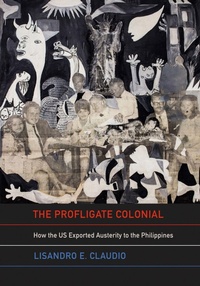
The Profligate Colonial
How the US Exported Austerity to the Philippines
Published on 15. November 2025
Book
Hardback
228 pages
978-1-5017-8407-1 (ISBN)
Description
In The Profligate Colonial, Lisandro E. Claudio reveals how austerity, long before it became a buzzword of modern technocracy, was a tool of US empire.
Austerity is often praised as prudence in hard times, a responsible response to crisis. In the Philippines today, it is treated as common sense, an unquestioned commitment to a strong currency, low inflation, and fiscal restraint. Claudio argues that this orthodoxy is in fact a colonial inheritance-a legacy of American rule that cast Filipinos as reckless spenders and imposed monetary discipline as a civilizing force. At the center of this logic is the "profligate colonial," a feminized, racialized figure who wastes public funds and so requires the steady hand of imperial governance.
Focusing on key moments in Philippine economic history across the twentieth century, Claudio charts how austerity was first exported through empire, then domesticated in line with nationalist ambitions. He shows that generations of Filipino policymakers, central bankers, and intellectuals absorbed the lessons of American "money doctors," transforming what was a means to build a colonial state on the cheap into a postcolonial moral imperative. Austerity became not just policy, but ideology - one that transcended political divides and reshaped the boundaries of the Philippine economic imagination.
As austerity politics rise once more in response to global inflation, The Profligate Colonial is a vital, incisive reminder of how austerity's appeal is less about economics than about a deep-rooted politics of control-one born in empire and still alive in policy today.
Austerity is often praised as prudence in hard times, a responsible response to crisis. In the Philippines today, it is treated as common sense, an unquestioned commitment to a strong currency, low inflation, and fiscal restraint. Claudio argues that this orthodoxy is in fact a colonial inheritance-a legacy of American rule that cast Filipinos as reckless spenders and imposed monetary discipline as a civilizing force. At the center of this logic is the "profligate colonial," a feminized, racialized figure who wastes public funds and so requires the steady hand of imperial governance.
Focusing on key moments in Philippine economic history across the twentieth century, Claudio charts how austerity was first exported through empire, then domesticated in line with nationalist ambitions. He shows that generations of Filipino policymakers, central bankers, and intellectuals absorbed the lessons of American "money doctors," transforming what was a means to build a colonial state on the cheap into a postcolonial moral imperative. Austerity became not just policy, but ideology - one that transcended political divides and reshaped the boundaries of the Philippine economic imagination.
As austerity politics rise once more in response to global inflation, The Profligate Colonial is a vital, incisive reminder of how austerity's appeal is less about economics than about a deep-rooted politics of control-one born in empire and still alive in policy today.
More details
Language
English
Place of publication
Ithaca
United States
Target group
College/higher education
Product notice
Paper over boards
Illustrations
5 charts - 5 Charts
Dimensions
Height: 162 mm
Width: 238 mm
Thickness: 23 mm
Weight
514 gr
ISBN-13
978-1-5017-8407-1 (9781501784071)
Copyright in bibliographic data and cover images is held by Nielsen Book Services Limited or by the publishers or by their respective licensors: all rights reserved.
Schweitzer Classification
Other editions
Additional editions
E-Book
11/2025
Cornell University Press
€29.49
Available for download
Person
Lisandro E. Claudio is an associate professor in the Department of South and Southeast Asian Studies at the University of California, Berkeley. He is the author of Liberalism and the Postcolony.
Content
Introduction: Hidden Empire, Hidden Austerity
1. Austerity Contracted: A Colonial Cross of Gold, 1902-1913
2. Austerity Defended: The Tragedy of the Philippine National Bank? 1916-1921
3. Austerity Nationalized: The Politics of "Independent" Central Banking in Independent Philippines, 1949-1960
4. Austerity Democratized: Dear Money, the Dictator, and the Miserly Left, 1970-1986
Conclusion: Profligate Others Everywhere
1. Austerity Contracted: A Colonial Cross of Gold, 1902-1913
2. Austerity Defended: The Tragedy of the Philippine National Bank? 1916-1921
3. Austerity Nationalized: The Politics of "Independent" Central Banking in Independent Philippines, 1949-1960
4. Austerity Democratized: Dear Money, the Dictator, and the Miserly Left, 1970-1986
Conclusion: Profligate Others Everywhere