

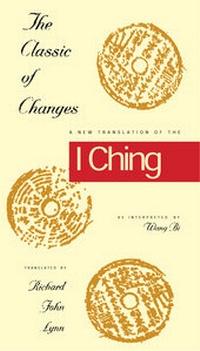
The Classic of Changes
A New Translation of the I Ching as Interpreted by Wang Bi
Columbia University Press
Will be published approx. on 8. December 1994
Book
Hardback
602 pages
978-0-231-08294-5 (ISBN)
Description
Used in China as a book of divination and source of wisdom for more than three thousand years, the I Ching has been taken up by millions of English-language speakers in the nineteenth century. The first translation ever to appear in English that includes one of the major Chinese philosophical commentaries, the Columbia I Ching presents the classic book of changes for the world today. Richard Lynn's introduction to this new translation explains the organization of The Classic of Changes through the history of its various parts, and describes how the text was and still is used as a manual of divination with both the stalk and coin methods. For the fortune-telling novice, he provides a chart of trigrams and hexagrams; an index of terms, names, and concepts; and a glossary and bibliography. Lynn presents for the first time in English the fascinating commentary on the I Ching written by Wang Bi (226-249), who was the main interpreter of the work for some seven hundred years. Wang Bi interpreted the I Ching as a book of moral and political wisdom, arguing that the text should not be read literally, but rather as an expression of abstract ideas.
Lynn places Wang Bi's commentary in historical context.
Lynn places Wang Bi's commentary in historical context.
Reviews / Votes
This is the best I Ching that has so far appeared. Times Literary Supplement (London) This new translation is welcome because of its crisp usage of modern-day English... Highly recommended. Library Journal Familiar with current historical and textual research, having no truck with 'ageless wisdoms' and leery of spirituality, Richard Lynn's translation of the I Ching as retranslated, explicated and interpreted by the young scholar Wang Bi and his followers, feels a world apart from that of Wilhelm. London Review of Books [Lynn]'s provided us with the materials from which to reconstruct Wang Bi's vision of the text. The result is clearly written and presented-the best entry into anI Ching world that we have so far. Shambala Sun Lynn has... produce[d] a translation of whose accuracy one can be optimally confident... [T]his is a solidly and attractively produced volume. Religion For beginners and devotees alike, Columbia's I Ching is the clearest and most authoritative translation of this ancient classic. -- Kidder Smith, Bowdoin College Philosophy East & WestMore details
Language
English
Place of publication
New York
United States
Target group
Professional and scholarly
Product notice
Trade binding
Weight
808 gr
ISBN-13
978-0-231-08294-5 (9780231082945)
Copyright in bibliographic data and cover images is held by Nielsen Book Services Limited or by the publishers or by their respective licensors: all rights reserved.
Schweitzer Classification
Other editions
Additional editions
The Classic of Changes
A New Translation of the <i>I Ching</i> as Interpreted by Wang Bi
E-Book
03/2004
1st Edition
Columbia University Press
from
€46.59
Available for download
The Classic of Changes
A New Translation of the I Ching as Interpreted by Wang Bi
Book
03/2004
Columbia University Press
€33.00
Shipment within 10-20 days
Person
Richard John Lynn has a Ph.D. in Chinese from Stanford University. Acclaimed as one of the outstanding translators of our time, he has taught at the University of California, Berkeley; Auckland University; and the University of British Columbia. He is currently professor of Chinese thought and literature at the University of Toronto. Lynn has also served as a Humanities Administrator in the Division of Research at the NEH, in charge of the Translators Grants Program.
Content
Acknowledgments Introduction General Remarks on the Changes of the Zhou, by Wang Bi Commentary on the Appended Phrases, Part One Commentary on the Appended Phrases, Part Two Providing the Sequences of the Hexagrams The Hexagrams in Irregular Order Explaining the Trigrams The Sixty-Four Hexagrams, with Texts and Commentaries Bibliography Glossary List of Proper Nouns Index