

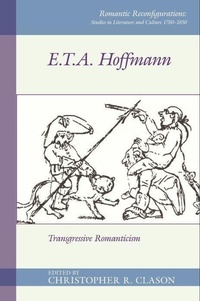
E. T. A. Hoffmann
Transgressive Romanticism
Published on 1. September 2021
Book
Paperback/Softback
272 pages
978-1-80085-667-7 (ISBN)
Description
This collection of essays addresses a very broad range of E. T. A. Hoffmann's most significant works, examining them through the lens of "transgression." Transgression bears relevance to Hoffmann's life and professions in three ways. First, his official career path was that of jurisprudence; he was active as a lawyer, a judge and eventually as one of the most important magistrates in Berlin. Second, his personal life was marked by numerous conflicts with political and social authorities. Seemingly no matter where he went, he experienced much chaos, grief and impoverishment in leading his always precarious existence. Third, his works explore characters and concepts beyond the boundaries of what was considered aesthetically acceptable. "Normal" bourgeois existence was often juxtaposed to the lives of criminals, sinners, and other deviants, both within the spaces of the known world as well as in supernatural realms. He, perhaps more than any other author of the German Romantic movement, regularly portrayed the dark side of existence in his works, including unconscious psychological phenomena, nightmares, somnambulism, vampirism, mesmerism, Doppelgaenger, and other forms of transgressive behavior. It is the intention of this volume to provide a new look at Hoffmann's very diverse body of work from numerous perspectives, stimulating interest in Hoffmann in English language audiences.
Reviews / Votes
Reviews'This new resource is both enjoyable and thoroughly thought-provoking-and so is well worth consultation by faculty and students.'Sean Williams, European Romantic Review 'Transgressive Romanticism engages its central spatial metaphor to make Hoffmann's complex potential as a
protorealist clear: expertly attuned to the forms of life and literature with which he was familiar, while always ready to subvert and think beyond them.'
Polly Dickson, German Studies Review
More details
Series
Language
English
Place of publication
Liverpool
United Kingdom
Target group
Professional and scholarly
Illustrations
9 Illustrations, black and white
Dimensions
Height: 154 mm
Width: 234 mm
Thickness: 22 mm
Weight
414 gr
ISBN-13
978-1-80085-667-7 (9781800856677)
Copyright in bibliographic data and cover images is held by Nielsen Book Services Limited or by the publishers or by their respective licensors: all rights reserved.
Schweitzer Classification
Person
Christopher R. Clason is Emeritus Professor of German at Oakland University. He is the editor of E. T. A. Hoffmann: Transgressive Romanticism (2018) and co-editor of Romantic Automata: Exhibitions, Figures, Organisms (2020), Romantic Rapports: New Essays on Romanticism Across the Disciplines (2017) and Literary and Poetic Representations of Work and Labor in Europe and Asia during the Romantic Era (2011).
Content
Acknowledgements
Introduction --- Christopher R. Clason, Oakland University
I. Transgression and Institutions
1. "A poor, imprisoned animal." Persons, Property, and the Unnatural Nature of the Law in E.T.A. Hoffmann's "Das Majorat." --- Alexander Schlutz, John Jay College and CUNY Graduate Center
2. Vergiftete Gaben: Violating the Laws of Hospitality in E. T. A. Hoffmann's "Das Fraeulein von Scuderi" --- Peter Erickson, Colorado State University
3. Transgressive Science in E.T.A. Hoffmann's Fantastic Tales --- Paola Mayer, University of GuelphII. Transgression and the Arts
4. E. T. A. Hoffmann and the Bamberg Theater --- Frederick Burwick, University of California, Los Angeles
5. Transitions and Slippages of Mimesis in E.T.A. Hoffmann's "Der goldene Topf," "Die Fermate," and "Das oede Haus." --- Beate Allert, Purdue University
6. Transgressions: On the (De-)Figuration of the Vampire in E. T. A. Hoffmann's "Vampyrism" --- Nicole Suetterlin, Harvard UniversityIII. Transgression in the Maerchen
7. Transgressive Play and Uncanny Toys in E.T.A. Hoffmann's "Das fremde Kind" --- Christina Weiler, Purdue University
8. Attending to the Everyday: Idiosyncrasy in E.T.A. Hoffmann's "The Golden Pot" --- Ruth Kellar, University of Wisconsin, Madison
9. Prinzessin Brambilla: The Aesthetic between Public and Private --- Howard Pollack-Millgate, DePauw UniversityIV. Transgression of Reception in Kater Murr
10. Hoffmann's "Two Worlds" and the Problem of Life-Writing --- Julian Knox, Georgia College
11. "Real Humor Cannot Be Captured in a Novel": Kierkegaard Reading E.T.A. Hoffmann's Lebens-Ansichten des Katers Murr --- James Rasmussen, United States Air Force AcademyWorks Cited
Index
Introduction --- Christopher R. Clason, Oakland University
I. Transgression and Institutions
1. "A poor, imprisoned animal." Persons, Property, and the Unnatural Nature of the Law in E.T.A. Hoffmann's "Das Majorat." --- Alexander Schlutz, John Jay College and CUNY Graduate Center
2. Vergiftete Gaben: Violating the Laws of Hospitality in E. T. A. Hoffmann's "Das Fraeulein von Scuderi" --- Peter Erickson, Colorado State University
3. Transgressive Science in E.T.A. Hoffmann's Fantastic Tales --- Paola Mayer, University of GuelphII. Transgression and the Arts
4. E. T. A. Hoffmann and the Bamberg Theater --- Frederick Burwick, University of California, Los Angeles
5. Transitions and Slippages of Mimesis in E.T.A. Hoffmann's "Der goldene Topf," "Die Fermate," and "Das oede Haus." --- Beate Allert, Purdue University
6. Transgressions: On the (De-)Figuration of the Vampire in E. T. A. Hoffmann's "Vampyrism" --- Nicole Suetterlin, Harvard UniversityIII. Transgression in the Maerchen
7. Transgressive Play and Uncanny Toys in E.T.A. Hoffmann's "Das fremde Kind" --- Christina Weiler, Purdue University
8. Attending to the Everyday: Idiosyncrasy in E.T.A. Hoffmann's "The Golden Pot" --- Ruth Kellar, University of Wisconsin, Madison
9. Prinzessin Brambilla: The Aesthetic between Public and Private --- Howard Pollack-Millgate, DePauw UniversityIV. Transgression of Reception in Kater Murr
10. Hoffmann's "Two Worlds" and the Problem of Life-Writing --- Julian Knox, Georgia College
11. "Real Humor Cannot Be Captured in a Novel": Kierkegaard Reading E.T.A. Hoffmann's Lebens-Ansichten des Katers Murr --- James Rasmussen, United States Air Force AcademyWorks Cited
Index