

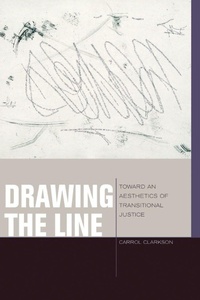
Drawing the Line
Toward an Aesthetics of Transitional Justice
Published on 11. November 2013
Book
Paperback/Softback
224 pages
978-0-8232-5416-3 (ISBN)
Description
Drawing the Line examines the ways in which cultural, political, and legal lines are imagined, drawn, crossed, erased, and redrawn in post-apartheid South Africa-through literary texts, artworks, and other forms of cultural production. Under the rubric of a philosophy of the limit, and with reference to a range of signifying acts and events, this book asks what it takes to recalibrate a sociopolitical scene, shifting perceptions of what counts and what matters, of what can be seen and heard, of what can be valued or regarded as meaningful.
The book thus argues for an aesthetics of transitional justice and makes an appeal for a postapartheid aesthetic inquiry, as opposed to simply a political or a legal one. Each chapter brings a South African artwork, text, speech, building, or social encounter into conversation with debates in critical theory and continental philosophy, asking: What challenge do these South African acts of signification and resignification pose to current literary-philosophical debates?
The book thus argues for an aesthetics of transitional justice and makes an appeal for a postapartheid aesthetic inquiry, as opposed to simply a political or a legal one. Each chapter brings a South African artwork, text, speech, building, or social encounter into conversation with debates in critical theory and continental philosophy, asking: What challenge do these South African acts of signification and resignification pose to current literary-philosophical debates?
Reviews / Votes
"Clarkson's book shows us in so many ways that the post-apartheid world is by no means a given world and that the question of its possibility will depend on whether we are still able to become aware again of - and willing to act ethically and politically upon - our poetic potentiality to bring forth a world that would aesthetically be other than and other to the Nietzschean eternal recurrence of 'the worst'." -- -Jaco Barnard-Naude SA Journal of Law, 131.4 "Drawing the Line is itself a boundary-crossing book in the sense that it pulls evidence from an extraordinarily wide range of disciplines: law, art and architecture, literature and literary theory, philosophy." -H-AfrArts "Drawing the Line will appeal to readers working in a variety of scholarly fields: it is an important text for anyone grounded in contemporary South African literary and cultural studies, offers rich contributions to interdisciplinary studies of transitional justice and jurisprudence, and will be valuable for scholars working at the intersection of ethics and aesthetics as well as those exploring the impacts of posthumanism on projects of social transformation." -Ariel: A Review of International English Literature "One rarely comes across work of such intelligence and imagination. This book is beautifully written and one finds oneself forever being caught out by wonderful and unpredicted connections, turns of phrase, the ease and acuity with which insights from disparate fields are brought together and developed." -- -Emilios Christodoulidis University of Glasgow "What makes Clarkson's project truly dialogical-and what distinguishes it from a number of other analyses of contemporary South African culture and literature-is that she both reads South African culture in terms of theory but also examines and, indeed displays, what South African culture might also offer theory." -- -Russell Samolsky University of California, Santa BarbaraMore details
Series
Language
English
Place of publication
New York
United States
Target group
Professional and scholarly
Product notice
Paperback (trade)
Dimensions
Height: 226 mm
Width: 152 mm
Thickness: 20 mm
Weight
318 gr
ISBN-13
978-0-8232-5416-3 (9780823254163)
Copyright in bibliographic data and cover images is held by Nielsen Book Services Limited or by the publishers or by their respective licensors: all rights reserved.
Schweitzer Classification
Other editions
Additional editions
E-Book
11/2013
1st Edition
Fordham University Press
€26.99
Available for download
E-Book
11/2013
1st Edition
Fordham University Press
€26.99
Available for download
Person
Carrol Clarkson is Professor of English Language and Literature at the University of Cape Town.
Content
Acknowledgments Introduction Part I: Drawing the Line 1. Drawing the Line 2. Redrawing the Lines Part II: Crossing the Line 3. Justice and the Art of Transition 4. Intersections: Ethics and Aesthetics 5. Poets, Philosophers, and Other Animals Part III: Lines of Force 6. Visible and Invisible: What Surfaces in Three Johannesburg Novels? 7. Who Are We? Conclusion Notes References Index