

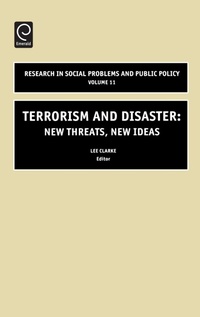
Terrorism and Disaster
New Threats, New Ideas
Will be published approx. on 1. October 2003
Book
Hardback
152 pages
978-0-7623-1043-2 (ISBN)
Description
The terror attacks of 9.11 signalled that people are increasingly put at risk of not only terrorism but natural and technological disasters as well. Since 9.11 scholars have been asking new questions about catastrophe and made important and interesting innovations in methods, concepts, and theories regarding disaster and terror. This volume brings together a creative set of papers, most of which are about the 9.11 attacks. They draw from several disciplines to address key questions: what lessons does the response to the collapse of the World Trade Center have for disaster planning? what has 9.11 meant for civil liberties in the US? how will survivors react over the long run? and how do we conceptualize panic and mass response?
Reviews / Votes
"It is a noteworthy contribution to the growing literature on the implications of the new era of terrorism, and in this regard should be included in the libraries of analysts and student of the New Terrorism." -INTERNATIONAL JOURNAL OF PUBLIC OPINION RESEARCH (2005)More details
Series
Language
English
Place of publication
United States
Publishing group
Emerald Publishing Limited
Target group
Professional and scholarly
Dimensions
Height: 240 mm
Width: 161 mm
Thickness: 13 mm
Weight
394 gr
ISBN-13
978-0-7623-1043-2 (9780762310432)
Copyright in bibliographic data and cover images is held by Nielsen Book Services Limited or by the publishers or by their respective licensors: all rights reserved.
Schweitzer Classification
Content
9.11 as disaster: on worst cases, terrorism, and catastrophe (L. Clarke). A civil defense against terror (O. Rodriguez). Empire of fear: imagined community and the September 11 attacks (A. Larabee). Disaster beliefs and institutional interests: recycling disaster myths in the aftermath of 9-11 (K. Tierney). The fox and the hedgehog: myopia about homeland vulnerability in US policies on terrorism (J.K. Mitchell). Terrorism as disaster: selected commonalities and long-term recovery for 9/11 survivors (B. Marshall et al.). Reconsidering convergence and converger legitimacy in response to the World Trade Center disaster (J. Kendra, T. Wachtendorf). Conceptualizing responses to extreme events: the problem of panic and failing gracefully (L. Clarke).