

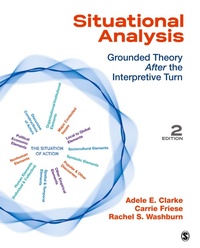
Situational Analysis
Grounded Theory After the Interpretive Turn
2nd Edition
Published on 16. October 2017
Book
Paperback/Softback
464 pages
978-1-4522-6090-7 (ISBN)
Description
The Second Edition of Situational Analysis: Grounded Theory After the Interpretive Turn offers an innovative extension of grounded theory useful in qualitative research projects that draws on interviews, observations, and visual, narrative, and historical discourse materials. To engage the dense complexities of real world situations, Situational Analysis (SA) braids together Strauss's ecological social worlds/arenas theory, Foucault's discourse analysis, and Deleuze and Guattari's rhizomes and assemblages. In SA, the situation itself becomes the fundamental unit of analysis. Using extensive examples, the authors discuss getting started, how to create three kinds of maps emphasizing differences and relationality (situational maps, social world/arena maps, and positional maps), the kinds of analytic work they accomplish, and how to write up the results centered on the distinctive strengths of the method. The book will serve as an invaluable resource for advanced undergraduate and graduate-level students, as well as professional researchers and consultants from diverse backgrounds pursuing qualitative projects.
Reviews / Votes
"The book is a milestone in the development of qualitative research. It shows comprehensively and convincingly how pragmatism and post-structuralism can be used to analyze the complexity of our contemporary condition." -- Rainer Winter "This updated text has moved the field further along in its understanding of not just the theoretical underpinning of SA, but the practical steps of how to use it well. Anyone wanting to know how to construct a sound SA research design must read this book." -- Adah Ward Randolph "Relentlessly empirical and fiercely situated, the second edition is dense, refreshing, and conversational. It invites readers to practice the art of Situational Analysis and extends the reach, relevance, and versatility of the conceptual methodology." -- Nancy D. Campbell "The new edition captures the substance and the excitement of Situational Analysis and its relation to other developments in social science, provides well-elaborated examples to make the methods concrete, and points to questions of theory that invite career-length exploration." -- Peter Taylor "Imagine a conceptual methodology textbook that serves as coach, mentor, and cheerleader for Situational Analysis. The second edition supports and facilitates constant reflection while you are researching, analyzing, and writing. It will motivate many fine projects in the years to come." -- Nancy Campbell "Situational Analysis helps researchers critically and constructively map the complexities of today's diverse and often contested aspects of human and technological interaction. Use of this second edition of Situational Analysis will enable further ideas and dialogues to address postmodern dilemmas." -- Tom Strong "This extensively updated edition puts qualitative data analysis in the grounded theory tradition on the map, literally and figuratively." -- Stefan Timmermans "The present book is a powerful revision of Situational Analysis. Adele E. Clarke and her co-authors succeed all through this 'theory-methods package' in combining older and newest theory and methodology in social inquiry beyond jargon, with a carefully elaborated introduction into the practice of doing SA analysis. The authors so much know and live what they are writing about - this is the book's core feeling from start to end." -- Reiner Keller "I have been teaching Situational Analysis to my graduate and post-graduate students based on the first edition of Clarke's book for some years. The students have appreciated her direct and hands-on approach to studying complex and intricate empirical issues. I very much look forward to use this second edition of Situational Analysis in my courses. It will offer the students even more guidance for their studies. It has a unique blend of theoretical depth and practical applicability that speaks directly to students and scholars who want engage with empirical complexities." -- Anders BuchMore details
Edition
2nd Revised edition
Language
English
Place of publication
Thousand Oaks
United States
Target group
College/higher education
Edition type
Revised edition
Dimensions
Height: 232 mm
Width: 187 mm
Thickness: 29 mm
Weight
928 gr
ISBN-13
978-1-4522-6090-7 (9781452260907)
Copyright in bibliographic data and cover images is held by Nielsen Book Services Limited or by the publishers or by their respective licensors: all rights reserved.
Schweitzer Classification
Other editions
Previous edition
Book
05/2005
1st Edition
SAGE Publications Inc
€62.50
Article exhausted; check for reprint
Persons
Adele E. Clarke was Professor of Sociology and History of Health Sciences at the University of California, San Francisco. She studied with Anselm Strauss and used and taught grounded theory, developing situational analysis as an extension. Her book Situational Analysis: Grounded Theory After the Postmodern Turn (SAGE, 2005) won the Cooley Distinguished Book Award, Society for the Study of Symbolic Interaction. The 2nd edition with Carrie Friese and Rachel Washburn appeared in 2018. Clarke's research centered on science, technology, and medicine studies, especially biomedicalization and technologies for women. Her book Disciplining Reproduction: Modernity, American Life Sciences and the "Problem of Sex" won the Basker Award, Society for Medical Anthropology, and Fleck Award, Society for Social Studies of Science. Clarke received the 2013 Bernal Prize for Outstanding Contributions from the Society for Social Studies of Science and the 2015 Reeder Award for Distinguished Contributions to Medical Sociology.
Carrie Friese (PhD) is associate professor of sociology at the London School of Economics and Political Science. Her initial research focused on assisted reproductive technologies for humans and endangered species, including the development of interspecies nuclear transfer (aka cloning) for species preservation in zoos. Her book Cloning Wild Life: Zoos, Captivity and the Future of Endangered Animals (NYU Press) appeared in 2013. Friese's new research project explores animal husbandry and care in scientific knowledge production, including comparisons of care practices and their regulation in the United Kingdom. She has used situational analysis across these research projects and has given talks and taught courses on the method across Europe.
Rachel Washburn (PhD) is associate professor of Sociology at Loyola Marymount University in Los Angeles. She used situational analysis in her doctoral research on the politics of human biomonitoring and has continued to do so in subsequent research on the same topic. Her dissertation, Measuring the Chemicals Within: The Social Terrain of Human Biomonitoring in the United States, was awarded the Anselm Strauss Outstanding Qualitative Dissertation Award in 2009. She has given talks and workshops on situational analysis at universities in the United States and Canada. Her current research examines the politics of mid-20th-century science related to the human health effects of pesticides.
Carrie Friese (PhD) is associate professor of sociology at the London School of Economics and Political Science. Her initial research focused on assisted reproductive technologies for humans and endangered species, including the development of interspecies nuclear transfer (aka cloning) for species preservation in zoos. Her book Cloning Wild Life: Zoos, Captivity and the Future of Endangered Animals (NYU Press) appeared in 2013. Friese's new research project explores animal husbandry and care in scientific knowledge production, including comparisons of care practices and their regulation in the United Kingdom. She has used situational analysis across these research projects and has given talks and taught courses on the method across Europe.
Rachel Washburn (PhD) is associate professor of Sociology at Loyola Marymount University in Los Angeles. She used situational analysis in her doctoral research on the politics of human biomonitoring and has continued to do so in subsequent research on the same topic. Her dissertation, Measuring the Chemicals Within: The Social Terrain of Human Biomonitoring in the United States, was awarded the Anselm Strauss Outstanding Qualitative Dissertation Award in 2009. She has given talks and workshops on situational analysis at universities in the United States and Canada. Her current research examines the politics of mid-20th-century science related to the human health effects of pesticides.
Content
List of Illustrations
Acknowledgments
Prologue to the Second Edition
What is Situational Analysis?
Overview of the Second Edition
Practical Developments
How to Read and Use this Book
About the Authors
PART I * FRAMING AND GROUNDING SITUATIONAL ANALYSIS
Introduction to Part I
Chapter 1 * Situational Analysis: Grounded Theory Mapping After the Interpretive Turn
What Is Grounded Theory?
A Genealogy of Grounded Theory and Situational Analysis
The Interpretive Turn
Grounds for a New Method
Situational Maps and Analysis
Reflections and Anticipations
Chapter 2 * Methodological Grounds of Situational Analysis
Grounded Theory, Pragmatism, and Interactionism: A Theory/Methods Package
Grounded Theory as Always Already Around the Interpretive Turn
Grounded Theory as Recalcitrant Against the Interpretive Turn
Pushing Grounded Theory Around the Interpretive Turn
Reflections and Anticipations
Chapter 3 * Theoretical Grounds of Situational Analysis
The "(Re)Turn to the Social" Across Social Theory
Pragmatist Interactionist Origins: From Chicago Ecologies to Social Worlds/Arenas
New Grounds I: Foucault and the Pragmatist Interactionist Project
New Grounds II: Taking the Nonhuman Explicitly Into Account
New Grounds III: Deleuze and Guattari's Rhizomes and Assemblages
Assembling the Theoretical Grounds of Situational Analysis
PART II * DOING SITUATIONAL ANALYSIS
Introduction to Part II
Chapter 4 * Getting Started: Practical Issues and Project Design
The Three Kinds of Situational Analysis Maps
Practical Issues in Getting Started
Doing Situational Analysis Project Design
Issues in Situational Analysis Project Design
Technical Tools Supporting Situational Analysis
Turning to Analysis
Chapter 5 * Doing Situational and Relational Maps
Abstract Situational Maps
Introducing the First Exemplar: Bone's Project
Situational Maps of Bone's Project
Doing Relational Analyses With Situational Maps
Relational Maps of Bone's Project
Final Comments on Situational and Relational Maps
Chapter 6 * Doing Social Worlds/Arenas Maps
What Are Social Worlds and Arenas?
Why Are Social Worlds and Arenas Analytically Important?
Introducing Social Worlds/Arenas Maps
Social Worlds/Arenas Map of Bone's Project
Doing Social Worlds/Arenas Maps
Memoing Social Worlds/Arenas Maps
Using Social Worlds/Arenas Maps in Your Project
Final Comments on Social Worlds/Arenas Maps
Chapter 7 * Doing Positional Maps
Abstract Positional Maps
Positional Maps of Bone's Project
Constructing Your Own Positional Maps
Articulating and Acting Upon Absent Positions
Why Are Positional Maps So Important?
Final Comments on Positional Maps
Chapter 8 * A Fully Worked Exemplar of Situational Analysis
Introducing Alonso-Yanez's Project
Alonso-Yanez's Situational Maps
Alonso-Yanez's Relational Maps
Alonso-Yanez's Social Worlds/Arenas Map
Alonso-Yanez's Positional Maps
Provisional Conclusions on Alonso-Yanez's Project
Chapter 9 * Writing It Up: Final Presentations and Project Maps
Writing It Up as an Analytic Process
Using Your Memos in Finalizing the Project
Turning Situational Analysis Maps Into Final Project Maps
Possibilities for Presenting and Publishing Your SA Project
Temporary Conclusions
PART III * MAPPING EXTANT DISCOURSE MATERIALS
Introduction to Part III
Chapter 10 * Turning to Discourses
What Is Discourse?
Why Analyze Discourses?
Turning Up the Volume on "Minor" Discourses
Single Site and Multisite Approaches
How to Design SA Discourse Projects
Turnings
Chapter 11 * Mapping Narrative Discourse Materials
Kinds of Extant Narrative Discourse Materials
Designing a Narrative Discourse Project
Doing Situational Maps of Narrative Discourse Materials
Doing Social Worlds/Arenas Maps of Narrative Discourse Materials
Doing Positional Maps of Narrative Discourse Materials
Final Comments: Situational Analysis of Narrative Discourse Materials
Chapter 12 * Mapping Visual Discourse Materials
The Rise of Visual Cultures
Doing Situational Analysis of Visual Discourse Materials
Visual Discourse Exemplar: Washburn's Biomonitoring Project
Final Comments: Situational Analysis of Visual Discourse Materials
Chapter 13 * Mapping Historical Discourse Materials
Historicizing Historical Approaches
Designing Historical and Historicizing Projects
Historical Discourse Analysis Exemplar: Introducing Message's Project
Doing Situational Maps of Historical Discourse Materials
Doing Social Worlds/Arenas Maps of Historical Discourse Materials
Doing Positional Maps of Historical Discourse Materials
Final Comments: Situational Analysis of Historical Discourse Materials
Epilogue: Situational Analysis Issues and FAQs
Comparing Early GT With Constructivist GT and SA
Tips on Learning and Teaching Situational Analysis
Decolonizing and (Post)Colonial Situational Analysis
SA Mapping as Facilitating Engagement and Collaboration
FAQs About Situational Analysis
Final Words
Appendices
Appendix A: Grounded Theory and Situational Analysis Websites
Appendix B: Selected Exemplars of Situational Analysis by Discipline
Appendix C: Selected Exemplars of Situational Analysis by Mapping Focus
References
Index
Acknowledgments
Prologue to the Second Edition
What is Situational Analysis?
Overview of the Second Edition
Practical Developments
How to Read and Use this Book
About the Authors
PART I * FRAMING AND GROUNDING SITUATIONAL ANALYSIS
Introduction to Part I
Chapter 1 * Situational Analysis: Grounded Theory Mapping After the Interpretive Turn
What Is Grounded Theory?
A Genealogy of Grounded Theory and Situational Analysis
The Interpretive Turn
Grounds for a New Method
Situational Maps and Analysis
Reflections and Anticipations
Chapter 2 * Methodological Grounds of Situational Analysis
Grounded Theory, Pragmatism, and Interactionism: A Theory/Methods Package
Grounded Theory as Always Already Around the Interpretive Turn
Grounded Theory as Recalcitrant Against the Interpretive Turn
Pushing Grounded Theory Around the Interpretive Turn
Reflections and Anticipations
Chapter 3 * Theoretical Grounds of Situational Analysis
The "(Re)Turn to the Social" Across Social Theory
Pragmatist Interactionist Origins: From Chicago Ecologies to Social Worlds/Arenas
New Grounds I: Foucault and the Pragmatist Interactionist Project
New Grounds II: Taking the Nonhuman Explicitly Into Account
New Grounds III: Deleuze and Guattari's Rhizomes and Assemblages
Assembling the Theoretical Grounds of Situational Analysis
PART II * DOING SITUATIONAL ANALYSIS
Introduction to Part II
Chapter 4 * Getting Started: Practical Issues and Project Design
The Three Kinds of Situational Analysis Maps
Practical Issues in Getting Started
Doing Situational Analysis Project Design
Issues in Situational Analysis Project Design
Technical Tools Supporting Situational Analysis
Turning to Analysis
Chapter 5 * Doing Situational and Relational Maps
Abstract Situational Maps
Introducing the First Exemplar: Bone's Project
Situational Maps of Bone's Project
Doing Relational Analyses With Situational Maps
Relational Maps of Bone's Project
Final Comments on Situational and Relational Maps
Chapter 6 * Doing Social Worlds/Arenas Maps
What Are Social Worlds and Arenas?
Why Are Social Worlds and Arenas Analytically Important?
Introducing Social Worlds/Arenas Maps
Social Worlds/Arenas Map of Bone's Project
Doing Social Worlds/Arenas Maps
Memoing Social Worlds/Arenas Maps
Using Social Worlds/Arenas Maps in Your Project
Final Comments on Social Worlds/Arenas Maps
Chapter 7 * Doing Positional Maps
Abstract Positional Maps
Positional Maps of Bone's Project
Constructing Your Own Positional Maps
Articulating and Acting Upon Absent Positions
Why Are Positional Maps So Important?
Final Comments on Positional Maps
Chapter 8 * A Fully Worked Exemplar of Situational Analysis
Introducing Alonso-Yanez's Project
Alonso-Yanez's Situational Maps
Alonso-Yanez's Relational Maps
Alonso-Yanez's Social Worlds/Arenas Map
Alonso-Yanez's Positional Maps
Provisional Conclusions on Alonso-Yanez's Project
Chapter 9 * Writing It Up: Final Presentations and Project Maps
Writing It Up as an Analytic Process
Using Your Memos in Finalizing the Project
Turning Situational Analysis Maps Into Final Project Maps
Possibilities for Presenting and Publishing Your SA Project
Temporary Conclusions
PART III * MAPPING EXTANT DISCOURSE MATERIALS
Introduction to Part III
Chapter 10 * Turning to Discourses
What Is Discourse?
Why Analyze Discourses?
Turning Up the Volume on "Minor" Discourses
Single Site and Multisite Approaches
How to Design SA Discourse Projects
Turnings
Chapter 11 * Mapping Narrative Discourse Materials
Kinds of Extant Narrative Discourse Materials
Designing a Narrative Discourse Project
Doing Situational Maps of Narrative Discourse Materials
Doing Social Worlds/Arenas Maps of Narrative Discourse Materials
Doing Positional Maps of Narrative Discourse Materials
Final Comments: Situational Analysis of Narrative Discourse Materials
Chapter 12 * Mapping Visual Discourse Materials
The Rise of Visual Cultures
Doing Situational Analysis of Visual Discourse Materials
Visual Discourse Exemplar: Washburn's Biomonitoring Project
Final Comments: Situational Analysis of Visual Discourse Materials
Chapter 13 * Mapping Historical Discourse Materials
Historicizing Historical Approaches
Designing Historical and Historicizing Projects
Historical Discourse Analysis Exemplar: Introducing Message's Project
Doing Situational Maps of Historical Discourse Materials
Doing Social Worlds/Arenas Maps of Historical Discourse Materials
Doing Positional Maps of Historical Discourse Materials
Final Comments: Situational Analysis of Historical Discourse Materials
Epilogue: Situational Analysis Issues and FAQs
Comparing Early GT With Constructivist GT and SA
Tips on Learning and Teaching Situational Analysis
Decolonizing and (Post)Colonial Situational Analysis
SA Mapping as Facilitating Engagement and Collaboration
FAQs About Situational Analysis
Final Words
Appendices
Appendix A: Grounded Theory and Situational Analysis Websites
Appendix B: Selected Exemplars of Situational Analysis by Discipline
Appendix C: Selected Exemplars of Situational Analysis by Mapping Focus
References
Index