

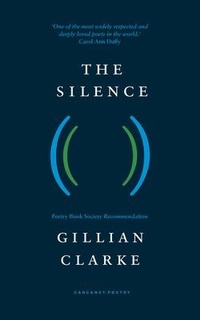
The Silence
Published on 28. March 2024
Book
Paperback/Softback
80 pages
978-1-80017-392-7 (ISBN)
Description
Shortlisted for the Derek Walcott Prize for Poetry 2025
A Poetry Book Society Spring Recommendation 2024
'The days have no names.
The day they count the dead,
the day they closed the doors,
turned off the lights.
We're still here in the silence,
hearing tree-talk,
the wind's secrets,
the company of birds.'
('The Year of the Dead')
The poems in Gillian Clarke's The Silence begin during
lockdown, to whose silences Clarke listens so attentively that other
voices emerge. As the book progresses, that silence deepens, in the
poems about her mother and childhood, about the Great War and its
aftermaths, and in her continuing attention to Welsh places and names,
and the rituals which make that world come in to focus. In these
scrupulous, musical poems, Clarke finds consolation in how silence makes
room for memory and for the company of the animal- and bird-life which
surrounds us. These poems, compulsively returning to key images and
formative moments, echo and bring back other ways of living to the
book's present moment.
A Poetry Book Society Spring Recommendation 2024
'The days have no names.
The day they count the dead,
the day they closed the doors,
turned off the lights.
We're still here in the silence,
hearing tree-talk,
the wind's secrets,
the company of birds.'
('The Year of the Dead')
The poems in Gillian Clarke's The Silence begin during
lockdown, to whose silences Clarke listens so attentively that other
voices emerge. As the book progresses, that silence deepens, in the
poems about her mother and childhood, about the Great War and its
aftermaths, and in her continuing attention to Welsh places and names,
and the rituals which make that world come in to focus. In these
scrupulous, musical poems, Clarke finds consolation in how silence makes
room for memory and for the company of the animal- and bird-life which
surrounds us. These poems, compulsively returning to key images and
formative moments, echo and bring back other ways of living to the
book's present moment.
Reviews / Votes
'Gillian Clarke is one of the most widely respected and deeply loved poets in the world' - Carol Ann Duffy'Clarke has a direct line to the natural world. She paints the Welsh landscape without idealising or romanticising, and in the process shows that nature doesn't need to be elevated to inspire a quiet awe.' - Financial Times
More details
Language
English
Place of publication
United Kingdom
Publishing group
Carcanet Press Ltd
Dimensions
Height: 135 mm
Width: 216 mm
Thickness: 8 mm
Weight
120 gr
ISBN-13
978-1-80017-392-7 (9781800173927)
Copyright in bibliographic data and cover images is held by Nielsen Book Services Limited or by the publishers or by their respective licensors: all rights reserved.
Schweitzer Classification
Other editions
Additional editions
Person
Born in Cardiff, Gillian Clarke is a poet and translator (from Welsh). She edited the Anglo-Welsh Review from 1975 to 1984, and ran poetry workshops in primary and secondary schools and for M.Phil. students at the University Of Glamorgan. She is president of Ty Newydd, the writers' centre in North Wales which she co-founded in 1990. She was the National Poet of Wales from 2008 to 2016. Her poetry is studied by GCSE students throughout Britain. She has given poetry readings in Europe and the United States, and her work has been translated into ten languages. She has a daughter and two sons, and lives with her architect husband on an eighteen-acre smallholding in Ceredigion, Wales, where they have planted 4,300 trees and care for the land according to conservation practice.