

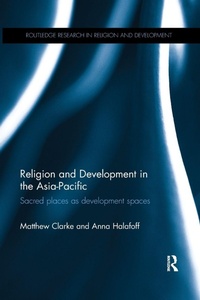
Religion and Development in the Asia-Pacific
Sacred places as development spaces
1st Edition
Published on 8. January 2019
Book
Paperback/Softback
152 pages
978-0-367-02708-7 (ISBN)
Description
Community development is most effective and efficient when it is situated and led at the local level and considers the social behaviours, needs and worldviews of local communities. With more than eight out of ten people globally self-reporting religious belief, Religion and Development in the Asia-Pacific: Sacred places as development spaces argues that the role and impact of religions on community development needs to be better understood. It also calls for greater attention to be given to the role of sacred places as sites for development activities, and for a deeper appreciation of the way in which sacred stories and teachings inspire people to work for the benefit of others in particular locations.
The book considers theories of 'place' as a component of successful development interventions and expands this analysis to consider the specific role that sacred places - buildings and social networks - have in planning, implementing and promoting sustainable development. A series of case studies examine various sacred places as sites for development activities. These case studies include Christian churches and disaster relief in Vanuatu; Muslim shrines and welfare provision in Pakistan; a women's Buddhist monastery in Thailand advancing gender equity; a Jewish aid organisation providing language training to Muslim Women in Australia; and Hawaiian sacred sites located within a holistic retreat centre committed to ecological sustainability.
Religion and Development in the Asia-Pacific demonstrates the important role that sacred spaces can play in development interventions, covering diverse major world religions, interfaith and spiritual contexts, and as such will be of considerable interest for postgraduate students and researchers in development studies, religious studies, sociology of religion and geography.
The book considers theories of 'place' as a component of successful development interventions and expands this analysis to consider the specific role that sacred places - buildings and social networks - have in planning, implementing and promoting sustainable development. A series of case studies examine various sacred places as sites for development activities. These case studies include Christian churches and disaster relief in Vanuatu; Muslim shrines and welfare provision in Pakistan; a women's Buddhist monastery in Thailand advancing gender equity; a Jewish aid organisation providing language training to Muslim Women in Australia; and Hawaiian sacred sites located within a holistic retreat centre committed to ecological sustainability.
Religion and Development in the Asia-Pacific demonstrates the important role that sacred spaces can play in development interventions, covering diverse major world religions, interfaith and spiritual contexts, and as such will be of considerable interest for postgraduate students and researchers in development studies, religious studies, sociology of religion and geography.
Reviews / Votes
"The highest value and bulk of their book...is five Asian-Pacific case studies of how religion and development are interrelated. It is a fascinating multi-faith range - Christian, Buddhist, Muslim, Jewish and multi-faith, and a more holistic spirituality initiative - that demonstrates how religious places often undergird development initiatives by offering not just geographic space but trust, belonging and continuity with existing community rhythms." - Darren Cronshaw, Pacific Journal of Baptist Studies (May 2017), 66-68More details
Series
Language
English
Place of publication
London
United Kingdom
Publishing group
Taylor & Francis Ltd
Target group
College/higher education
Dimensions
Height: 234 mm
Width: 156 mm
Thickness: 9 mm
Weight
245 gr
ISBN-13
978-0-367-02708-7 (9780367027087)
Copyright in bibliographic data and cover images is held by Nielsen Book Services Limited or by the publishers or by their respective licensors: all rights reserved.
Schweitzer Classification
Other editions
Additional editions
Matthew Clarke | Anna Halafoff
Religion and Development in the Asia-Pacific
Sacred places as development spaces
Book
09/2016
1st Edition
Routledge
€231.10
Shipment within 10-20 days
Matthew Clarke | Anna Halafoff
Religion and Development in the Asia-Pacific
Sacred places as development spaces
E-Book
08/2016
Routledge
€52.49
Available for download
Matthew Clarke | Anna Halafoff
Religion and Development in the Asia-Pacific
Sacred places as development spaces
E-Book
08/2016
Routledge
€52.49
Available for download
Persons
Matthew Clarke is Head of the School of Humanities and Social Sciences, Deakin University, Australia.
Anna Halafoff is a Senior Lecturer in Sociology at Deakin University, Australia.
Anna Halafoff is a Senior Lecturer in Sociology at Deakin University, Australia.
Content
1. Religion, Development and Geography 2. Vanuatu and Christian Churches 3. Minhaj-ul-Quran International, Charity and Education 4. Songdhammakalyani Monastery and Gender Equity in Modern Buddhism 5. Kalani, 'Nature, Culture, Wellness' and Sustainable Development 6. Stand Up and Muslim Sudanese Women in Melbourne Conclusion - Bridging Theory and Practice around Place and Space