

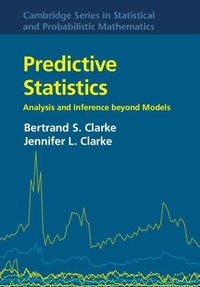
Predictive Statistics
Analysis and Inference beyond Models
Published on 12. April 2018
Book
Hardback
656 pages
978-1-107-02828-9 (ISBN)
Description
All scientific disciplines prize predictive success. Conventional statistical analyses, however, treat prediction as secondary, instead focusing on modeling and hence estimation, testing, and detailed physical interpretation, tackling these tasks before the predictive adequacy of a model is established. This book outlines a fully predictive approach to statistical problems based on studying predictors; the approach does not require predictors correspond to a model although this important special case is included in the general approach. Throughout, the point is to examine predictive performance before considering conventional inference. These ideas are traced through five traditional subfields of statistics, helping readers to refocus and adopt a directly predictive outlook. The book also considers prediction via contemporary 'black box' techniques and emerging data types and methodologies where conventional modeling is so difficult that good prediction is the main criterion available for evaluating the performance of a statistical method. Well-documented open-source R code in a Github repository allows readers to replicate examples and apply techniques to other investigations.
Reviews / Votes
'Prediction, one of the most important practical applications of statistical analysis, has rarely been treated as anything more than an afterthought in most formal treatments of statistical inference. This important book aims to counter this neglect by a wholehearted emphasis on prediction as the primary purpose of the analysis. The authors cut a broad swathe through the statistical landscape, conducting thorough analyses of numerous traditional, recent, and novel techniques, to show how these are illuminated by taking the predictive perspective.' Philip Dawid, University of Cambridge 'The prime focus in statistics has always been on modeling rather than prediction; as a result, different prediction methods have arisen within different subfields of statistics, and a general, all-encompassing account has been lacking. For the first time, this book provides such an account and, as such, it convincingly argues for the primacy of prediction. The authors consider a wide range of topics from a predictive point of view and I am impressed by both the breadth and depth of the topics addressed and by the unifying story the authors manage to tell.' Peter Gruenwald, Centrum Wiskunde & Informatica and Universiteit Leiden 'The book Predictive Statistics by Bertrand S. and Jennifer L. Clarke provides for an interesting and thought-provoking read. The underlying idea is that much of current statistical thinking is focused on model building instead of taking prediction seriously.' Harald Binder, Biometrical JournalMore details
Series
Language
English
Place of publication
Cambridge
United Kingdom
Target group
Professional and scholarly
Dimensions
Height: 260 mm
Width: 183 mm
Thickness: 40 mm
Weight
1413 gr
ISBN-13
978-1-107-02828-9 (9781107028289)
Copyright in bibliographic data and cover images is held by Nielsen Book Services Limited or by the publishers or by their respective licensors: all rights reserved.
Schweitzer Classification
Other editions
Additional editions
E-Book
04/2018
Cambridge University Press
€63.99
Available for download
E-Book
04/2018
Cambridge University Press
€76.99
Available for download
Persons
Bertrand S. Clarke is Chair of the Department of Statistics at the University of Nebraska, Lincoln. His research focuses on predictive statistics and statistical methodology in genomic data. He is a fellow of the American Statistical Association, serves as editor or associate editor for three journals, and has published numerous papers in several statistical fields as well as a book on data mining and machine learning. Jennifer Clarke is Professor of Food Science and Technology, Professor of Statistics, and Director of the Quantitative Life Sciences Initiative at the University of Nebraska, Lincoln. Her current interests include statistical methodology for metagenomics and prediction, statistical computation, and multitype data analysis. She serves on the steering committee of the Midwest Big Data Hub and is co-PI on an award from the NSF focused on data challenges in digital agriculture.
Content
Part I. The Predictive View: 1. Why prediction?; 2. Defining a predictive paradigm; 3. What about modeling?; 4. Models and predictors: a bickering couple; Part II. Established Settings for Prediction: 5. Time series; 6. Longitudinal data; 7. Survival analysis; 8. Nonparametric methods; 9. Model selection; Part III. Contemporary Prediction: 10. Blackbox techniques; 11. Ensemble methods; 12. The future of prediction; References; Index.