

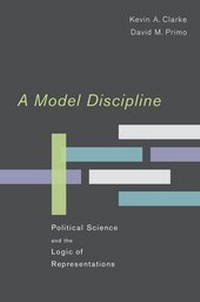
A Model Discipline
Political Science and the Logic of Representations
Published on 16. February 2012
Book
Hardback
232 pages
978-0-19-538219-8 (ISBN)
Description
Political science is an intensely quantitative discipline, and models are central. Political scientists use models--formal and informal, statistical and qualitative--to investigate and illuminate causal mechanisms, generate comparative data, and understand the conditions under which certain outcomes are expected to occur. But even though the use of models has grown dramatically in the discipline, there is very little understanding among political scientists of the role or function that models play in the scientific enterprise more generally. Moreover, theoretical models and empirical models have traditionally been treated as separate (hence the division between theorists and empiricists). Today, however, the emphasis is on using models to generate testable predictions that serve as hypotheses for subsequent data analysis. But how do we justify and rationalize the method? Why test predictions from a deductive, and thus truth-preserving, system?
David Primo and Kevin Clarke tackle these central questions in this novel work of methodology. They argue that the lack of a suitable justification for model testing is not the only reason to revisit the role of models in political science. Most importantly, they contend that models should be seen as 'objects' and thus neither true nor false. Rather, they should be evaluated in the same fashion as models are evaluated in the physical sciences--good models are useful for particular purposes. Nothing more, nothing less. Divided into two parts, the book first establishes that no social scientific endeavor is philosophy-free. The second part focuses on different types of models, and closes with a framework for integrating theoretical and statistical models.
David Primo and Kevin Clarke tackle these central questions in this novel work of methodology. They argue that the lack of a suitable justification for model testing is not the only reason to revisit the role of models in political science. Most importantly, they contend that models should be seen as 'objects' and thus neither true nor false. Rather, they should be evaluated in the same fashion as models are evaluated in the physical sciences--good models are useful for particular purposes. Nothing more, nothing less. Divided into two parts, the book first establishes that no social scientific endeavor is philosophy-free. The second part focuses on different types of models, and closes with a framework for integrating theoretical and statistical models.
Reviews / Votes
This is an outstanding book that should be read, thought about, and discussed by every political scientist. Professors Clarke and Primo provide a clear discussion of what models are, a persuasive critique of current practice in the discipline, and solid guidance for how to effectively assess models of all types. This is a must-read. * Andrew D. Martin, Professor of Law and Political Science, Washington University in St. Louis * This is not a book for those who need the comforts of conventional wisdom. It mounts a powerful challenge to our prevailing orthodoxies, both theoretical and methodological. This is fresh, aggressive thinkin? * a joy to encounter.Christopher Achen, Princeton University * This smart book proposes two things simultaneously for political scientists. First, we ought to have a consensus on what we should not do with our models, and that is we should not insist on testing them as models. But second, we also ought to allow for diversity in what our theoretical models can do, how they are judged, and how they are structured. They argue that models ought to be judged based on how useful they are. The same can be said for books-and this is a very useful book. * Ken Kollman, University of Michigan, Ann Arbor *More details
Language
English
Place of publication
New York
United States
Target group
College/higher education
Professional and scholarly
students and scholars of political science, statistics, and social scientific research
Illustrations
6 b/w illus.
Dimensions
Height: 160 mm
Width: 239 mm
Thickness: 20 mm
Weight
422 gr
ISBN-13
978-0-19-538219-8 (9780195382198)
Copyright in bibliographic data and cover images is held by Nielsen Book Services Limited or by the publishers or by their respective licensors: all rights reserved.
Schweitzer Classification
Other editions
Additional editions
Kevin A. Clarke | David M. Primo
A Model Discipline
Political Science and the Logic of Representations
Book
02/2012
Oxford University Press Inc
€74.00
Shipment within 15-20 days
Kevin A. Clarke | David M. Primo
A Model Discipline
Political Science and the Logic of Representations
E-Book
02/2011
OUP eBook
€34.99
Available for download
Persons
Kevin A. Clarke is Associate Professor of Political Science at the University of Rochester. His research focuses on political methodology and model discrimination tests. Clarke's articles have appeared in American Political Science Review, American Journal of Political Science, Political Analysis, and many other journals.
David M. Primo is Associate Professor of Political Science at the University of Rochester. His research focuses on American politics and political economy. Primo has authored or co-authored two books, The Plane Truth and Transportation Policy and Rules and Restraint, and many journal articles.
David M. Primo is Associate Professor of Political Science at the University of Rochester. His research focuses on American politics and political economy. Primo has authored or co-authored two books, The Plane Truth and Transportation Policy and Rules and Restraint, and many journal articles.
Content
Preface ; 1 A Model Discipline ; 1.1 The Model in Political Science ; 1.2 Metaphors and Analogies, Fables and Fictions ; 1.3 The broad themes of the book ; 1.3.1 Science is not what we think it is ; 1.3.2 Current practice is not "philosophy-free" ; 1.3.3 Models are objects ; 1.3.4 Models are not tested with data ; 1.3.5 Explanation ; 1.4 Plan of the Book ; 1.5 What this Book is Not ; 2 The Science in Political Science ; 2.1 Introduction ; 2.2 What Political Scientists Say They Are Doing ; 2.3 Hypothetico-Deductivism ; 2.4 Problems with H-D ; 2.4.1 Deductions are Truth-Preserving ; 2.4.2 Data Can't Speak for Themselves ; 2.4.3 Other Problems with H-D ; 2.5 How We Got Here ; 2.5.1 Logical Positivism ; 2.5.2 Pathologies of Rational Choice ; 2.5.3 Methods and Models ; 2.5.4 The Empirical Implications of Theoretical Models ; 2.6 Conclusion ; 3 What is a Model? ; 3.1 Introduction ; 3.2 Models as Maps ; 3.3 A Few Examples ; 3.4 The Received View of Scientific Theories ; 3.5 The Semantic Conception of Scientific Theories ; 3.6 The Model-Based View of Scientific Theories ; 3.7 Models and Theories ; 3.8 Conclusion ; 4 Theoretical Models ; 4.1 Introduction ; 4.2 Aspects of Theoretical Models ; 4.3 The Purposes of Models ; 4.3.1 Foundational Models ; 4.3.2 Organizational Models ; 4.3.3 Exploratory Models ; 4.3.4 Predictive Models ; 4.4 Judging a Theoretical Model ; 4.4.1 Prediction is the Wrong Standard (Usually) ; 4.4.2 The Illusion of Precise Standards ; 4.4.3 Dimensions of Usefulness ; 4.5 Conclusion ; 5 Empirical Models ; 5.1 Introduction ; 5.2 What is an Empirical Model? ; 5.2.1 A Model-Based Understanding ; 5.3 The Purposes of Empirical Models ; 5.4 The Illogic of Theory Testing ; 5.4.1 Falsificationism ; 5.4.2 Verificationism ; 5.4.3 Bayesian Confirmation ; 5.5 The Other Uses of Empirical Modeling ; 5.6 Conclusion ; 6 Explanation ; 6.1 Introduction ; 6.2 Existing justifications ; 6.3 Explanation ; 6.3.1 What constitutes an explanation? ; 6.3.2 Explanation in Political Science ; 6.4 Models as explanations ; 6.5 Choosing among explanations ; 6.5.1 Comparative Model Testing ; 6.5.2 Is choosing necessary? ; 6.6 Conclusion ; 7 Conclusion ; 7.1 Introduction ; 7.2 Review of the argument ; 7.3 Issues and counterarguments ; Bibliography