

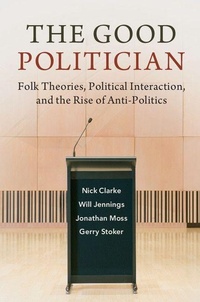
The Good Politician
Folk Theories, Political Interaction, and the Rise of Anti-Politics
Published on 26. April 2018
Book
Hardback
324 pages
978-1-316-51621-8 (ISBN)
Description
Surveys show a lack of trust in political actors and institutions across much of the democratic world. Populist politicians and parties attempt to capitalise on this political disaffection. Commentators worry about our current 'age of anti-politics'. Focusing on the United Kingdom, using responses to public opinion surveys alongside diaries and letters collected by Mass Observation, this book takes a long view of anti-politics going back to the 1940s. This historical perspective reveals how anti-politics has grown in scope and intensity over the last half-century. Such growth is explained by citizens' changing images of 'the good politician' and changing modes of political interaction between politicians and citizens. Current efforts to reform and improve democracy will benefit greatly from the new evidence and conceptual framework set out in this important study.
Reviews / Votes
'It is not at all easy to write an important book on such an important topic. But that is precisely what we have here - and, reassuringly, it is both an optimistic book and one strongly grounded in the empirical evidence. It should be required reading for all politicians - good and not so good alike - and for all of us invited periodically to choose between the good and the not so good amongst them.' Colin Hay, Sciences Po, Paris 'Anyone interested in the future of representative political systems in Britain and other advanced democracies will find a lot to chew on in The Good Politician. It is accessible enough for the general reader but rich enough to allow for multiple deep, academic readings. It is hard to imagine the book being dislodged as the best account of anti-political sentiment in Britain for many years to come.' Peter Allen, LSE Review of BooksMore details
Language
English
Place of publication
Cambridge
United Kingdom
Target group
Professional and scholarly
Illustrations
Worked examples or Exercises; 13 Tables, black and white; 7 Halftones, black and white; 22 Line drawings, black and white
Dimensions
Height: 235 mm
Width: 157 mm
Thickness: 22 mm
Weight
624 gr
ISBN-13
978-1-316-51621-8 (9781316516218)
Copyright in bibliographic data and cover images is held by Nielsen Book Services Limited or by the publishers or by their respective licensors: all rights reserved.
Schweitzer Classification
Other editions
Additional editions
E-Book
04/2018
Cambridge University Press
€21.99
Available for download
Nick Clarke | Will Jennings | Jonathan Moss
The Good Politician
Folk Theories, Political Interaction, and the Rise of Anti-Politics
Book
04/2018
Cambridge University Press
€41.80
Shipment within 15-20 days
Nick Clarke | Will Jennings | Jonathan Moss
The Good Politician
Folk Theories, Political Interaction, and the Rise of Anti-Politics
E-Book
04/2018
Cambridge University Press
€26.49
Available for download
Persons
Nick Clarke is Associate Professor of Human Geography at the University of Southampton. Will Jennings is Professor of Political Science and Public Policy at the University of Southampton. Jonathan Moss is Lecturer in Politics at the University of Sussex. Gerry Stoker is Centenary Professor of Governance at the University of Canberra and Professor of Governance at the University of Southampton.
Content
Introduction; 1. The problem of anti-politics; 2. Taking the long view and listening to citizens' voices; 3. Beyond trendless fluctuation: the broadening social scope of anti-politics; 4. Beyond permanent apathy: the broadening political scope of anti-politics; 5. Beyond the decline of deference: the rising intensity of anti-politics; 6. Beyond depoliticisation: the persistent force of stealth democratic folk theories; 7. Changing images of the good politician; 8. Changing modes of political interaction; 9. Changing folk theories: from stealth democracy to stealth populism; Conclusion.