

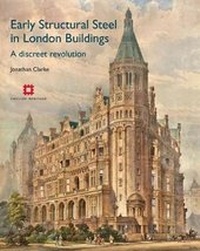
Early Structural Steel in London Buildings
A discreet revolution
Will be published approx. on 15. February 2014
Book
Hardback
408 pages
978-1-84802-103-7 (ISBN)
Description
At its heart, this book is an examination of how a new structural material - mass-produced steel - came to be first applied to the buildings of one of the world's great cities. The focus is evolution and change in London's buildings and architecture in the late Victorian and early Edwardian period; its emphasis is unashamedly constructional. A great deal has been written about the shape, style and ornament of metropolitan buildings of the period, but comparatively little on their structural anatomy and physiology.
The first part examines the technological developments and economic forces that brought structural steel into being. Central to this was the invention of the Bessemer and Siemens-Martin processes which revolutionised steelmaking and enabled the mass production of a metal which outmatched both cast and wrought iron. Steel became the pillar of a new phase of industrialisation and urbanisation throughout the world, and London, where Henry Bessemer had conducted his initial steelmaking experiments, was one of the first cities to make use of it.
The second part of the book is an examination of how structural steel was exploited in different types of London building before 1910. As steel construction developed, and buildings became larger and more complex, structure was forced back onto the architectural agenda. Techniques of framing evolved to make buildings more open, better lit, more stable, or to give them stronger floors or wider roofs.
The first part examines the technological developments and economic forces that brought structural steel into being. Central to this was the invention of the Bessemer and Siemens-Martin processes which revolutionised steelmaking and enabled the mass production of a metal which outmatched both cast and wrought iron. Steel became the pillar of a new phase of industrialisation and urbanisation throughout the world, and London, where Henry Bessemer had conducted his initial steelmaking experiments, was one of the first cities to make use of it.
The second part of the book is an examination of how structural steel was exploited in different types of London building before 1910. As steel construction developed, and buildings became larger and more complex, structure was forced back onto the architectural agenda. Techniques of framing evolved to make buildings more open, better lit, more stable, or to give them stronger floors or wider roofs.
Reviews / Votes
... this book contains material to delight anyone with a more than passing interest in theatre design and construction. ... Read the full story in Jonathan Clarke's splendidly illustrated, delightfully readable pages.John Earl, Theatres Magazine The detailed and yet very readable text is supported by over 350 excellent illustrations in black and white and colour. This valuable book fills an important gap in our understanding of Victorian and Edwardian design and construction.
Ken Moth, Context Another sumptuous book from the English Heritage stable! ... We must therefore be thankful to Jonathan Clarke for assembling and illustrating such a comprehensive selection of significant steel buildings.
Keith Falconer, Industrial Archaeology Review ... The quality of production is excellent throughout. ... this book ... deals thoroughly and very readably with a subject that has not hitherto received the attention it deserves.
Michael Bussell, International Journal for the History of Engineering and Technology This fascinating, profusely illustrated book on early steel structures will enable the reader to look at the important legacy of late Victorian and Edwardian buildings in London in a totally different light.
Harriet Devlin, The Historic Environment Jonathan Clarke does what too few architectural historians manage to do - that is, get behind the building's facade and really confront its structure. To do this one needs, as well as plans, good sectional and construction drawings, and those this book has in quantity ... it offers a rich review of an architecture that, for all its historicist expression, was as modern as the dated building regulations would allow.
Neil Jackson, The Victorian English Heritage have done the author proud and the book is a splendid object in itself, well designed and superbly illustrated. ... Clarke writes clearly and well and sets out the technical issues with admirable clarity. His book will certainly be required reading for anyone interested in construction history, but really it deserves to ve ready by anyone interested in 19th and 20th century architecture.
Steven Brindle, Transactions of the Ancient Monuments Society The book is a very well researched, interesting read.
Clive Dawson, SPAB Jonathan Clarke's book provides an unprecedented overview of an important era in construction history - the birth of the modern construction industry.
Bill Addis, Construction History Not only is this a book with resonances belied by its title, but a handsomely produced and generously illustrated one as well.
Andrew Saint, English Heritage Historical Review
More details
Series
Language
English
Place of publication
Swindon
United Kingdom
Target group
Professional and scholarly
Illustrations
357 Illustrations
Dimensions
Height: 276 mm
Width: 219 mm
Weight
1942 gr
ISBN-13
978-1-84802-103-7 (9781848021037)
Copyright in bibliographic data and cover images is held by Nielsen Book Services Limited or by the publishers or by their respective licensors: all rights reserved.
Schweitzer Classification
Person
Author, London.
Content
Acknowledgements
Introduction
Part 1: Technological preconditions and other contexts
1. Towards a structural steel
2. Constructional steelwork and its iron inheritance
3. The Continental dimension
4. The London Building Regulations
5. Philosophical concerns about iron, steel, and framed construction
6. Professional conflicts: architect-engineer dynamics
7. American influence
8. The evolution of the fully framed building
Part 2: Steel into London buildings, and iron precedents
9. Theatres and music halls
10. Clubs and hotels
11. Banks and offices
12. Shops, houses, churches, pools, fire stations and tube stations
13. Industrial buildings
14. Conclusion: a revolution realised
Notes
Bibliography
Index
Introduction
Part 1: Technological preconditions and other contexts
1. Towards a structural steel
2. Constructional steelwork and its iron inheritance
3. The Continental dimension
4. The London Building Regulations
5. Philosophical concerns about iron, steel, and framed construction
6. Professional conflicts: architect-engineer dynamics
7. American influence
8. The evolution of the fully framed building
Part 2: Steel into London buildings, and iron precedents
9. Theatres and music halls
10. Clubs and hotels
11. Banks and offices
12. Shops, houses, churches, pools, fire stations and tube stations
13. Industrial buildings
14. Conclusion: a revolution realised
Notes
Bibliography
Index