

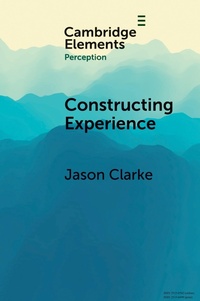
Constructing Experience
Expectation and Attention in Perception
Published on 30. January 2025
Book
Hardback
90 pages
978-1-009-58856-0 (ISBN)
Description
This Element examines the influence of expectation and attention on conscious perception. It explores the debate on whether attention is necessary for conscious perception by presenting empirical evidence from studies on inattentional blindness, change blindness, and the attentional blink. While the evidence strongly suggests that attention is necessary for conscious perception, other research has shown that expectation can shape perception, sometimes leading to illusory experiences where predicted stimuli are perceived despite their absence. This phenomenon, termed 'expectation awareness', suggests that attention may not be necessary for all conscious experiences. These findings are explored within the predictive processing framework, where the brain is characterized as a prediction engine, continuously updating its internal models to minimize prediction errors. Integrating findings from psychology, neuroscience, and cognitive science, this Element provides a predictive processing model of how attention and expectation construct perceptual reality. It also discusses clinical and theoretical implications and suggests future research.
More details
Series
Language
English
Place of publication
Cambridge
United Kingdom
Illustrations
Worked examples or Exercises
Dimensions
Height: 235 mm
Width: 157 mm
Thickness: 10 mm
Weight
294 gr
ISBN-13
978-1-009-58856-0 (9781009588560)
Copyright in bibliographic data and cover images is held by Nielsen Book Services Limited or by the publishers or by their respective licensors: all rights reserved.
Schweitzer Classification
Other editions
Additional editions
Book
01/2025
Cambridge University Press
€26.80
Shipment within 15-20 days
Person
Content
1. Introduction; 2. Consciousness; 3. Perception; 4. Attention; 5. Expectation; 6. Attention and expectation; 7. Expectation awareness: seeing what is not there; 8. Implications, future research, and concluding remarks; References.