

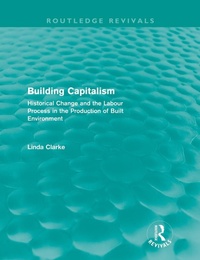
Building Capitalism (Routledge Revivals)
Historical Change and the Labour Process in the Production of Built Environment
1st Edition
Published on 22. November 2012
Book
Paperback/Softback
316 pages
978-0-415-68802-4 (ISBN)
Description
First published in 1992, this Routledge Revival sees the reissue of a truly original exploration of the nature of urbanization and capitalism.
Linda Clarke's vital work argues that:
Urbanization is a product of the social human labour engaged in building as well as a concentration of the labour force.
The quality of the labour process determines the development of production.
Changes to the built environment reflect changes in the production process and, in particular, the development of wage labour.
To support these arguments, the author identifies a qualitatively new historical stage of capitalist building production involving a significant expansion of wage labour, and hence capital, and the transition from artisan to industrial production.
Linda Clarke draws from a wide range of original material relating to the development of London from the mid-eighteenth to the early nineteenth century to provide a complete description of the development process: materials extraction, roadbuilding, housebuilding, paving, cleansing, etc; profiles of builders and contractors involved, and a picture of the new working class communities, as in Somers Town - their living conditions, population, working environment, and politics.
Linda Clarke's vital work argues that:
Urbanization is a product of the social human labour engaged in building as well as a concentration of the labour force.
The quality of the labour process determines the development of production.
Changes to the built environment reflect changes in the production process and, in particular, the development of wage labour.
To support these arguments, the author identifies a qualitatively new historical stage of capitalist building production involving a significant expansion of wage labour, and hence capital, and the transition from artisan to industrial production.
Linda Clarke draws from a wide range of original material relating to the development of London from the mid-eighteenth to the early nineteenth century to provide a complete description of the development process: materials extraction, roadbuilding, housebuilding, paving, cleansing, etc; profiles of builders and contractors involved, and a picture of the new working class communities, as in Somers Town - their living conditions, population, working environment, and politics.
More details
Series
Language
English
Place of publication
London
United Kingdom
Publishing group
Taylor & Francis Ltd
Target group
College/higher education
Dimensions
Height: 246 mm
Width: 189 mm
Thickness: 18 mm
Weight
655 gr
ISBN-13
978-0-415-68802-4 (9780415688024)
Copyright in bibliographic data and cover images is held by Nielsen Book Services Limited or by the publishers or by their respective licensors: all rights reserved.
Schweitzer Classification
Other editions
Additional editions
Linda Clarke
Building Capitalism (Routledge Revivals)
Historical Change and the Labour Process in the Production of Built Environment
E-Book
12/2012
1st Edition
Routledge
€64.49
Available for download
Linda Clarke
Building Capitalism (Routledge Revivals)
Historical Change and the Labour Process in the Production of Built Environment
E-Book
12/2012
Routledge
€64.49
Available for download
Linda Clarke
Building Capitalism (Routledge Revivals)
Historical Change and the Labour Process in the Production of Built Environment
Book
07/2011
1st Edition
Routledge
€262.00
Shipment within 15-20 days
Person
Content
Part 1: Theoretical Questions and Considerations 1. Urbanization as a Production Process 2. Transition and Historical Change in the Urbanization Process 3. Stages a Structure or Transition 4. The End of Artisan Production Part 2: Urbanization through Artisan Production: From Brill Farm to Somers Town 5. Eighteenth-Century Building Conditions in and Around London 6. The Early Development of Brill Farm and its surroundings 7. A Breakdown in the Process of Building St. Pancras Part 3: Urbanization Through Contracting 8. The Builder as Contractor 9. A New Stage of Building Production 10. The Capital Expands