

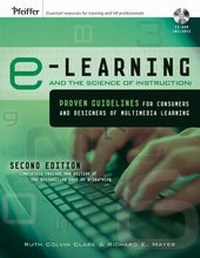
e-Learning and the Science of Instruction
Proven Guidelines for Consumers and Designers of Multimedia Learning
2nd Edition
Published on 1. September 2007
Book
Hardback
496 pages
978-0-7879-8683-4 (ISBN)
Description
Praise for the Second Edition of
e-Learning and the Science of Instruction
"Their first edition was a landmark work. This new edition is even better. Too many guidelines for instructional design are based on opinion or an attempt to be consistent with some philosophical position. It is most refreshing when one of the world's most respected learning researchers teams with the premier translator of scientific findings to produce a set of e-learning guidelines based on empirical research findings. Both novice and experienced instructional designers will observe more effective and efficient learning from their instructional products if they implement the guidelines in this book."
-M. David Merrill, Visiting Professor, Florida State University
"As a scholar-practitioner, e-Learning and the Science of Instruction has been an invaluable resource. Clark and Mayer have a knack for placing theory into applicable and practical examples of instructionally sound e-learning. In the last four years, I have used this book as a reference for several e-learning courses and as a manager of several instructional designers. Quite frankly, our field needs more evidenced-based examples of instructionally sound e-learning and less of the 'wow' factor!"
?-Gina Ann Richter, President, GO-Learning Inc.
"This book is required reading in my graduate-level Instructional Media Design course. As an instructor, I appreciate the sound empirical basis for the book's e-learning guidelines. The students, on the other hand, are grateful for the clear, concise language used to describe the guidelines, which makes their application straightforward."
-Robert K. Atkinson, Assistant Professor, Educational Technology, Arizona State University
e-Learning and the Science of Instruction
"Their first edition was a landmark work. This new edition is even better. Too many guidelines for instructional design are based on opinion or an attempt to be consistent with some philosophical position. It is most refreshing when one of the world's most respected learning researchers teams with the premier translator of scientific findings to produce a set of e-learning guidelines based on empirical research findings. Both novice and experienced instructional designers will observe more effective and efficient learning from their instructional products if they implement the guidelines in this book."
-M. David Merrill, Visiting Professor, Florida State University
"As a scholar-practitioner, e-Learning and the Science of Instruction has been an invaluable resource. Clark and Mayer have a knack for placing theory into applicable and practical examples of instructionally sound e-learning. In the last four years, I have used this book as a reference for several e-learning courses and as a manager of several instructional designers. Quite frankly, our field needs more evidenced-based examples of instructionally sound e-learning and less of the 'wow' factor!"
?-Gina Ann Richter, President, GO-Learning Inc.
"This book is required reading in my graduate-level Instructional Media Design course. As an instructor, I appreciate the sound empirical basis for the book's e-learning guidelines. The students, on the other hand, are grateful for the clear, concise language used to describe the guidelines, which makes their application straightforward."
-Robert K. Atkinson, Assistant Professor, Educational Technology, Arizona State University
More details
Edition
2., Auflage
Language
English
Place of publication
New York
United States
Publishing group
John Wiley & Sons Inc
Target group
Professional and scholarly
Edition type
Revised edition
Illustrations
Illustrations
Dimensions
Height: 23.6 cm
Width: 18.5 cm
Thickness: 32 mm
Weight
964 gr
ISBN-13
978-0-7879-8683-4 (9780787986834)
Schweitzer Classification
Other editions
New editions
Ruth C. Clark | Richard E. Mayer
e-Learning and the Science of Instruction
Proven Guidelines for Consumers and Designers of Multimedia Learning
Book
09/2011
3rd Edition
Wiley
€61.90
Article exhausted; check for reprint
Persons
Ruth Colvin Clark has worked for more than twenty-five years with instructional professionals assigned to design, develop, and select effective training for classroom or computer delivery. She is widely published in the areas of training, development, and performance improvement.
Richard E. Mayer is professor of psychology at the University of California, Santa Barbara. He is an internationally-recognized expert in the application of learning psychology to design of instruction in multimedia learning environments and the author of Multimedia Learning and is the editor of the Cambridge Handbook of Multimedia Learning.
Richard E. Mayer is professor of psychology at the University of California, Santa Barbara. He is an internationally-recognized expert in the application of learning psychology to design of instruction in multimedia learning environments and the author of Multimedia Learning and is the editor of the Cambridge Handbook of Multimedia Learning.
Content
1. e-Learning: Promise and Pitfalls.
2. How Do People Learn from e-Courses.
3. Applying the Multimedia Principle: Use Words and Graphics, Rather Than Words Alone.
4. Applying the Contiguity Principle: Align Words to Corresponding Graphics.
5. Applying the Modality Principle: Present Words as Audio Narration, Rather Than On-Screen Text.
6. Applying the Redundancy Principle: Explain Visuals with Words in Audio or Text: Not Both.
7. Applying the Coherence Principle: Adding Interesting Material Can Hurt Learning.
8. Applying the Personalization Principle: Use Conversational Style and Virtual Coaches.
9. Applying the Segmenting and Pretraining Principles: Managing Complexity by Breaking a Lesson into Parts.
10. Leveraging Examples in e-Learning.
11. Does Practice Make Perfect?
12. Learning Together Virtually.
13. Who's in Control? Guidelines for e-Learning Navigation.
14. e-Learning to Build Thinking Skills.
15. Simulations and Games in e-Learning.
16. Applying the Guidelines.
2. How Do People Learn from e-Courses.
3. Applying the Multimedia Principle: Use Words and Graphics, Rather Than Words Alone.
4. Applying the Contiguity Principle: Align Words to Corresponding Graphics.
5. Applying the Modality Principle: Present Words as Audio Narration, Rather Than On-Screen Text.
6. Applying the Redundancy Principle: Explain Visuals with Words in Audio or Text: Not Both.
7. Applying the Coherence Principle: Adding Interesting Material Can Hurt Learning.
8. Applying the Personalization Principle: Use Conversational Style and Virtual Coaches.
9. Applying the Segmenting and Pretraining Principles: Managing Complexity by Breaking a Lesson into Parts.
10. Leveraging Examples in e-Learning.
11. Does Practice Make Perfect?
12. Learning Together Virtually.
13. Who's in Control? Guidelines for e-Learning Navigation.
14. e-Learning to Build Thinking Skills.
15. Simulations and Games in e-Learning.
16. Applying the Guidelines.