

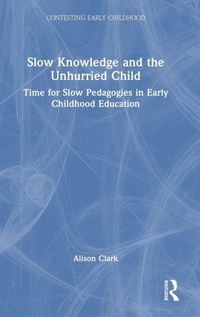
Slow Knowledge and the Unhurried Child
Time for Slow Pedagogies in Early Childhood Education
1st Edition
Published on 30. December 2022
Book
Hardback
160 pages
978-0-367-50880-7 (ISBN)
Description
This book explores the relationship with time in early childhood by arguing for the valuing of slow pedagogies and slow knowledge. Alison Clark points to alternative practices in Early Childhood Education and Care that enable a different pace and rhythm, against the backdrop of the acceleration in early childhood and the proliferation of testing and measurement. Diverse approaches are explored to enable an 'unhurried child' and less hurried adults.
Slow Knowledge and the Unhurried Child is divided in three parts. Part 1, Reasons to be slow, looks at the pressures in Early Childhood Education and Care to speed up and for children to be 'readied' for the next stage. The book then explores different relationships with time for young children and educators. Part 2, Slow pedagogies and practices, explore some of the forms slow practices can take including outdoors, in the studio, in everyday routines, through stories, in pedagogical documentation and in 'slow' research. Part 3, Moving forward, shows what a 'timefull' approach to ECEC can look like, whilst debating the challenges and possibilities that exist.
The book serves as a catalyst for urgent discussion about the need to slow down in early childhood education and teacher education and explores case studies of where slow early childhood education are already happening. It will be a key reading for researchers, practitioners and policy-makers about the relationship with time in early childhood and the importance of taking a longer view.
Slow Knowledge and the Unhurried Child is divided in three parts. Part 1, Reasons to be slow, looks at the pressures in Early Childhood Education and Care to speed up and for children to be 'readied' for the next stage. The book then explores different relationships with time for young children and educators. Part 2, Slow pedagogies and practices, explore some of the forms slow practices can take including outdoors, in the studio, in everyday routines, through stories, in pedagogical documentation and in 'slow' research. Part 3, Moving forward, shows what a 'timefull' approach to ECEC can look like, whilst debating the challenges and possibilities that exist.
The book serves as a catalyst for urgent discussion about the need to slow down in early childhood education and teacher education and explores case studies of where slow early childhood education are already happening. It will be a key reading for researchers, practitioners and policy-makers about the relationship with time in early childhood and the importance of taking a longer view.
More details
Series
Language
English
Place of publication
London
United Kingdom
Publishing group
Taylor & Francis Ltd
Target group
Professional and scholarly
Professional
Dimensions
Height: 240 mm
Width: 161 mm
Thickness: 14 mm
Weight
432 gr
ISBN-13
978-0-367-50880-7 (9780367508807)
Copyright in bibliographic data and cover images is held by Nielsen Book Services Limited or by the publishers or by their respective licensors: all rights reserved.
Schweitzer Classification
Other editions
Additional editions
Alison Clark
Slow Knowledge and the Unhurried Child
Time for Slow Pedagogies in Early Childhood Education
Book
12/2022
1st Edition
Routledge
€46.80
Shipment within 15-20 days
Alison Clark
Slow Knowledge and the Unhurried Child
Time for Slow Pedagogies in Early Childhood Education
E-Book
12/2022
1st Edition
Routledge
€44.99
Available for download
Alison Clark
Slow Knowledge and the Unhurried Child
Time for Slow Pedagogies in Early Childhood Education
E-Book
12/2022
1st Edition
Routledge
€44.99
Available for download
Person
Alison Clark is Professor of Early Childhood Education at the University of South-Eastern Norway and Honorary Senior Research Fellow at the Institute of Education, University College London, UK.
Content
Foreword by Michel Vandenbroeck. Preface. Acknowledgement. Part One: Reasons to be slow. 1. Accelerated childhood. 2. Clock time. 3. Play time. 4. Slow pedagogies and slow knowledge. Part Two Slow pedagogies and slow practices: What does slow look like in Early Childhood Education?. 5. Slow Practices in Place. 6. Slow practices and pedagogical documentation. 7. Slow practices and the everyday. 8. Slow practices and stories. 9. Slow listening in research and practice. Part Three: Moving forward. 10.Time for a rethink. Appendix. References.