

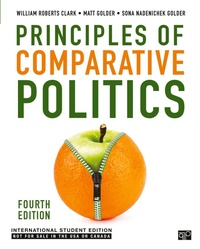
Principles of Comparative Politics - International Student Edition
4th Edition
Published on 18. October 2024
Book
Paperback/Softback
768 pages
978-1-0718-5253-8 (ISBN)
Description
Principles of Comparative Politics offers a view into the rich world of comparative inquiry, research, and scholarship. This groundbreaking text gives students meaningful insight into how cross-national comparison is actually conducted and why it matters. William R. Clark, Matt Golder, and Sona N. Golder walk us through the enduring questions that scholars grapple with, the issues about which consensus has started to emerge, and the tools comparativists use to analyze the complex and interesting problems at the heart of the field.
The thoroughly revised Fourth Edition includes streamlined discussion and analysis of key topics and theories in the field.
The thoroughly revised Fourth Edition includes streamlined discussion and analysis of key topics and theories in the field.
Reviews / Votes
This book provides an excellent introduction to the science of comparative politics. The authors have expertly crafted a thematic arrangement of topics that provides students with a cutting-edge introduction to the state of our discipline. The book really has few peers in this regard. -- Christopher Hale The best textbook in comparative politics. -- Thiago Silva A scientific approach to the study of comparative politics. It is a book on comparative political *science* rather than a book that simply describes politics in other countries. -- Robin E. Best * Binghamton University (SUNY) *More details
Edition
4th Revised edition
Language
English
Place of publication
Washington
United States
Publishing group
SAGE Publications Inc
Target group
College/higher education
Edition type
Revised edition
Dimensions
Height: 232 mm
Width: 186 mm
Thickness: 41 mm
Weight
1352 gr
ISBN-13
978-1-0718-5253-8 (9781071852538)
Copyright in bibliographic data and cover images is held by Nielsen Book Services Limited or by the publishers or by their respective licensors: all rights reserved.
Schweitzer Classification
Persons
William Roberts Clark is head of the Department of Political Science at Texas A&M University and a fellow at the Institute for the Study of Religion at Baylor University. He is the author of Capitalism, Not Globalism, and his articles have appeared in American Political Science Review, Comparative Political Studies, Political Analysis, and European Union Politics, among other journals. He has been teaching at a wide variety of public and private schools (William Paterson College, Rutgers University, Georgia Tech, Princeton, New York University, and the University of Michigan) for more than three decades. Matt Golder was previously assistant professor of political science at Florida State University. He is the author of articles which have appeared in the American Journal of Political Science, British Journal of Political Science, Comparative Political Studies, Electoral Studies, and Political Analysis among other journals. He has taught classes on comparative politics, advanced industrialized democracies, quantitative methods, and European politics at the University of Iowa, Florida State University, and the University of Essex. Sona Nadenichek Golder was previously assistant professor of political science at Florida State University. She is the author of The Logic of Pre-Electoral Coalition Formation, and has published articles in the British Journal of Political Science, Electoral Studies, and European Union Politics. She teaches courses on European politics, democracies and dictatorships, comparative institutions, game theory, and comparative politics at Florida State University and was a Mentor-in-Residence for the 2007 Empirical Implications of Theoretical Models Summer Program at UCLA .
Content
1. Introduction
Political Ideology
Overview of the Book
2. What Is Science?
What Is Science?
The Scientific Method
An Introduction to Logic
Myths about Science
Conclusion
3. What Is Politics?
The Exit, Voice, and Loyalty Game
Solving the Exit, Voice, and Loyalty Game
Evaluating the Exit, Voice, and Loyalty Game
Conclusion
Preparation for the Problems
4. The Origins of the Modern State
What Is the State?
The Social Contract View of the State
The Predatory View of the State
Conclusion
Preparation for the Problems
5. Democracy and Dictatorship: Conceptualization and Measurement
Early Democracy versus Modern Democracy
Classifying Democracies and Dictatorships
Conclusion
6. The Economic Determinants of Democracy and Dictatorship
A Brief Overview of Modernization Theory
Income and Democracy
Modernization Theory and Democracy
The Conditionality of Modernization Theory
Inequality and Democracy
Conclusion
7. The Cultural Determinants of Democracy and Dictatorship
Classical Cultural Arguments: Mill and Montesquieu
Does Democracy Require a Civic Culture?
Are Some Religions Incompatible with Democracy?
Theorizing about Culture
Conclusion
8. Democratic Transitions
Bottom-Up Transitions to Democracy
Top-Down Transitions to Democracy
Conclusion
Preparation for Problems Dealing with Incomplete Information Games
9. Varieties of Dictatorship
A Common Typology of Authoritarian Regimes
The Two Fundamental Problems of Authoritarian Rule
Selectorate Theory
Conclusion
10. Problems with Group Decision Making
Problems with Group Decision Making
Arrow's Theorem
Conclusion
11. Parliamentary, Presidential, and Semi-Presidential Democracies
Classifying Democracies
Governments in Parliamentary Democracies
Governments in Presidential Democracies
Governments in Semi-Presidential Democracies
A Unifying Framework: Principal-Agent and Delegation Problems
Conclusion
12. Elections and Electoral Systems
Elections and Electoral Integrity
Electoral Systems
Legislative Electoral System Choice
Conclusion
13. Parties, Party Systems, and Party Competition
Political Parties: What Are They, and What Do They Do?
Party Systems
Types of Political Parties
The Number of Political Parties
Party Competition
Conclusion
14. Institutional Veto Players
Federalism
Bicameralism
Constitutionalism
Veto Players
Conclusion
15. Consequences of Democratic Institutions
Majoritarian or Consensus Democracy?
The Effect of Political Institutions on Fiscal Policy
Electoral Laws, Federalism, and Ethnic Conflict
Presidentialism and Democratic Survival
Conclusion
Political Ideology
Overview of the Book
2. What Is Science?
What Is Science?
The Scientific Method
An Introduction to Logic
Myths about Science
Conclusion
3. What Is Politics?
The Exit, Voice, and Loyalty Game
Solving the Exit, Voice, and Loyalty Game
Evaluating the Exit, Voice, and Loyalty Game
Conclusion
Preparation for the Problems
4. The Origins of the Modern State
What Is the State?
The Social Contract View of the State
The Predatory View of the State
Conclusion
Preparation for the Problems
5. Democracy and Dictatorship: Conceptualization and Measurement
Early Democracy versus Modern Democracy
Classifying Democracies and Dictatorships
Conclusion
6. The Economic Determinants of Democracy and Dictatorship
A Brief Overview of Modernization Theory
Income and Democracy
Modernization Theory and Democracy
The Conditionality of Modernization Theory
Inequality and Democracy
Conclusion
7. The Cultural Determinants of Democracy and Dictatorship
Classical Cultural Arguments: Mill and Montesquieu
Does Democracy Require a Civic Culture?
Are Some Religions Incompatible with Democracy?
Theorizing about Culture
Conclusion
8. Democratic Transitions
Bottom-Up Transitions to Democracy
Top-Down Transitions to Democracy
Conclusion
Preparation for Problems Dealing with Incomplete Information Games
9. Varieties of Dictatorship
A Common Typology of Authoritarian Regimes
The Two Fundamental Problems of Authoritarian Rule
Selectorate Theory
Conclusion
10. Problems with Group Decision Making
Problems with Group Decision Making
Arrow's Theorem
Conclusion
11. Parliamentary, Presidential, and Semi-Presidential Democracies
Classifying Democracies
Governments in Parliamentary Democracies
Governments in Presidential Democracies
Governments in Semi-Presidential Democracies
A Unifying Framework: Principal-Agent and Delegation Problems
Conclusion
12. Elections and Electoral Systems
Elections and Electoral Integrity
Electoral Systems
Legislative Electoral System Choice
Conclusion
13. Parties, Party Systems, and Party Competition
Political Parties: What Are They, and What Do They Do?
Party Systems
Types of Political Parties
The Number of Political Parties
Party Competition
Conclusion
14. Institutional Veto Players
Federalism
Bicameralism
Constitutionalism
Veto Players
Conclusion
15. Consequences of Democratic Institutions
Majoritarian or Consensus Democracy?
The Effect of Political Institutions on Fiscal Policy
Electoral Laws, Federalism, and Ethnic Conflict
Presidentialism and Democratic Survival
Conclusion