

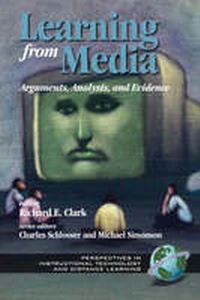
Learning from Media
Arguments, Analysis, and Evidence
Published on 5. September 2000
Book
Hardback
372 pages
978-1-930608-76-4 (ISBN)
Description
This volume incorporates essays questioning the meta-analyses of computer-based instruction research, Robert Kozma's counterpoint theory of "learning with media", science-based technology verus experience-based craft and science-based "authentic technologies".
More details
Series
Language
English
Place of publication
Charlotte
United States
Publishing group
Emerald Publishing Inc
Target group
College/higher education
Professional and scholarly
Illustrations
appendices
Dimensions
Height: 229 mm
Width: 152 mm
Thickness: 25 mm
Weight
716 gr
ISBN-13
978-1-930608-76-4 (9781930608764)
Copyright in bibliographic data and cover images is held by Nielsen Book Services Limited or by the publishers or by their respective licensors: all rights reserved.
Schweitzer Classification
Other editions
New editions
Book
03/2012
2nd Edition
Information Age Publishing
€122.60
Shipment within 3-4 weeks
Content
Preface; Richard E. Clark.
Chapter 1. Media Are "Mere Vehicles": The Opening Argument; Richard E. Clark.
Chapter 2. Questioning the Meta-Analyses of Computer-Based Instruction Research; Richard E. Clark.
Chapter 3. Why Should We Expect Media to Teach Anyone Anything?; Richard E. Clark and Gavriel Salomon.
Chapter 4. International Views of the Media Debate; Richard E. Clark and Brenda M. Sugrue.
Chapter 5. What About Multi-Media Effects on Learning?; Richard E. Clark and Terry Craig.
Chapter 6. Do Media Aid Critical Thinking, Problem Solving or "Learning to Learn"?; Richard E. Clark.
Chapter 7. A Summary of the Disagreements with the "Mere Vehicles" Argument; Richard E. Clark.
Chapter 8. Robert Kozma's Counterpoint Theory of "Learning With Media"; Robert B. Kozma.
Chapter 9. Kozma Reframes and Extends His Counter Argument; Robert B. Kozma.
Chapter 10. A Review of Kozma and Clark's Arguments; Gary R. Morrison.
Chapter 11. The Media Versus Methods Issue; Richard E. Clark.
Chapter 12. Are Methods "Replaceable"?: A Reply to Critics in the ETRD Special Issue on the Debate; Richard E. Clark.
Chapter 13. New Directions: An Argument for Research-Based Performance Technology; Richard E. Clark and Fred Estes.
Chapter 14. New Directions: How to Develop "Authentic Technologies"; Richard E. Clark and Fred Estes.
Chapter 15. New Directions: Cognitive and Motivational Research Issues; Richard E. Clark.
Chapter 16. New Directions: Evaluating Distance Education Technologies; Richard E. Clark.
Chapter 17. New Directions: Equivalent Evaluation of Instructional Media: The Next Round of Media Comparison Studies; Gary R. Morrison.
Chapter 18. What Is Next In The Media and Methods Debate?; Richard E. Clark.
Chapter 1. Media Are "Mere Vehicles": The Opening Argument; Richard E. Clark.
Chapter 2. Questioning the Meta-Analyses of Computer-Based Instruction Research; Richard E. Clark.
Chapter 3. Why Should We Expect Media to Teach Anyone Anything?; Richard E. Clark and Gavriel Salomon.
Chapter 4. International Views of the Media Debate; Richard E. Clark and Brenda M. Sugrue.
Chapter 5. What About Multi-Media Effects on Learning?; Richard E. Clark and Terry Craig.
Chapter 6. Do Media Aid Critical Thinking, Problem Solving or "Learning to Learn"?; Richard E. Clark.
Chapter 7. A Summary of the Disagreements with the "Mere Vehicles" Argument; Richard E. Clark.
Chapter 8. Robert Kozma's Counterpoint Theory of "Learning With Media"; Robert B. Kozma.
Chapter 9. Kozma Reframes and Extends His Counter Argument; Robert B. Kozma.
Chapter 10. A Review of Kozma and Clark's Arguments; Gary R. Morrison.
Chapter 11. The Media Versus Methods Issue; Richard E. Clark.
Chapter 12. Are Methods "Replaceable"?: A Reply to Critics in the ETRD Special Issue on the Debate; Richard E. Clark.
Chapter 13. New Directions: An Argument for Research-Based Performance Technology; Richard E. Clark and Fred Estes.
Chapter 14. New Directions: How to Develop "Authentic Technologies"; Richard E. Clark and Fred Estes.
Chapter 15. New Directions: Cognitive and Motivational Research Issues; Richard E. Clark.
Chapter 16. New Directions: Evaluating Distance Education Technologies; Richard E. Clark.
Chapter 17. New Directions: Equivalent Evaluation of Instructional Media: The Next Round of Media Comparison Studies; Gary R. Morrison.
Chapter 18. What Is Next In The Media and Methods Debate?; Richard E. Clark.