

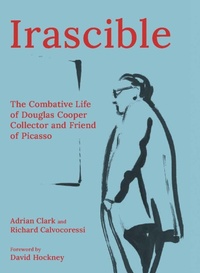
Irascible
The Combative Life of Douglas Cooper, Collector and Friend of Picasso
Published on 8. April 2025
Book
Hardback
592 pages
978-0-300-28269-6 (ISBN)
Description
A pioneering collector of Cubist art, the English art historian and critic Douglas Cooper was one of the most important-and divisive-figures in the international art world of the 20th century
Born into a wealthy family whose money was made in the 19th century in Australia, Douglas Cooper (1911-1984) built up much of his collection of works by Picasso, Braque, Gris, and Leger in the 1930s. He also trained himself to become a respected art historian, his reputation as a scholar resting largely on his catalogue of the Courtauld Collection (1954) and his catalogue raisonne of Juan Gris (1977). He also organised exhibitions of Gauguin, Braque, and two major displays of Cubism. The second of these, The Essential Cubism, co-curated with Gary Tinterow and held at the Tate in 1983, was one of the most remarkable accumulations of Cubist painting, sculpture, and drawings ever brought together.
Based on extensive research and packed with new material and fresh interpretations, Irascible focuses on Cooper's colourful life and significant accomplishments: his financing and directorship of the Mayor Gallery in London as a young man in the 1930s, when he became close to artists such as Francis Bacon, Paul Nash, Henry Moore, Paul Klee, Joan Miro, and Max Ernst; his wartime experiences as an ambulance driver in support of the collapsing French army in 1940; his job as a senior Monuments Man in charge of tracking down Nazi-looted art in Switzerland; his move to the south of France in the early 1950s, taking his collection with him; and his legendary feuds with leading figures and institutions in the British art world. This book is also the definitive account of Cooper's collecting, art dealing, writing, and curating.
Born into a wealthy family whose money was made in the 19th century in Australia, Douglas Cooper (1911-1984) built up much of his collection of works by Picasso, Braque, Gris, and Leger in the 1930s. He also trained himself to become a respected art historian, his reputation as a scholar resting largely on his catalogue of the Courtauld Collection (1954) and his catalogue raisonne of Juan Gris (1977). He also organised exhibitions of Gauguin, Braque, and two major displays of Cubism. The second of these, The Essential Cubism, co-curated with Gary Tinterow and held at the Tate in 1983, was one of the most remarkable accumulations of Cubist painting, sculpture, and drawings ever brought together.
Based on extensive research and packed with new material and fresh interpretations, Irascible focuses on Cooper's colourful life and significant accomplishments: his financing and directorship of the Mayor Gallery in London as a young man in the 1930s, when he became close to artists such as Francis Bacon, Paul Nash, Henry Moore, Paul Klee, Joan Miro, and Max Ernst; his wartime experiences as an ambulance driver in support of the collapsing French army in 1940; his job as a senior Monuments Man in charge of tracking down Nazi-looted art in Switzerland; his move to the south of France in the early 1950s, taking his collection with him; and his legendary feuds with leading figures and institutions in the British art world. This book is also the definitive account of Cooper's collecting, art dealing, writing, and curating.
Reviews / Votes
"In their deeply researched biography, Adrian Clark and Richard Calvocoressi do not dispute what they call the 'terrible baseline' of Cooper's personality. If anything, they amplify it. Yet in their exhaustive, three-part account of Cooper's life . . . they aim to resurrect another Cooper as well."-Hugh Eakin, Wall Street Journal"An important and well-illustrated record of the life of a major figure in the European art world."-James Stourton, Literary Review
Included in New Statesman's "Best summer reads 2025"
"In just short of 600 lavishly illustrated pages, Adrian Clark and Richard Calvocoressi do an exemplary job of setting the record straight."-David Ekserdjian, The Oldie
"Cooper was not always a likeable man, but he was never dull."-Michael Prodger, New Statesman
"A much-needed, well-informed, and amusing account of a man who championed early modernist painting."-Dr. Clare Finn, Artlyst
"The detail through which [Cooper's life] is traced is impressive, even if, as described, the subject's character often appals."-Matthew Gale, Art Newspaper
Shortlisted for Apollo Book of the Year 2025
More details
Language
English
Place of publication
United States
Target group
Professional and scholarly
Product notice
Cloth over boards
Illustrations
300 color illus.
Dimensions
Height: 247 mm
Width: 185 mm
Thickness: 47 mm
Weight
1600 gr
ISBN-13
978-0-300-28269-6 (9780300282696)
Copyright in bibliographic data and cover images is held by Nielsen Book Services Limited or by the publishers or by their respective licensors: all rights reserved.
Schweitzer Classification
Persons
Adrian Clark has published extensively on various British artists and is the author of a biography of John Rothenstein, director (1938-64) of the Tate Gallery, and Cooper's bete noire. He also co-wrote, with Jeremy Dronfield, a biography of the collector and financier of Horizon magazine, Peter Watson.
Richard Calvocoressi is a senior curator at Gagosian in London. He was previously director of the Henry Moore Foundation and the Scottish National Gallery of Modern Art, where he acquired masterpieces from the collection of Cooper's rival, Sir Roland Penrose. He has published on numerous artists, including Oskar Kokoschka, Paul Klee, Lee Miller, Francis Bacon, Lucian Freud, Georg Baselitz, and Anselm Kiefer.
Richard Calvocoressi is a senior curator at Gagosian in London. He was previously director of the Henry Moore Foundation and the Scottish National Gallery of Modern Art, where he acquired masterpieces from the collection of Cooper's rival, Sir Roland Penrose. He has published on numerous artists, including Oskar Kokoschka, Paul Klee, Lee Miller, Francis Bacon, Lucian Freud, Georg Baselitz, and Anselm Kiefer.