

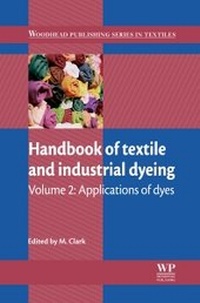
Handbook of Textile and Industrial Dyeing
Volume 2: Applications of Dyes
Published on 25. October 2011
Book
Hardback
344 pages
978-1-84569-696-2 (ISBN)
Description
Dyeing is one of the most effective and popular methods used for colouring textiles and other materials. Dyes are employed in a variety of industries, from cosmetic production to the medical sector. The two volumes of the Handbook of textile and industrial dyeing provide a detailed review of the latest techniques and equipment used in the dyeing industry, as well as examining dyes and their application in a number of different industrial sectors.
Volume 2 deals with major applications of dyes and is divided into two parts. Part one covers textile applications, with chapters dealing with the dyeing of wool, synthetic and cellulosic fibres, and textile fibre blends. In part two, industrial applications of dyes are examined, with topics including dyes used in food and in the cosmetics industry.
With its distinguished editor and contributions from some of the world's leading authorities, the Handbook of textile and industrial dyeing is an essential reference for designers, colour technologists and product developers working in a variety of sectors, and will also be suitable for academic use.
Volume 2 deals with major applications of dyes and is divided into two parts. Part one covers textile applications, with chapters dealing with the dyeing of wool, synthetic and cellulosic fibres, and textile fibre blends. In part two, industrial applications of dyes are examined, with topics including dyes used in food and in the cosmetics industry.
With its distinguished editor and contributions from some of the world's leading authorities, the Handbook of textile and industrial dyeing is an essential reference for designers, colour technologists and product developers working in a variety of sectors, and will also be suitable for academic use.
More details
Series
Language
English
Place of publication
Cambridge
United Kingdom
Publishing group
Elsevier Science & Technology
Target group
College/higher education
Dimensions
Height: 234 mm
Width: 156 mm
Weight
660 gr
ISBN-13
978-1-84569-696-2 (9781845696962)
Copyright in bibliographic data and cover images is held by Nielsen Book Services Limited or by the publishers or by their respective licensors: all rights reserved.
Schweitzer Classification
Other editions
Additional editions
Handbook of Textile and Industrial Dyeing: Volume 2
Applications of Dyes
E-Book
10/2011
Woodhead Publishing Ltd
€180.00
Available for download
Person
Dr Matthew Clark is a lecturer in the Department of Colour Science at the University of Leeds.
Content
Contributor contact details
Woodhead Publishing Series in Textiles
Part I: Textile applications
Chapter 1: The colouration of wool
Abstract:
1.1 Introduction
1.2 Overview of industry practice
1.3 The theoretical basis of wool dyeing
1.4 Environmental impact of wool colouration processes
1.5 Reactive dyes for wool
1.6 Wool protection during dyeing by using reactive dyes and/or anti-setting agents
1.7 Ink-jet printing of wool fabrics
Chapter 2: Dyeing of synthetic fibres
Abstract:
2.1 Introduction
2.2 Mass coloration
2.3 Disperse dyes
2.4 Disperse dyes on acetate fibres
2.5 Disperse dyes on polyester fibres
2.6 Disperse dyes on texturised polyester
2.7 Disperse dyes on modified polyester
2.8 Disperse dyes on nylon
2.9 Disperse dyes on other fibres
2.10 Dyeing of nylon fibres
2.11 Anionic dyes on nylon
2.12 Reactive dyes on nylon
2.13 Dyeing of modified nylons
2.14 Dyeing of aramid fibres
2.15 Basic or cationic dyes
2.16 Dyeing of acrylic fibres with basic dyes
2.17 Dyeing of olefin fibres
2.18 Dyeing of elastomeric fibres
2.19 Future trends
Chapter 3: Dyeing of cellulosic fibres
Abstract:
3.1 Introduction
3.2 Cellulosic fibres
3.3 Main methods of dyeing cellulosic fibres
3.4 Future trends
Chapter 4: Dyeing of textile fibre blends
Abstract
4.1 Introduction
4.2 Key fibre blends
4.3 Dyeing of textile blends
4.4 Main dyeing methods
4.5 Future trends
4.6 Sources of further information and advice
4.7 Acknowledgement
Part II: Industrial applications
Chapter 5: Colourants and dyes for the cosmetics industry
Abstract:
5.1 Introduction
5.2 Regulations and definitions
5.3 Raw material types and chemistry
5.4 Product types
5.5 Future trends
Chapter 6: Dyes for the medical industry
Abstract:
6.1 Introduction
6.2 Dyes for indication
6.3 Dyes as colourants in medicines
6.4 Dyes for therapy
6.5 Medical photosensitisers
6.6 Potential adverse effects of dyes
6.7 Future prospects
Chapter 7: Automotive dyes and pigments
Abstract:
7.1 Introduction
7.2 Key issues of automotive dyes and pigments
7.3 Major pigment types used in automotive coatings
7.4 Techniques commonly used to improve the technical performance of pigments
7.5 Application technology
7.6 Future trends in automotive pigments
Chapter 8: Food colourants
Abstract:
8.1 Introduction
8.2 UK and EU legislation
8.3 Synthetic food colours
8.4 Illegal dyes
8.5 Natural dyes
8.6 Conclusions
8.7 Acknowledgements
Index
Woodhead Publishing Series in Textiles
Part I: Textile applications
Chapter 1: The colouration of wool
Abstract:
1.1 Introduction
1.2 Overview of industry practice
1.3 The theoretical basis of wool dyeing
1.4 Environmental impact of wool colouration processes
1.5 Reactive dyes for wool
1.6 Wool protection during dyeing by using reactive dyes and/or anti-setting agents
1.7 Ink-jet printing of wool fabrics
Chapter 2: Dyeing of synthetic fibres
Abstract:
2.1 Introduction
2.2 Mass coloration
2.3 Disperse dyes
2.4 Disperse dyes on acetate fibres
2.5 Disperse dyes on polyester fibres
2.6 Disperse dyes on texturised polyester
2.7 Disperse dyes on modified polyester
2.8 Disperse dyes on nylon
2.9 Disperse dyes on other fibres
2.10 Dyeing of nylon fibres
2.11 Anionic dyes on nylon
2.12 Reactive dyes on nylon
2.13 Dyeing of modified nylons
2.14 Dyeing of aramid fibres
2.15 Basic or cationic dyes
2.16 Dyeing of acrylic fibres with basic dyes
2.17 Dyeing of olefin fibres
2.18 Dyeing of elastomeric fibres
2.19 Future trends
Chapter 3: Dyeing of cellulosic fibres
Abstract:
3.1 Introduction
3.2 Cellulosic fibres
3.3 Main methods of dyeing cellulosic fibres
3.4 Future trends
Chapter 4: Dyeing of textile fibre blends
Abstract
4.1 Introduction
4.2 Key fibre blends
4.3 Dyeing of textile blends
4.4 Main dyeing methods
4.5 Future trends
4.6 Sources of further information and advice
4.7 Acknowledgement
Part II: Industrial applications
Chapter 5: Colourants and dyes for the cosmetics industry
Abstract:
5.1 Introduction
5.2 Regulations and definitions
5.3 Raw material types and chemistry
5.4 Product types
5.5 Future trends
Chapter 6: Dyes for the medical industry
Abstract:
6.1 Introduction
6.2 Dyes for indication
6.3 Dyes as colourants in medicines
6.4 Dyes for therapy
6.5 Medical photosensitisers
6.6 Potential adverse effects of dyes
6.7 Future prospects
Chapter 7: Automotive dyes and pigments
Abstract:
7.1 Introduction
7.2 Key issues of automotive dyes and pigments
7.3 Major pigment types used in automotive coatings
7.4 Techniques commonly used to improve the technical performance of pigments
7.5 Application technology
7.6 Future trends in automotive pigments
Chapter 8: Food colourants
Abstract:
8.1 Introduction
8.2 UK and EU legislation
8.3 Synthetic food colours
8.4 Illegal dyes
8.5 Natural dyes
8.6 Conclusions
8.7 Acknowledgements
Index