

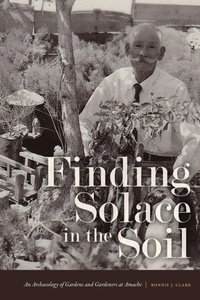
Finding Solace in the Soil
An Archaeology of Gardens and Gardeners at Amache
Published on 7. April 2022
Book
Paperback/Softback
224 pages
978-1-64642-337-8 (ISBN)
Description
Finding Solace in the Soil tells the largely unknown story of the gardens of Amache, the War Relocation Authority incarceration camp in Colorado. Combining physical evidence with oral histories and archival data and enriched by the personal photographs and memories of former Amache incarcerees, the book describes how gardeners cultivated community in confinement.
Before incarceration, many at Amache had been farmers, gardeners, or nursery workers. Between 1942 and 1945, they applied their horticultural expertise to the difficult high plains landscape of southeastern Colorado. At Amache they worked to form microclimates, reduce blowing sand, grow better food, and achieve stability and preserve community at a time of dehumanizing dispossession. In this book archaeologist Bonnie J. Clark examines botanical data like seeds, garden-related artifacts, and other material evidence found at Amache, as well as oral histories from survivors and archival data including personal letters and government records, to recount how the prisoners of Amache transformed the harsh military setting of the camp into something resembling a town. She discusses the varieties of gardens found at the site, their place within Japanese and Japanese American horticultural traditions, and innovations brought about by the creative use of limited camp resources.
The gardens were regarded by the incarcerees as a gift to themselves and to each other. And they were also, it turns out, a gift to the future as repositories of generational knowledge where a philosophical stance toward nature was made manifest through innovation and horticultural skill. Framing the gardens and gardeners of Amache within the larger context of the incarceration of Japanese Americans and of recent scholarship on displacement and confinement, Finding Solace in the Soil will be of interest to gardeners, historical archaeologists, landscape archaeologists, cultural anthropologists, and scholars of Japanese American history and horticultural history.
Before incarceration, many at Amache had been farmers, gardeners, or nursery workers. Between 1942 and 1945, they applied their horticultural expertise to the difficult high plains landscape of southeastern Colorado. At Amache they worked to form microclimates, reduce blowing sand, grow better food, and achieve stability and preserve community at a time of dehumanizing dispossession. In this book archaeologist Bonnie J. Clark examines botanical data like seeds, garden-related artifacts, and other material evidence found at Amache, as well as oral histories from survivors and archival data including personal letters and government records, to recount how the prisoners of Amache transformed the harsh military setting of the camp into something resembling a town. She discusses the varieties of gardens found at the site, their place within Japanese and Japanese American horticultural traditions, and innovations brought about by the creative use of limited camp resources.
The gardens were regarded by the incarcerees as a gift to themselves and to each other. And they were also, it turns out, a gift to the future as repositories of generational knowledge where a philosophical stance toward nature was made manifest through innovation and horticultural skill. Framing the gardens and gardeners of Amache within the larger context of the incarceration of Japanese Americans and of recent scholarship on displacement and confinement, Finding Solace in the Soil will be of interest to gardeners, historical archaeologists, landscape archaeologists, cultural anthropologists, and scholars of Japanese American history and horticultural history.
Reviews / Votes
"Finding Solace in the Soil breaks new ground in its informed discussion of camp gardens and equally of the process of archeological reconstruction-a means still uncommon for exploring the recent past. Bonnie Clark's novel methodology and collection of data leads to persuasive findings."-Greg Robinson, Universite du Quebec a Montreal
"Bonnie J. Clark has done an amazing job of transforming artifacts from the past into real life points of discussion for the present. . . . a fascinating and complex examination."
-International Examiner
More details
Language
English
Place of publication
Colorado
United States
Target group
Professional and scholarly
Interest Age: From 18 to 99 years
Product notice
Paperback (trade)
Dimensions
Height: 229 mm
Width: 152 mm
Thickness: 12 mm
Weight
307 gr
ISBN-13
978-1-64642-337-8 (9781646423378)
Copyright in bibliographic data and cover images is held by Nielsen Book Services Limited or by the publishers or by their respective licensors: all rights reserved.
Schweitzer Classification
Person
Bonnie J. Clark is professor and curator for archaeology in the University of Denver's Anthropology Department. Since 2005 her primary research focus has been the DU Amache Project, a collaborative endeavor committed to preserving, researching, and interpreting the tangible remains of Amache, the World War II Japanese American incarceration camp in Colorado. She is coeditor of Archaeological Landscapes on the High Plains and coauthor of Denver: An Archaeological History.