

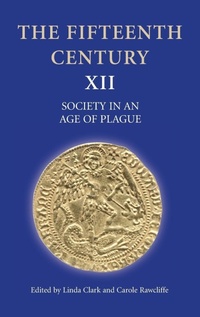
The Fifteenth Century XII
Society in an Age of Plague
Published on 15. August 2013
Book
Hardback
241 pages
978-1-84383-875-3 (ISBN)
Description
Essays address plague and disease in the fifteenth century, as manifested throughout Europe.
Described as "a golden age of pathogens", the long fifteenth century was notable for a series of international, national and regional epidemics that had a profound effect upon the fabric of society. The impact of pestilence upon the literary, religious, social and political life of men, women and children throughout Europe and beyond continues to excite lively debate among historians, as the ten papers presented in this volume confirm. They deal with theresponse of urban communities in England, France and Italy to matters of public health, governance and welfare, as well as addressing the reactions of the medical profession to successive outbreaks of disease, and of individuals to the omnipresence of death, while two, very different, essays examine the important, if sometimes controversial, contribution now being made by microbiologists to our understanding of the Black Death.
Contributors: J.L. Bolton, Elma Brenner, Samuel Cohn, John Henderson, Neil Murphy, Elizabeth Rutledge, Samantha Sagui, Karen Smyth, Jane Stevens Crawshaw, Sheila Sweetinburgh.
Described as "a golden age of pathogens", the long fifteenth century was notable for a series of international, national and regional epidemics that had a profound effect upon the fabric of society. The impact of pestilence upon the literary, religious, social and political life of men, women and children throughout Europe and beyond continues to excite lively debate among historians, as the ten papers presented in this volume confirm. They deal with theresponse of urban communities in England, France and Italy to matters of public health, governance and welfare, as well as addressing the reactions of the medical profession to successive outbreaks of disease, and of individuals to the omnipresence of death, while two, very different, essays examine the important, if sometimes controversial, contribution now being made by microbiologists to our understanding of the Black Death.
Contributors: J.L. Bolton, Elma Brenner, Samuel Cohn, John Henderson, Neil Murphy, Elizabeth Rutledge, Samantha Sagui, Karen Smyth, Jane Stevens Crawshaw, Sheila Sweetinburgh.
Reviews / Votes
A thought-provoking collection of articles. * ARCHIVES * Interesting and important. * THE RICARDIAN * These essays offer an interesting glimpse of how the century after the Black Death continued to acknowledge, respond to, plan for and generally live with this waxing and waning threat. * SOCIAL HISTORY OF MEDICINE * Aid[s] our understanding of [plague] and its human responses and will be a welcome addition to any medical history library. * VESALIUS * [O]ffers a good overview to the types of social and institutional challenges that medieval Europeans faced with regular outbreaks of plague and other disease. . . . Those teaching advanced-level courses on the Black Death, medical history, or medieval public health will find the volume useful for themselves as well as their students. * SPECULUM *More details
Series
Language
English
Place of publication
Woodbridge
United Kingdom
Publishing group
Boydell & Brewer Ltd
Target group
Professional and scholarly
Product notice
Cloth over boards
Illustrations
4 s/w Abbildungen, 6 s/w Zeichnungen
4 b/w, 6 line illus.
Dimensions
Height: 240 mm
Width: 161 mm
Thickness: 18 mm
Weight
531 gr
ISBN-13
978-1-84383-875-3 (9781843838753)
Copyright in bibliographic data and cover images is held by Nielsen Book Services Limited or by the publishers or by their respective licensors: all rights reserved.
Schweitzer Classification
Other editions
Additional editions
E-Book
08/2013
1st Edition
De Gruyter
€48.99
Available for download
Persons
LINDA CLARK is Editor Emeritus at the History of Parliament. NEIL MURPHY is Professor of Medieval and Early Modern History at Northumbria University. Sheila Sweetinburgh is a Principal Research Fellow in the Centre for Kent History and Heritage at Canterbury Christ Church University and editor of Early Medieval Kent, 800-1220 (Boydell, 2016) and Later Medieval Kent, 1220-1540 (Boydell, 2018).
Content
Introduction - Carole Rawcliffe
Looking for Yersinia Pestis: Scientists, Historians and the Black Death - Jim L Bolton
Pestilence and Poetry: John Lydgate's Danse Macabre - Karen Smyth
Pilgrimage in 'an Age of Plague': Seeking Canterbury's 'hooly blisful martir' in 1420 and 1470 - Sheila Sweetinburgh
An Urban Environment: Norwich in the Fifteenth Century - Elizabeth Rutledge
Mid-Level Officials in Fifteenth-Century Norwich - Samantha Sagui
Leprosy and Public Health in Late Medieval Rouen - Elma Brenner
Plague Ordinances and the Management of Infectious Diseases in Northern French Towns, c.1450 - c.1560 - Neil Murphy
The Renaissance Invention of Quarantine - Jane Stevens Crawshaw
Coping with Epidemics in Renaissance Italy: Plague and the Great Pox - John Henderson
The Historian and the Laboratory: The Black Death Disease - Samuel K. Cohn
Looking for Yersinia Pestis: Scientists, Historians and the Black Death - Jim L Bolton
Pestilence and Poetry: John Lydgate's Danse Macabre - Karen Smyth
Pilgrimage in 'an Age of Plague': Seeking Canterbury's 'hooly blisful martir' in 1420 and 1470 - Sheila Sweetinburgh
An Urban Environment: Norwich in the Fifteenth Century - Elizabeth Rutledge
Mid-Level Officials in Fifteenth-Century Norwich - Samantha Sagui
Leprosy and Public Health in Late Medieval Rouen - Elma Brenner
Plague Ordinances and the Management of Infectious Diseases in Northern French Towns, c.1450 - c.1560 - Neil Murphy
The Renaissance Invention of Quarantine - Jane Stevens Crawshaw
Coping with Epidemics in Renaissance Italy: Plague and the Great Pox - John Henderson
The Historian and the Laboratory: The Black Death Disease - Samuel K. Cohn