

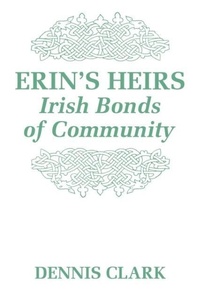
Erin's Heirs
Irish Bonds of Community
Published on 4. November 2009
Book
Paperback/Softback
250 pages
978-0-8131-9294-9 (ISBN)
Description
"They will melt like snowflakes in the sun," said one observer of nineteenth-century Irish emigrants to America. Not only did they not melt, they formed one of the most extensive and persistent ethnic subcultures in American history. Dennis Clark now offers an insightful analysis of the social means this group has used to perpetuate its distinctiveness amid the complexity of American urban life.
Basing his study on family stories, oral interviews, organizational records, census data, radio scripts, and the recollections of revolutionaries and intellectuals, Clark offers an absorbing panorama that shows how identity, organization, communication, and leadership have combined to create the Irish-American tradition. In his pages we see gifted storytellers, tough dockworkers, scribbling editors, and colorful actresses playing their roles in the Irish-American saga.
As Clark shows, the Irish have defended and extended their self-image by cultivating their ethnic identity through transmission of family memories and by correcting community portrayals of themselves in the press and theatre. They have strengthened their ethnic ties by mutual association in the labor force and professions and in response to social problems. And they have created a network of communications ranging from 150 years of Irish newspapers to America's longest-running ethnic radio show and a circuit of university teaching about Irish literature and history. From this framework of subcultural activity has arisen a fascinating gallery of leadership that has expressed and symbolized the vitality of the Irish-American experience.
Although Clark draws his primary material from Philadelphia, he relates it to other cities to show that even though Irish communities have differed they have shared common fundamentals of social development. His study constitutes a pathbreaking theoretical explanation of the dynamics of Irish-American life.
Basing his study on family stories, oral interviews, organizational records, census data, radio scripts, and the recollections of revolutionaries and intellectuals, Clark offers an absorbing panorama that shows how identity, organization, communication, and leadership have combined to create the Irish-American tradition. In his pages we see gifted storytellers, tough dockworkers, scribbling editors, and colorful actresses playing their roles in the Irish-American saga.
As Clark shows, the Irish have defended and extended their self-image by cultivating their ethnic identity through transmission of family memories and by correcting community portrayals of themselves in the press and theatre. They have strengthened their ethnic ties by mutual association in the labor force and professions and in response to social problems. And they have created a network of communications ranging from 150 years of Irish newspapers to America's longest-running ethnic radio show and a circuit of university teaching about Irish literature and history. From this framework of subcultural activity has arisen a fascinating gallery of leadership that has expressed and symbolized the vitality of the Irish-American experience.
Although Clark draws his primary material from Philadelphia, he relates it to other cities to show that even though Irish communities have differed they have shared common fundamentals of social development. His study constitutes a pathbreaking theoretical explanation of the dynamics of Irish-American life.
More details
Language
English
Place of publication
Lexington
United States
Target group
Professional and scholarly
Product notice
Paperback (trade)
Unsewn / adhesive bound
Dimensions
Height: 229 mm
Width: 152 mm
Thickness: 14 mm
Weight
390 gr
ISBN-13
978-0-8131-9294-9 (9780813192949)
Copyright in bibliographic data and cover images is held by Nielsen Book Services Limited or by the publishers or by their respective licensors: all rights reserved.
Schweitzer Classification
Person
Dennis Clark has written a number of books and many studies on immigrant and urban history.