

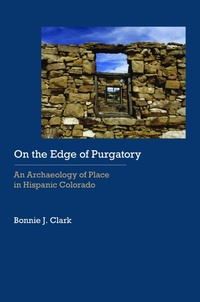
On the Edge of Purgatory
An Archaeology of Place in Hispanic Colorado
Published on 1. January 2012
Book
Hardback
176 pages
978-0-8032-1372-2 (ISBN)
Description
Southeastern Colorado was known as the northernmost boundary of New Spain in the sixteenth century. By the late 1800s, the region was U.S. territory, but the majority of settlers remained Hispanic families. They had a complex history of interaction with indigenous populations in the area and adopted many of the indigenous methods of survival in this difficult environment. Today their descendants compose a vocal part of the Hispanic population of Colorado.
Bonnie J. Clark investigates the unwritten history of this unique Hispanic population. Combining archaeological research, contemporary ethnography, and oral and documentary history, Clark examines the everyday lives of this population over time. Framing this discussion within the wider context of the changing economic and political processes at work, Clark looks at how changing and contesting ethnic and gender identities were experienced on a daily basis. Providing new insights into the construction of ethnic identity in the American West over hundreds of years, this study complicates and enriches our understanding of the role of Hispanic populations in the West.
Bonnie J. Clark investigates the unwritten history of this unique Hispanic population. Combining archaeological research, contemporary ethnography, and oral and documentary history, Clark examines the everyday lives of this population over time. Framing this discussion within the wider context of the changing economic and political processes at work, Clark looks at how changing and contesting ethnic and gender identities were experienced on a daily basis. Providing new insights into the construction of ethnic identity in the American West over hundreds of years, this study complicates and enriches our understanding of the role of Hispanic populations in the West.
Reviews / Votes
"Bonnie J. Clark offers a concise, dense, and richly textured account of daily life in the late-nineteenth-century Hispanic settlements of rural southeastern Colorado."-Kelly L. Jenks, Center for Colorado and the West "History buffs in comfortable armchairs will enjoy learning about the activities of other historical societies around the state, like tiny Aguilar's south of Walsenburg. Not to mention the scholars who will welcome Bonnie J. Clark's On the Edge of Purgatory as a model for the serious study of people and places."-Virginia Simmons, Colorado Central Magazine "A new and reinvigorated scholarship on the archaeology of nineteenth-century Hispanic Americans in the American Southwest is emerging, and On the Edge of Purgatory by Bonnie Clark is a significant contribution."-J. Andrew Darling, Journal of Anthropological ResearchMore details
Series
Language
English
Place of publication
Lincoln
United States
Target group
Professional and scholarly
College/higher education
Product notice
Cloth over boards
Illustrations
26 illustrations, 6 maps, 6 tables
Dimensions
Height: 231 mm
Width: 150 mm
Thickness: 23 mm
Weight
358 gr
ISBN-13
978-0-8032-1372-2 (9780803213722)
Copyright in bibliographic data and cover images is held by Nielsen Book Services Limited or by the publishers or by their respective licensors: all rights reserved.
Schweitzer Classification
Person
Bonnie J. Clark is an associate professor of anthropology at the University of Denver. She is coauthor of several books, including Archaeological Landscapes on the High Plains, Denver: An Archaeological History, and Colorado Prehistory: A Context for the Platte River Basin.
Content
List of Illustrations
List of Maps
List of Tables
Acknowledgments
Introduction: Finding Purgatory
Chapter 1. Hispanic Colorado
Chapter 2. Inhabiting the Lower Purgatory
Chapter 3. Making a Living and a Life
Chapter 4. Plazas and Community
Chapter 5. Lessons from the Landscape
Conclusion: The Archaeology of Places
References Cited
Index
List of Maps
List of Tables
Acknowledgments
Introduction: Finding Purgatory
Chapter 1. Hispanic Colorado
Chapter 2. Inhabiting the Lower Purgatory
Chapter 3. Making a Living and a Life
Chapter 4. Plazas and Community
Chapter 5. Lessons from the Landscape
Conclusion: The Archaeology of Places
References Cited
Index