


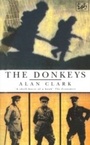
The Donkeys
Published on 12. December 1991
Book
Paperback/Softback
240 pages
978-0-7126-5035-9 (ISBN)
Description
The landmark expose of incompetent leadership on the Western Front - why the British troops were lions led by donkeys
On 26 September 1915, twelve British battalions - a strength of almost 10,000 men - were ordered to attack German positions in France. In the three-and-a-half hours of the battle, they sustained 8,246 casualties. The Germans suffered no casualties at all.
Why did the British Army fail so spectacularly? What can be said of the leadership of generals? And most importantly, could it have all been prevented? In The Donkeys, eminent military historian Alan Clark scrutinises the major battles of that fateful year and casts a steady and revealing light on those in High Command - French, Rawlinson, Watson and Haig among them - whose orders resulted in the virtual destruction of the old professional British Army. Clark paints a vivid and convincing picture of how brave soldiers, the lions, were essentially sent to their deaths by incompetent and indifferent officers - the donkeys.
'An eloquent and painful book... Clark leaves the impression that vanity and stupidity were the main ingredients of the massacres of 1915. He writes searingly and unforgettably' Evening Standard
On 26 September 1915, twelve British battalions - a strength of almost 10,000 men - were ordered to attack German positions in France. In the three-and-a-half hours of the battle, they sustained 8,246 casualties. The Germans suffered no casualties at all.
Why did the British Army fail so spectacularly? What can be said of the leadership of generals? And most importantly, could it have all been prevented? In The Donkeys, eminent military historian Alan Clark scrutinises the major battles of that fateful year and casts a steady and revealing light on those in High Command - French, Rawlinson, Watson and Haig among them - whose orders resulted in the virtual destruction of the old professional British Army. Clark paints a vivid and convincing picture of how brave soldiers, the lions, were essentially sent to their deaths by incompetent and indifferent officers - the donkeys.
'An eloquent and painful book... Clark leaves the impression that vanity and stupidity were the main ingredients of the massacres of 1915. He writes searingly and unforgettably' Evening Standard
Reviews / Votes
A shell-burst of a book * The Economist * An eloquent and painful book... Clark leaves the impression that vanity and stupidity were the main ingredients of the massacres of 1915. He writes searingly and unforgettably -- George Malcolm Thomson * Evening Standard * Mr Clark writes with verve, venom and real feeling for the men whose lives the brasshats squandered -- Paul Johnson * New Statesman * So far from being "just another war book" that it is likely to be bought and read for years to come -- Vernon Fane * Sphere * He is a writer with considerable gifts both of description and narrative. His subject gives them plenty of scope; indeed his descriptions of battles and battlefields are sometimes masterly -- Michael Howard * Listener *More details
Language
English
Place of publication
London
United Kingdom
Publishing group
Vintage
Product notice
Paperback (UK-trade)
Dimensions
Height: 216 mm
Width: 135 mm
Thickness: 15 mm
Weight
332 gr
ISBN-13
978-0-7126-5035-9 (9780712650359)
Copyright in bibliographic data and cover images is held by Nielsen Book Services Limited or by the publishers or by their respective licensors: all rights reserved.
Schweitzer Classification
Other editions
Additional editions
Person
Alan Clark was educated at Eton and Christ Church, Oxford. He served in the Household Cavalry before qualifying for the Bar in 1955. In 1974 he became Conservative MP for Plymouth Sutton and went on to hold a number of ministerial posts. He wrote several works of military history: The Fall of Crete, Barbarossa: The Russo-German Conflict 1941-45 and Aces High: The War in the Air over the Western Front. He also published his Diaries. Alan Clark died in 1999.