

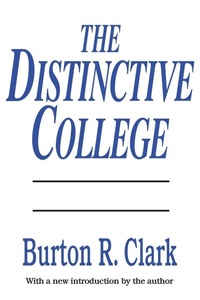
The Distinctive College
Antioch, Reed, and Swathmore
2nd Edition
Published on 30. January 1992
Book
Paperback/Softback
294 pages
978-1-56000-592-6 (ISBN)
Description
The factors contributing to the greatness of a first-rank liberal arts college are difficult to analyze. Hidden from view in the mysteries of tradition and institutional aura, the insistent questions remain: How has it been done? Can it still be done? In an intensive analysis of three highly regarded liberal arts colleges, Burton R. Clark uses a developmental approach to formal organization to seek out answers to these questions.
The author begins with a presentation of the historical development of three colleges, Antioch, Reed, and Swarthmore. He describes in detail how broad institutional innovations were introduced and made to endure. He then carefully notes the unique events, special conditions, and unusual features that are the components of each institution's fabric. Each of the three narratives is guided by comparative categories, that produce analytical and theoretical insights into organizational development.
From the above data Clark develops the concept of the "organizational saga" as the central ingredient in the making of the distinctive college. He explains this concept in terms of organizational role and mission, using the historical narratives of the first section to suggest the bases for the development of sagas.
In its empirical findings and conceptual formulations, The Distinctive College, first published in 1970, has played an important role in the analysis and understanding of college culture in contemporary America. It is a study of leadership, as well as an examination of how values are realized in the everyday routine of participants in the life of educational organizations. It remains the premier sociological study of institution building in American higher education.
The author begins with a presentation of the historical development of three colleges, Antioch, Reed, and Swarthmore. He describes in detail how broad institutional innovations were introduced and made to endure. He then carefully notes the unique events, special conditions, and unusual features that are the components of each institution's fabric. Each of the three narratives is guided by comparative categories, that produce analytical and theoretical insights into organizational development.
From the above data Clark develops the concept of the "organizational saga" as the central ingredient in the making of the distinctive college. He explains this concept in terms of organizational role and mission, using the historical narratives of the first section to suggest the bases for the development of sagas.
In its empirical findings and conceptual formulations, The Distinctive College, first published in 1970, has played an important role in the analysis and understanding of college culture in contemporary America. It is a study of leadership, as well as an examination of how values are realized in the everyday routine of participants in the life of educational organizations. It remains the premier sociological study of institution building in American higher education.
More details
Series
Edition
2nd edition
Language
English
Place of publication
New York
United States
Publishing group
Taylor & Francis Inc
Target group
College/higher education
Professional and scholarly
Dimensions
Height: 229 mm
Width: 152 mm
Thickness: 16 mm
Weight
432 gr
ISBN-13
978-1-56000-592-6 (9781560005926)
Copyright in bibliographic data and cover images is held by Nielsen Book Services Limited or by the publishers or by their respective licensors: all rights reserved.
Schweitzer Classification
Other editions
Additional editions
Book
09/2017
2nd Edition
Routledge
€231.20
Shipment within 10-20 days
E-Book
09/2017
2nd Edition
Routledge
€65.99
Available for download
E-Book
09/2017
2nd Edition
Routledge
€65.99
Available for download
Person
Burton R. Clark
Content
1: Zooming In (and Out) on Social Problems; 2: The Landscape of Domestic Violence and the Public's Narrow Picture; 3: "I Get My Experience from the Media": Using Media to Understand Social Problems; 4: Women's Magazines: The Victim Empowerment Frame; 5: Social Problems As Inspiration, Entertainment, and Emotion: Women's Magazines and Other Entertainment Media; 6: Men's and Conservative Political Magazines: The Antifeminist Frame; 7: Liberal Political Magazines: The Social Justice Frame; 8: Framing the Victim; 9: In Search of a New Social Problem about Violence