

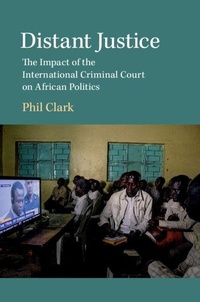
Distant Justice
The Impact of the International Criminal Court on African Politics
Published on 8. November 2018
Book
Paperback/Softback
392 pages
978-1-108-46337-9 (ISBN)
Description
There are a number of controversies surrounding the International Criminal Court (ICC) in Africa. Critics have charged it with neo-colonial meddling in African affairs, accusing it of undermining national sovereignty and domestic attempts to resolve armed conflict. Here, based on 650 interviews over 11 years, Phil Clark critically assesses the politics of the ICC in Uganda and the Democratic Republic of Congo, focusing particularly on the Court's multi-level impact on national politics and the lives of everyday citizens. He explores the ICC's effects on peace negotiations, national elections, domestic judicial reform, amnesty processes, combatant demobilisation and community-level accountability and reconciliation. In attempting to distance itself from African conflict zones geographically, philosophically and procedurally, Clark also reveals that the ICC has become more politicised and damaging to African polities, requiring a substantial rethink of the approaches and ideas that underpin the ICC's practice of distant justice.
Reviews / Votes
'Many people talk about the effects of the International Criminal Court in Africa, but Phil Clark is easily the most learned and therefore qualified to do so. His careful and lucid investigation of how justice from afar has transformed local politics is a thrilling achievement.' Samuel Moyn, Yale University, Connecticut 'Meticulously researched and engagingly written, Distant Justice is a must-read for anyone seeking to understand the vexed relationship between the International Criminal Court and African governments. Phil Clark mounts a compelling critique of the ICC's complicated entanglements in Africa and advises caution regarding what international legal responses to mass atrocities can usefully accomplish.' Richard Ashby Wilson, author of Incitement on Trial: Prosecuting International Speech Crimes 'Phil Clark has written the definitive book on Africa and the International Criminal Court. Distant Justice has it all - extensive research, vivid interviews, creative insights, gentle lessons, and an upbeat cadence. With laser-sharp focus, Clark exposes the limits of international law. And with energetic optimism, he shows how law can do better.' Mark A. Drumbl, Washington and Lee University, Virginia 'This book took 11 years in the writing and it was worth the wait. Phil Clark confirms his reputation as amongst the best Africanist scholars writing on transitional justice. Distant Justice is empirically grounded - the lived experiences of over 650 interviewees shine through. It is also theoretically rich and beautifully written. If you want to understand the relationship between justice, politics and international relations in Africa, read it. It's a tour de force.' Kieran McEvoy, Queen's University Belfast 'In Distant Justice, Phil Clark has written an epochal work on the ICC. He allows the facts and the evidence to speak without political varnish. Clark appropriately indicts the ICC for being an imperial project that's tone deaf about its deficits. However, he pleads for deep reforms and correctly rejects the arguments to throw the baby out with the bathwater.' Makau Mutua, State University of New York 'Few international institutions - not even that old bete noir, the International Monetary Fund - have drawn as much political ire in Africa as the ICC. Needless to say, the reasons are varied and intricate. By focusing on the issue of 'distance' Phil Clark's far-reaching examination of the ICC in Africa offers new and interesting perspectives on why the relationship is so conflicted and dysfunctional. It also critically re-engages with the phenomenon of 'justice' as (mis)understood across borders and cultures. Distant Justice is a highly-nuanced, deeply researched and wide-ranging exploration of the intersection between international institutions, domestic (and regional) politics and on-the-ground perspectives of ordinary individuals about a phenomenon of such critical relevance to contemporary society.' J. Oloka-Onyango, author of When Courts do PoliticsMore details
Language
English
Place of publication
Cambridge
United Kingdom
Target group
College/higher education
Professional and scholarly
Product notice
Paperback (trade)
Illustrations
Worked examples or Exercises
Dimensions
Height: 229 mm
Width: 152 mm
Thickness: 22 mm
Weight
569 gr
ISBN-13
978-1-108-46337-9 (9781108463379)
Copyright in bibliographic data and cover images is held by Nielsen Book Services Limited or by the publishers or by their respective licensors: all rights reserved.
Schweitzer Classification
Other editions
Additional editions
Book
11/2018
Cambridge University Press
€133.70
Shipment within 15-20 days
E-Book
10/2018
Cambridge University Press
€29.49
Available for download
Person
Phil Clark is a Reader in Comparative and International Politics at School of Oriental and African Studies, University of London. He specialises in conflict and post-conflict issues in Africa, including transitional justice, peacebuilding and reconciliation. He is also a senior research fellow at the School of Leadership at the University of Johannesburg. Previously, Dr Clark was the co-founder and convenor of Oxford Transitional Justice Research and established the Research, Policy and Higher Education programme at the Aegis Trust Rwanda. His articles have featured in the Guardian, The New York Times, the BBC and CNN websites, Foreign Affairs, Times Higher Education Supplement, Prospect, Dissent, The East African, the Australian and the Huffington Post. His last book was The Gacaca Courts, Post-Genocide Justice and Reconciliation in Rwanda: Justice without Lawyers (Cambridge, 2010). He holds a doctorate in Politics from the University of Oxford, where he studied as a Rhodes Scholar.
Content
1. Introduction: the warlord in the forecourt; 2. Court between two poles: conceptualising 'complementarity' and 'distance'; 3. Who pulls the strings? The ICC's relations with states; 4. In whose name? The ICC's relations with affected communities; 5. When courts collide: the ICC and domestic prosecutions; 6. Peace versus justice Redux: the ICC, amnesties and peace negotiations; 7. The ICC and community-based responses to atrocity; 8. Continental patterns: assessing the ICC's impact in the remaining African situations; 9. Conclusion: narrowing the distance.