

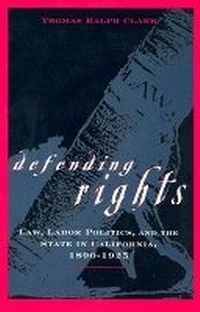
Defending Rights
Law, Labor Politics and the State in California, 1890-1925
Published on 1. November 2002
Book
Hardback
224 pages
978-0-8143-3043-2 (ISBN)
Description
In ongoing efforts to understand the "exceptionalism" of the American labor movement, historians have proposed a reason why American unions never fully embraced the independent and social democratic politics of their European counterparts: a hostile legal system, they argue, fostered a deep distrust of state intervention among early labor leaders. Thomas Clark joins revisionists in questioning this "apolitical" and "antistatist" characterization of the early labor movement, but from a new perspective. By focusing on law and labor activity at the state level rather than the national level and using California as his case study, Clark shows how legal hostility pushed labor into politics on a local level with greater urgency and failed to compel labor to oppose state intervention more generally. Focusing on California provides Clark a unique opportunity to investigate the law's impact in two different settings - "closed shop" San Francisco and "open shop" Los Angeles - within the parameters of a single state legal system.
Clark describes how local court and police hostility pushed labor into periodic experiments with third-party politics, and, as in San Francisco, sometimes helped labor achieve some measure of control over the police. Since employers could still turn to state courts for injunctions, unions began an anti-injunction campaign through interest-group lobbying and building coalitions with Progressive reformers. As it sought to limit state intervention in labor disputes, the movement still pursued an array of state-sponsored reforms. Such approaches to law and politics, argues Clark, forecast the labor-liberal alliance that would become the hallmark of the New Deal coalition.
Clark describes how local court and police hostility pushed labor into periodic experiments with third-party politics, and, as in San Francisco, sometimes helped labor achieve some measure of control over the police. Since employers could still turn to state courts for injunctions, unions began an anti-injunction campaign through interest-group lobbying and building coalitions with Progressive reformers. As it sought to limit state intervention in labor disputes, the movement still pursued an array of state-sponsored reforms. Such approaches to law and politics, argues Clark, forecast the labor-liberal alliance that would become the hallmark of the New Deal coalition.
More details
Language
English
Place of publication
Detroit, MI
United States
Target group
College/higher education
Professional and scholarly
Dimensions
Height: 229 mm
Width: 152 mm
ISBN-13
978-0-8143-3043-2 (9780814330432)
Copyright in bibliographic data and cover images is held by Nielsen Book Services Limited or by the publishers or by their respective licensors: all rights reserved.
Schweitzer Classification
Person
Thomas R. Clark is a lecturer in the Department of History at California State University, Sacramento.