

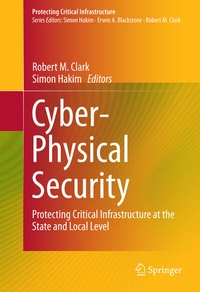
Cyber-Physical Security
Protecting Critical Infrastructure at the State and Local Level
Published on 18. August 2016
Book
Hardback
XVIII, 281 pages
978-3-319-32822-5 (ISBN)
Description
This book focuses on the vulnerabilities of state and local services to cyber-threats and suggests possible protective action that might be taken against such threats. Cyber-threats to U.S. critical infrastructure are of growing concern to policymakers, managers and consumers. Information and communications technology (ICT) is ubiquitous and many ICT devices and other components are interdependent; therefore, disruption of one component may have a negative, cascading effect on others. Cyber-attacks might include denial of service, theft or manipulation of data. Damage to critical infrastructure through a cyber-based attack could have a significant impact on the national security, the economy, and the livelihood and safety of many individual citizens. Traditionally cyber security has generally been viewed as being focused on higher level threats such as those against the internet or the Federal government. Little attention has been paid to cyber-security at the state and local level. However, these governmental units play a critical role in providing services to local residents and consequently are highly vulnerable to cyber-threats. The failure of these services, such as waste water collection and water supply, transportation, public safety, utility services, and communication services, would pose a great threat to the public. Featuring contributions from leading experts in the field, this volume is intended for state and local government officials and managers, state and Federal officials, academics, and public policy specialists.
More details
Series
Edition
1st ed. 2017
Language
English
Place of publication
Cham
Switzerland
Publishing group
Springer International Publishing
Target group
Professional and scholarly
Illustrations
32 farbige Abbildungen
XVIII, 281 p. 32 illus. in color.
Dimensions
Height: 241 mm
Width: 160 mm
Thickness: 22 mm
Weight
617 gr
ISBN-13
978-3-319-32822-5 (9783319328225)
DOI
10.1007/978-3-319-32824-9
Schweitzer Classification
Other editions
Additional editions
Robert M. Clark | Simon Hakim
Cyber-Physical Security
Protecting Critical Infrastructure at the State and Local Level
Book
06/2018
Springer
€106.99
Shipment within 10-15 days
Robert M. Clark | Simon Hakim
Cyber-Physical Security
Protecting Critical Infrastructure at the State and Local Level
E-Book
08/2016
Springer
€96.29
Available for download
Persons
Robert M. Clark is currently an independent consultant in environmental
engineering and public health. He is an Adjunct Professor in Civil and
Environmental Engineering at the University of Cincinnati and recently
completed service as a member of the National Research Council's Committee
on ''Public Water Distribution Systems: Assessing and Reducing Risks.'' As a
consultant Dr. Clark has worked on homeland security issues with Sandia National
Laboratories, the US Environmental Protection Agency (USEPA) and Rutgers
University (Newark Campus), among others. He served as an environmental
engineer in the U.S. Public Health Service and the U.S. EPA from 1961 to August
2002 and was Director of the USEPA's Water Supply and Water Resources
Division (WSWRD) for 14 years (1985-1999). In 1999 he was appointed to a
Senior Expert Position in the USEPA with the title Senior Research Engineering
Advisor and retired from the USEPA in August of 2002. Dr. Clark was a member
of USEPA's Water Protection Task Force and was USEPA's liaison for homeland
security research. Dr. Clark has published over 380 papers and 5 books and has
been professionally active in several organizations where he served in numerous
leadership positions. He is a lifetime member of both the American Water Works
Association (AWWA) and the American Society of Civil Engineers (ASCE).
Dr. Clark is recognized both nationally and internationally and has received
numerous awards for his work. Dr. Clark holds B.S. degrees in Civil Engineering
from Oregon State University (1960), and in Mathematics from Portland State
University (1961), M.S. degrees in Mathematics from Xavier University (1964),
and Civil Engineering from Cornell University (1968) and a Ph.D. in
Environmental Engineering from the University of Cincinnati (1976). He is a
registered engineer in the State of Ohio
Simon Hakim is a professor of economics and director of the Center for Competitive Government at Temple University. He is currently editing a book series on Protecting Critical Infrastructures with Springer Publisher. He earned M.A. and Ph.D. degrees in Regional Science from the University of Pennsylvania. He also holds an M.Sc. degree in City and Regional Planning from the Technion, Israel Institute of Technology, and a B.A. in Economics at Hebrew University in Jerusalem. His special areas of research and teaching are privatization, public policy, private/public police, and homeland security. Dr. Hakim has published 58 scientific articles in leading economic, criminal justice, security, and public policy journals. He has written over 40 professional articles and edited 14 books. He collaborated with Professor Blackstone on a major textbook dealing with the security industry. He is constantly invited to teach classes on privatization, and international economics in MBA programs worldwide. Dr. Hakim has conducted several funded research and consulting projects for the U.S. Departments of Justice and Labor, the Commonwealth Foundation, the Independent Institute, the Alarm Industry Research and Education Foundation, the City of Philadelphia, the Philadelphia International Airport, ADT, Vector Security, and other leading security companies.
Simon Hakim is a professor of economics and director of the Center for Competitive Government at Temple University. He is currently editing a book series on Protecting Critical Infrastructures with Springer Publisher. He earned M.A. and Ph.D. degrees in Regional Science from the University of Pennsylvania. He also holds an M.Sc. degree in City and Regional Planning from the Technion, Israel Institute of Technology, and a B.A. in Economics at Hebrew University in Jerusalem. His special areas of research and teaching are privatization, public policy, private/public police, and homeland security. Dr. Hakim has published 58 scientific articles in leading economic, criminal justice, security, and public policy journals. He has written over 40 professional articles and edited 14 books. He collaborated with Professor Blackstone on a major textbook dealing with the security industry. He is constantly invited to teach classes on privatization, and international economics in MBA programs worldwide. Dr. Hakim has conducted several funded research and consulting projects for the U.S. Departments of Justice and Labor, the Commonwealth Foundation, the Independent Institute, the Alarm Industry Research and Education Foundation, the City of Philadelphia, the Philadelphia International Airport, ADT, Vector Security, and other leading security companies.
Content
Protecting Critical Infrastructure at the State Provincial and Local Level: Issues in Cyber-Physical Security.- Cybersecurity Terminology and Frameworks.- Assessing Cyber Threats and Solutions for Municipalities.- Cyber Perimeters for Critical Infrastructures.- A Security Evaluation of a Municipal Computer Network: The Case of Collaboration between the City of Pittsburgh and Carnegie Mellon University.- Cyber Risks in the Marine Transportation System.- Creating a Cybersecurity Culture for Your Water/Waste Water Utility.- The Community Cyber Security Maturity Model.- Fighting Cybercrime: A Joint Effort.- Cybersecurity Challenges: The Israeli Water Sector Example.- Efforts to Get People Involved In Cyber-Physical Security: Case Studies of Australia And Singapore.- Cyber Security, Trust-Building and Trust-Management: As Tools for Multi-Agency Cooperation within the Functions Vital To SocietyAn Analysis of the Nature of Spam as Cybercrime.- Securing theAutomotive Critical Infrastructure