

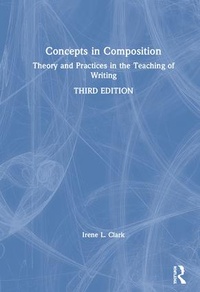
Concepts in Composition
Theory and Practices in the Teaching of Writing
3rd Edition
Published on 3. June 2019
Book
Hardback
466 pages
978-1-138-08864-1 (ISBN)
Description
Concepts in Composition is designed to foster reflection on how theory impacts practice, allowing prospective teachers to assume the dual role of both teacher and student as they enter the discipline of Writing Studies and become familiar with some of its critical conversations. Now in its third edition, the volume offers up-to-date scholarship and a deeper focus on diversity, both in the classroom and in relation to Writing Studies and literacy more broadly. This text continues to offer a wealth of practical assignments, classroom activities, and readings in each chapter. It is the ideal resource for the undergraduate or graduate student looking to pursue a career in writing instruction.
More details
Edition
3rd edition
Language
English
Place of publication
London
United Kingdom
Publishing group
Taylor & Francis Ltd
Target group
College/higher education
Illustrations
4 s/w Abbildungen
4 Illustrations, black and white
Dimensions
Height: 254 mm
Width: 178 mm
Weight
1040 gr
ISBN-13
978-1-138-08864-1 (9781138088641)
Copyright in bibliographic data and cover images is held by Nielsen Book Services Limited or by the publishers or by their respective licensors: all rights reserved.
Schweitzer Classification
Other editions
Additional editions
Book
05/2019
3rd Edition
Routledge
€99.70
Shipment within 10-20 days
E-Book
05/2019
3rd Edition
Routledge
€92.49
Available for download
E-Book
05/2019
3rd Edition
Routledge
€92.49
Available for download
Person
Irene L. Clark is Professor of English, Director of Composition, and Director of the Master's Option in Rhetoric and Composition at California State University, Northridge. She previously taught at the University of Southern California (USC), where she also co-directed the university's Writing Program and directed its Writing Center. She has authored several textbooks for both undergraduate and graduate students and written a number of articles concerned with Writing Studies, genre, and transfer. Her recent scholarly interest is in the interconnection between literacy and current work in neuroplasticity-the ability of the brain to alter in response to experience. She holds a B.A. in Music from Hunter College, an M.A. in English from Columbia University, and a Ph.D. in English Literature from USC.
Content
Table of Contents
Processes: Approaches and Issues Irene L. Clark
Reading(s) Composing Behaviors of One-and Multi-Draft Writers
Author: Muriel Harris (1989)
Source: College English, 51 (2): 174-190
Author: Mary Jo Reiff (2006)
Source: In Relations, Locations, Positions: Composition Theory for Writing Teachers. Eds. Peter Vandenberg, Sue Hum, Jennifer Clary-Lemon. NCTE: Urbana IL, 157-206
Invention: Issues and Strategies Irene L. Clark
Reading: Rigid Rules, Inflexible Plans, and the Stifling of Language, A Cognitivist Analysis of Writer's Block
Author: Mike Rose (1980)
Source: College Composition and Communication, 31(4): 389-401
Revision: Issues and Strategies Betty Bamberg and Irene L. Clark
Reading: Revision Strategies of Student Writers and Experienced Adult Writers
Author: Nancy Sommers (1980)
Source: College Composition and Communication, 31(4): 378-388
Audiences Irene L. Clark
Reading: Closing My Eyes as I speak: An Argument for Ignoring Audience
Author: Peter Elbow (1987)
Source: College English, 49(1): 50-69
Genre, Transfer, and Related Issues Irene L. Clark
Reading: "Emphasizing Similarity" but Not "Eliding Difference": Exploring Sub- Disciplinary Differences as a Way to Teach Genre Flexibly
Katherine Schaefer (2015)
WAC Journal, 26: 36-55
Reading/Writing Connections Irene L. Clark
Reading: Motivation and Connection: Teaching Reading (and Writing) in the Composition Classroom
Author: Michael Bunn (2013)
Source: College Composition and Communication, 64(3): 496-516
Assessment: Issues and Controversies Julie Neff-Lippman
Reading: Across the Drafts
Author: Nancy Sommers (2006)
Source: College Composition and Communication, 58: 248-257
Teaching Multilingual Students in a Composition Class Olga Griswold and John Edlund
Reading: Promoting Grammar and Language Development in the Writing Class: Why, What How, and When
Author: Dana R. Ferris (2016)
Source: In Teaching English Grammar to Speakers of Other Languages. Ed. E. Hinkel. New York: Hinkel (2016) pp. 222-245
Language, Linguistic Diversity, and Writing Sharon Klein
Reading: Clarifying the Multiple Dimensions of Monolingualism: Keeping Our Sights on Language Politics
Authors: Missy Watson and Rachael Shapiro (2018)
Source: Composition Forum, 38, http://compositionforum.com/issue/38/
Issues in Digital and Multimodal Writing: Composition Instruction for the 21st Century Jennifer Sheppard
Reading: The Movement of Air, the Breath of Meaning: Aurality and Multimodal Composing
Author: Cynthia L. Selfe (2009)
Source: College Composition and Communication, 60(4): 616-663
Processes: Approaches and Issues Irene L. Clark
Reading(s) Composing Behaviors of One-and Multi-Draft Writers
Author: Muriel Harris (1989)
Source: College English, 51 (2): 174-190
Author: Mary Jo Reiff (2006)
Source: In Relations, Locations, Positions: Composition Theory for Writing Teachers. Eds. Peter Vandenberg, Sue Hum, Jennifer Clary-Lemon. NCTE: Urbana IL, 157-206
Invention: Issues and Strategies Irene L. Clark
Reading: Rigid Rules, Inflexible Plans, and the Stifling of Language, A Cognitivist Analysis of Writer's Block
Author: Mike Rose (1980)
Source: College Composition and Communication, 31(4): 389-401
Revision: Issues and Strategies Betty Bamberg and Irene L. Clark
Reading: Revision Strategies of Student Writers and Experienced Adult Writers
Author: Nancy Sommers (1980)
Source: College Composition and Communication, 31(4): 378-388
Audiences Irene L. Clark
Reading: Closing My Eyes as I speak: An Argument for Ignoring Audience
Author: Peter Elbow (1987)
Source: College English, 49(1): 50-69
Genre, Transfer, and Related Issues Irene L. Clark
Reading: "Emphasizing Similarity" but Not "Eliding Difference": Exploring Sub- Disciplinary Differences as a Way to Teach Genre Flexibly
Katherine Schaefer (2015)
WAC Journal, 26: 36-55
Reading/Writing Connections Irene L. Clark
Reading: Motivation and Connection: Teaching Reading (and Writing) in the Composition Classroom
Author: Michael Bunn (2013)
Source: College Composition and Communication, 64(3): 496-516
Assessment: Issues and Controversies Julie Neff-Lippman
Reading: Across the Drafts
Author: Nancy Sommers (2006)
Source: College Composition and Communication, 58: 248-257
Teaching Multilingual Students in a Composition Class Olga Griswold and John Edlund
Reading: Promoting Grammar and Language Development in the Writing Class: Why, What How, and When
Author: Dana R. Ferris (2016)
Source: In Teaching English Grammar to Speakers of Other Languages. Ed. E. Hinkel. New York: Hinkel (2016) pp. 222-245
Language, Linguistic Diversity, and Writing Sharon Klein
Reading: Clarifying the Multiple Dimensions of Monolingualism: Keeping Our Sights on Language Politics
Authors: Missy Watson and Rachael Shapiro (2018)
Source: Composition Forum, 38, http://compositionforum.com/issue/38/
Issues in Digital and Multimodal Writing: Composition Instruction for the 21st Century Jennifer Sheppard
Reading: The Movement of Air, the Breath of Meaning: Aurality and Multimodal Composing
Author: Cynthia L. Selfe (2009)
Source: College Composition and Communication, 60(4): 616-663