

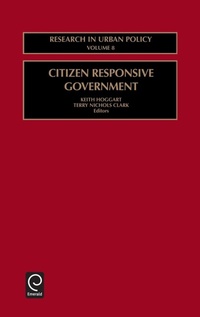
Citizen Responsive Government
Will be published approx. on 20. December 2000
Book
Hardback
304 pages
978-0-7623-0499-8 (ISBN)
Description
How can government stay linked to its citizens? Across the world, governments' basic principles are turned on their heads as global markets, weakened national states, and active citizens emerge. Governments increasingly act not alone, but many governments and private groups make policy jointly - labeled 'governance'. But this raises new concerns for adequate citizen responsiveness. Leaders and parties previously considered left or right make unexpected choices - as leaders explore Third Ways, New Political Cultures, and more. As policy choices grow more complicated, they are harder to present to citizens - which undermines citizen legitimacy of parties and elected officials. How can government maintain democratic accountability? This volume explores new answers by probing citizen involvement in specific cities and countries the world over. There is no single problem, hence no single remedy. But by contrasting key elements of national and local contexts, this volume offers lessons about how citizens are variously activated; about what works, where, and why. From specific results emerge insights about how citizens may drive policy, or be ignored, in a time of turbulence and rapid cultural change for government policy making.
More details
Series
Language
English
Place of publication
United States
Publishing group
Emerald Publishing Limited
Target group
Professional and scholarly
Dimensions
Height: 240 mm
Width: 161 mm
Thickness: 21 mm
Weight
622 gr
ISBN-13
978-0-7623-0499-8 (9780762304998)
Copyright in bibliographic data and cover images is held by Nielsen Book Services Limited or by the publishers or by their respective licensors: all rights reserved.
Schweitzer Classification
Content
List of tables. List of figures. City governments and their citizens: an overview of the book (T. Nichols Clark, K. Hoggart). The legitimacy of local government - what makes a difference? Evidence from Norway (L. Rose, P.A. Pettersen). Citizens, councilors and urban institutional reform: the case of The Netherlands (B. Denters). Municipal responsiveness to local interest groups: a cross-national study (K. Hoggart). Translocal orders and urban environmentalism: lessons from a German and a United States city (J. Sellers). The responsiveness of local councilors to citizen preferences in Stuttgart: the case of sports policies (M. Walter). Pledges and performance: an empirical analysis of the relationship between manifesto commitments and local services (G. Boyne, R. Ashworth). Urban policy-making in Germany: the impact of parties on municipal budgets and employment (V. Kunz). Politicization, neo-liberalism and new forms of local governance in Portugal (C.N. Silva) Enhancing local fiscal autonomy: the Japanese case with comparative reference to South Korea and the United States (Yoshiaki Kobayashi). Do new leaders risk shorter political lives? Assessing the impact of the new political culture (T.Nichols Clark). The contributors.