

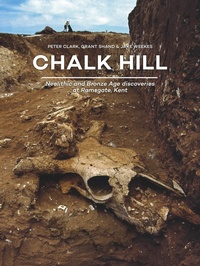
Chalk Hill
Neolithic and Bronze Age discoveries at Ramsgate, Kent
1st Edition
Published on 30. March 2019
Book
Paperback/Softback
275 pages
978-90-8890-607-7 (ISBN)
Description
Excavations at Chalk Hill, Ramsgate in south-eastern Britain were primarily aimed at investigating the remains of a possible early Neolithic causewayed enclosure visible on aerial photographs. However, the monument could not in fact be categorised as a causewayed enclosure, but instead represented a type of early Neolithic ritual monument unique to the British Isles.
The earliest significant features recorded on the site dated to the early Neolithic (roughly 3700-3600 cal BC). They took the form of three concentric arcs of intercutting pit clusters forming discrete 'segments', the fills of which produced rich assemblages of pottery, flintwork, animal bone and other material. Much of this material appeared to have been deliberately placed in the pits rather than representing casual disposal of refuse. There are indications that material placed in different pits at different times may have derived from the same source, a 'midden' or some such which was not located during the excavations. The pit clusters appeared to have resulted from repeated pit-digging in the same location over an extended period of time. The site therefore contributes a more nuanced understanding of the heterogeneity of monumental architecture in the early Neolithic of the British Isles.
This report is therefore critical for understanding the early Neolithisation of southern Britain, the relations between Neolithic incomers and indigenous Mesolithic hunter-gatherers, the potential creolisation of different cultural groups and cross-Channel relations in the early 4th Millennium BC.
The site probably went out of use in around 3600 cal BC, and subsequent use of the landscape in the Bronze Age and later periods is evocative of the perception of 'special places' in the landscape long after they were abandoned.
With contributions by Enid Allison, Alex Bayliss, Robin Bendrey, Christopher Bronk Ramsey, Kate Clark, Alex Gibson, Chris Green, Louise Harrison, Frances Healy, Linda Hurcombe, Rob Ixer, Jacqueline McKinley, Barbara McNee, Ruth Pelling, Nicola Powell, Louise Rayner, Paula Reimer, Johannes van der Plicht, Alasdair Whittle and Tania Wilson
The earliest significant features recorded on the site dated to the early Neolithic (roughly 3700-3600 cal BC). They took the form of three concentric arcs of intercutting pit clusters forming discrete 'segments', the fills of which produced rich assemblages of pottery, flintwork, animal bone and other material. Much of this material appeared to have been deliberately placed in the pits rather than representing casual disposal of refuse. There are indications that material placed in different pits at different times may have derived from the same source, a 'midden' or some such which was not located during the excavations. The pit clusters appeared to have resulted from repeated pit-digging in the same location over an extended period of time. The site therefore contributes a more nuanced understanding of the heterogeneity of monumental architecture in the early Neolithic of the British Isles.
This report is therefore critical for understanding the early Neolithisation of southern Britain, the relations between Neolithic incomers and indigenous Mesolithic hunter-gatherers, the potential creolisation of different cultural groups and cross-Channel relations in the early 4th Millennium BC.
The site probably went out of use in around 3600 cal BC, and subsequent use of the landscape in the Bronze Age and later periods is evocative of the perception of 'special places' in the landscape long after they were abandoned.
With contributions by Enid Allison, Alex Bayliss, Robin Bendrey, Christopher Bronk Ramsey, Kate Clark, Alex Gibson, Chris Green, Louise Harrison, Frances Healy, Linda Hurcombe, Rob Ixer, Jacqueline McKinley, Barbara McNee, Ruth Pelling, Nicola Powell, Louise Rayner, Paula Reimer, Johannes van der Plicht, Alasdair Whittle and Tania Wilson
Reviews / Votes
The plans and section drawings are clear and consistent throughout, in many cases conveying the complexity of the deposits more eloquently than the accompanying text. [...] Peter Clark's 13-page-long discussion (Chapter 6), which is authoritative, thought-provoking and well-written. * The Prehistoric Society *More details
Edition
1. Auflage
Language
English
Place of publication
Leiden
Netherlands
Target group
Professional and scholarly
Illustrations
61fc/57bw
Dimensions
Height: 280 mm
Width: 210 mm
Thickness: 19 mm
Weight
1036 gr
ISBN-13
978-90-8890-607-7 (9789088906077)
Copyright in bibliographic data and cover images is held by Nielsen Book Services Limited or by the publishers or by their respective licensors: all rights reserved.
Schweitzer Classification
Persons
Peter Clark was raised in Illinois, where he graduated from New Trier Township High School. He was in the United States Army from 1965 to 1968, including Vietnam service with the 1st Infantry Division. He is a graduate of the University of Illinois and Yale Law School and a member of the Massachusetts Bar. He has been a county prosecutor, counsel to state mental health and social service agencies, a legal aid lawyer, and an Assistant Attorney General in Massachusetts. He currently serves in the U.S. Department of Health & Human Services in the Office of the Inspector General. Grant Shand was a Field Archaeologist with the Canterbury Archaeological Trust between 1985 and 2007. In this role he participated in many archaeological excavations throughout the county of Kent, most notably directing the major excavations at Chalk Hill, Ramsgate between 1997 and 1998. He left the Trust in 2007 when he moved to Canada. Jake Weekes completed his doctorate at the University of Kent in 2005 and was a part-time lecturer there in Roman Archaeology and Classics from 1999-2007. He coordinated the South East Research Framework for the Historic Environment from 2007-8, before becoming Research Officer for the Canterbury Archaeological Trust.
Having developed a good working knowledge of the archaeology of south-east England from the Palaeolithic to the present, Jake maintains specific research interests in various aspects of British Prehistory, Roman Britain, Funerary Archaeology and early medieval Canterbury. Author of a number of respected articles and site reports since 2000, he is co-editor of the recent Death as a Process. The Archaeology of the Roman Funeral, and has contributed the chapter on Cemeteries and Funerary Practice for the new Oxford Handbook to Roman Britain.
Having developed a good working knowledge of the archaeology of south-east England from the Palaeolithic to the present, Jake maintains specific research interests in various aspects of British Prehistory, Roman Britain, Funerary Archaeology and early medieval Canterbury. Author of a number of respected articles and site reports since 2000, he is co-editor of the recent Death as a Process. The Archaeology of the Roman Funeral, and has contributed the chapter on Cemeteries and Funerary Practice for the new Oxford Handbook to Roman Britain.
Content
1. Introduction (Peter Clark)
2. Early Prehistoric Landscapes
Site Description (Peter Clark and Jake Weekes)
The palaeoenvironment (Chris Green)
Radiocarbon dating (Alex Bayliss, Frances Healy, Johannes van der Plicht, Christopher Bronk Ramsey, Paula Reimer, Grant Shand, Jake Weekes and Alasdair Whittle)
The early prehistoric flint (Tania Wilson)
Microwear analysis of selected tools (Linda Hurcombe)
Other stone artefacts (Grant Shand)
Worked stone tools (Rob Ixer)
Neolithic and early Bronze Age pottery (Alex Gibson)
Jet belt- or pulley-ring (Nicola Powell)
Human bone (Jacqueline McKinley)
Animal bone (Robin Bendrey)
Coprolites (Enid Allison)
Shellfish (Enid Allison)
Charred plant remains (Ruth Pelling)
3. Later Prehistoric Landscapes
Site Description (Peter Clark and Jake Weekes)
Radiocarbon Dating: The late Bronze Age/early Iron Age enclosure (Alex Bayliss, Frances Healy, Johannes van der Plicht, Christopher Bronk Ramsey, Paula Reimer, Grant Shand, Jake Weekes and Alasdair Whittle)
Flint from mid to late Bronze Age and early Iron Age features (Tania Wilson)
Worked stone tools (Rob Ixer)
Later prehistoric pottery (Barbara McNee)
Daub (Louise Harrison)
Registered finds (Nicola Powell)
Human bone (Jacqueline McKinley)
Animal bone (Robin Bendrey)
Shellfish (Enid Allison)
Charred plant remains (Ruth Pelling)
4. Early Historic Landscapes
Site description (Peter Clark and Jake Weekes)
Flint from Post-Iron Age features (Tania Wilson)
Post-late Bronze Age/early Iron Age pottery (Louise Rayner)
Registered finds (Nicola Powell)
Animal bone (Robin Bendrey)
Shellfish (Enid Allison)
Charred plant remains (Ruth Pelling)
5. Discussion: An Interpretation of the 'Causewayed Enclosure' (Jake Weekes)
6. Discussion: Chalk Hill in its Prehistoric and Historic context (Peter Clark)
List of references
Appendix I: Inner Arc Segment Catalogue
Appendix II: Middle Arc Segment Catalogue
Appendix III: Outer Arc Segment Catalogue
Appendix IV: Early Prehistoric Pottery Sherd Groups
2. Early Prehistoric Landscapes
Site Description (Peter Clark and Jake Weekes)
The palaeoenvironment (Chris Green)
Radiocarbon dating (Alex Bayliss, Frances Healy, Johannes van der Plicht, Christopher Bronk Ramsey, Paula Reimer, Grant Shand, Jake Weekes and Alasdair Whittle)
The early prehistoric flint (Tania Wilson)
Microwear analysis of selected tools (Linda Hurcombe)
Other stone artefacts (Grant Shand)
Worked stone tools (Rob Ixer)
Neolithic and early Bronze Age pottery (Alex Gibson)
Jet belt- or pulley-ring (Nicola Powell)
Human bone (Jacqueline McKinley)
Animal bone (Robin Bendrey)
Coprolites (Enid Allison)
Shellfish (Enid Allison)
Charred plant remains (Ruth Pelling)
3. Later Prehistoric Landscapes
Site Description (Peter Clark and Jake Weekes)
Radiocarbon Dating: The late Bronze Age/early Iron Age enclosure (Alex Bayliss, Frances Healy, Johannes van der Plicht, Christopher Bronk Ramsey, Paula Reimer, Grant Shand, Jake Weekes and Alasdair Whittle)
Flint from mid to late Bronze Age and early Iron Age features (Tania Wilson)
Worked stone tools (Rob Ixer)
Later prehistoric pottery (Barbara McNee)
Daub (Louise Harrison)
Registered finds (Nicola Powell)
Human bone (Jacqueline McKinley)
Animal bone (Robin Bendrey)
Shellfish (Enid Allison)
Charred plant remains (Ruth Pelling)
4. Early Historic Landscapes
Site description (Peter Clark and Jake Weekes)
Flint from Post-Iron Age features (Tania Wilson)
Post-late Bronze Age/early Iron Age pottery (Louise Rayner)
Registered finds (Nicola Powell)
Animal bone (Robin Bendrey)
Shellfish (Enid Allison)
Charred plant remains (Ruth Pelling)
5. Discussion: An Interpretation of the 'Causewayed Enclosure' (Jake Weekes)
6. Discussion: Chalk Hill in its Prehistoric and Historic context (Peter Clark)
List of references
Appendix I: Inner Arc Segment Catalogue
Appendix II: Middle Arc Segment Catalogue
Appendix III: Outer Arc Segment Catalogue
Appendix IV: Early Prehistoric Pottery Sherd Groups