

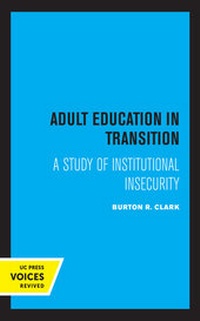
Adult Education in Transition
A Study of Institutional Insecurity
1st Edition
Will be published approx. on 8. January 2021
Book
Hardback
168 pages
978-0-520-36445-5 (ISBN)
Description
This sociological analysis examines the adult education system in California, exploring its development over the past 25 years as a distinct entity within the public education framework. The study approaches adult education not only from an educational perspective but through a sociological lens, assessing the influence of organizational and institutional pressures on its evolution. Central to this work is the idea that educational values and functions are shaped by the broader organizational dynamics within which they operate. By investigating how adult schools adapt to external and internal forces, the study aims to provide insights into both the unique challenges faced by adult education institutions and broader sociological theories of institutional change.
One key focus of the study is the concept of "organizational adaptation," wherein the adult school has had to adjust to pressures from its environment, including legislative demands, public expectations, and administrative constraints. This adaptive process is not simply reactive; it also shapes the institution's mission and functions, gradually fostering a service-oriented model that aligns closely with the needs of the community. This service orientation is reflected in how adult schools develop and sustain their programs, often with significant input from the students and community members they serve. Such responsiveness marks a departure from traditional educational models and offers a compelling case study in how institutions adapt to remain relevant and effective within public school systems.
Furthermore, the study identifies the structural and environmental factors that drive this shift toward a service-based model. Key among these are the marginal status of adult education within the larger public school system, the evolving purposes of adult education since the early 20th century, and legislative influences that shape the policies and practices of adult schools. Through an examination of historical context, policy frameworks, and empirical data from specific case studies, particularly within the Los Angeles area, this study reveals the complex interplay between organizational adaptation and educational mission, ultimately proposing that adult education institutions serve as valuable models for understanding the adaptive functions of public organizations in response to societal demands.
This title is part of UC Press's Voices Revived program, which commemorates University of California Press's mission to seek out and cultivate the brightest minds and give them voice, reach, and impact. Drawing on a backlist dating to 1893, Voices Revived makes high-quality, peer-reviewed scholarship accessible once again using print-on-demand technology. This title was originally published in 1968.
One key focus of the study is the concept of "organizational adaptation," wherein the adult school has had to adjust to pressures from its environment, including legislative demands, public expectations, and administrative constraints. This adaptive process is not simply reactive; it also shapes the institution's mission and functions, gradually fostering a service-oriented model that aligns closely with the needs of the community. This service orientation is reflected in how adult schools develop and sustain their programs, often with significant input from the students and community members they serve. Such responsiveness marks a departure from traditional educational models and offers a compelling case study in how institutions adapt to remain relevant and effective within public school systems.
Furthermore, the study identifies the structural and environmental factors that drive this shift toward a service-based model. Key among these are the marginal status of adult education within the larger public school system, the evolving purposes of adult education since the early 20th century, and legislative influences that shape the policies and practices of adult schools. Through an examination of historical context, policy frameworks, and empirical data from specific case studies, particularly within the Los Angeles area, this study reveals the complex interplay between organizational adaptation and educational mission, ultimately proposing that adult education institutions serve as valuable models for understanding the adaptive functions of public organizations in response to societal demands.
This title is part of UC Press's Voices Revived program, which commemorates University of California Press's mission to seek out and cultivate the brightest minds and give them voice, reach, and impact. Drawing on a backlist dating to 1893, Voices Revived makes high-quality, peer-reviewed scholarship accessible once again using print-on-demand technology. This title was originally published in 1968.
More details
Series
Edition
First Edition
Language
English
Place of publication
Berkerley
United States
Target group
Professional and scholarly
Product notice
Cloth over boards
Dimensions
Height: 234 mm
Width: 156 mm
Thickness: 13 mm
Weight
408 gr
ISBN-13
978-0-520-36445-5 (9780520364455)
Copyright in bibliographic data and cover images is held by Nielsen Book Services Limited or by the publishers or by their respective licensors: all rights reserved.
Schweitzer Classification
Other editions
Additional editions
E-Book
07/2023
1st Edition
Naval Institute Press
€23.49
Available for download
Book
09/2020
1st Edition
University of California Press
€42.16
Article not available at the moment