

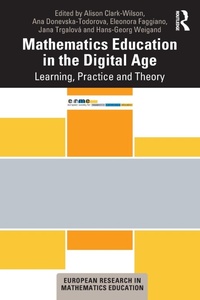
Mathematics Education in the Digital Age
Learning, Practice and Theory
1st Edition
Published on 25. May 2021
Book
Paperback/Softback
236 pages
978-0-367-68452-5 (ISBN)
Description
The wide availability of digital educational resources for mathematics teaching and learning is indisputable, with some notable genres of technologies having evolved, such as graphing calculators, dynamic graphing, dynamic geometry and data visualization tools. But what does this mean for teachers of mathematics, and how do their roles evolve within this digital landscape? This essential book offers an international perspective to help bridge theory and practice, including coverage of networking theories, curriculum design, task implementation, online resources and assessment.
Mathematics Education in the Digital Age details the impacts this digital age has, and will continue to have, on the parallel aspects of learning and teaching mathematics within formal education systems and settings. Written by a group of international authors, the chapters address the following themes:
Mathematics teacher education and professional development
Mathematics curriculum development and task design
The assessment of mathematics
Theoretical perspectives and methodologies/approaches for researching mathematics education in the digital age
This book highlights not only the complex nature of the field, but also the advancements in theoretical and practical knowledge that is enabling the mathematics education community to continue to learn in this increasingly digital age. It is an essential read for all mathematics teacher educators and master teachers.
Mathematics Education in the Digital Age details the impacts this digital age has, and will continue to have, on the parallel aspects of learning and teaching mathematics within formal education systems and settings. Written by a group of international authors, the chapters address the following themes:
Mathematics teacher education and professional development
Mathematics curriculum development and task design
The assessment of mathematics
Theoretical perspectives and methodologies/approaches for researching mathematics education in the digital age
This book highlights not only the complex nature of the field, but also the advancements in theoretical and practical knowledge that is enabling the mathematics education community to continue to learn in this increasingly digital age. It is an essential read for all mathematics teacher educators and master teachers.
More details
Series
Language
English
Place of publication
London
United Kingdom
Publishing group
Taylor & Francis Ltd
Target group
College/higher education
Illustrations
39 s/w Abbildungen, 24 s/w Photographien bzw. Rasterbilder, 15 s/w Zeichnungen, 4 s/w Tabellen
4 Tables, black and white; 15 Line drawings, black and white; 24 Halftones, black and white; 39 Illustrations, black and white
Dimensions
Height: 234 mm
Width: 156 mm
Thickness: 14 mm
Weight
392 gr
ISBN-13
978-0-367-68452-5 (9780367684525)
Copyright in bibliographic data and cover images is held by Nielsen Book Services Limited or by the publishers or by their respective licensors: all rights reserved.
Schweitzer Classification
Other editions
Additional editions
Alison Clark-Wilson | Ana Donevska-Todorova | Eleonora Faggiano
Mathematics Education in the Digital Age
Learning, Practice and Theory
Book
05/2021
1st Edition
Routledge
€206.50
Shipment within 15-20 days
Alison Clark-Wilson | Ana Donevska-Todorova | Eleonora Faggiano
Mathematics Education in the Digital Age
Learning, Practice and Theory
E-Book
05/2021
1st Edition
Routledge
€45.99
Available for download
Alison Clark-Wilson | Ana Donevska-Todorova | Eleonora Faggiano
Mathematics Education in the Digital Age
Learning, Practice and Theory
E-Book
05/2021
1st Edition
Routledge
€45.99
Available for download
Persons
Alison Clark-Wilson is a Principal Research Fellow at UCL Institute of Education, London, United Kingdom. Alison's research spans aspects of designing, implementing and evaluating digital technologies for mathematics education. She leads the European Society for Research in Mathematics Education's working group on "teaching mathematics with technology and other resources".
Ana Donevska-Todorova earned her PhD at the Institute of Mathematics at the Humboldt-University of Berlin and now works in the research field of meaningful design, application and dissemination of digital resources for teaching and learning mathematics. She is fully engaged with the activities of the European Society for Research in Mathematics Education as a member of its International Programme Committee and as a co-leader of the ERME Topic Conferences Mathematics Education in the Digital Age.
Eleonora Faggiano is Assistant Professor in Mathematics Education at the University of Bari Aldo Moro, Italy. Her research interests concern the integration of digital and non-digital resources in the teaching practices and mathematics teacher professional development.
Jana Trgalova is Associate Professor at Claude Bernard University, France. She is involved in primary and secondary mathematics teacher education and her research focuses on digital technology and resources for mathematics education, their design, appropriation, use and evaluation.
Hans-Georg Weigand is Professor at University of Wuerzburg, Germany. He is interested in the use of digital technologies in mathematics education and teacher education, having authored books on algebra, geometry and computers in mathematics education. He leads the European Society for Research in Mathematics Education's working group on "learning mathematics with technology and other resources".
Ana Donevska-Todorova earned her PhD at the Institute of Mathematics at the Humboldt-University of Berlin and now works in the research field of meaningful design, application and dissemination of digital resources for teaching and learning mathematics. She is fully engaged with the activities of the European Society for Research in Mathematics Education as a member of its International Programme Committee and as a co-leader of the ERME Topic Conferences Mathematics Education in the Digital Age.
Eleonora Faggiano is Assistant Professor in Mathematics Education at the University of Bari Aldo Moro, Italy. Her research interests concern the integration of digital and non-digital resources in the teaching practices and mathematics teacher professional development.
Jana Trgalova is Associate Professor at Claude Bernard University, France. She is involved in primary and secondary mathematics teacher education and her research focuses on digital technology and resources for mathematics education, their design, appropriation, use and evaluation.
Hans-Georg Weigand is Professor at University of Wuerzburg, Germany. He is interested in the use of digital technologies in mathematics education and teacher education, having authored books on algebra, geometry and computers in mathematics education. He leads the European Society for Research in Mathematics Education's working group on "learning mathematics with technology and other resources".
Content
1. Introduction 2. Online resources for mathematics teaching and learning at the university level: Three case examples that highlight principles for task design driven by students' and teachers' needs 3. Quality of task-design in technology-enhanced resources for teaching and learning mathematics 4. Towards Pragmatic Theories that Underpin the Design of Teacher Professional Development Concerning Technology Use in School Mathematics 5. Technology-rich assessment in mathematics 6. Digital platforms for mathematics teacher curriculum design: affordances and constraints 7. CAS from an Assessment Point of View: Challenges and Potentials 8. Digital maps of the connections in school mathematics: Three projects to enhance teaching and learning 9. The Role of Technology in the Pragmatic-Abstract Continuum in Mathematics Curriculum Development and Task Design 10. A framework for analysing students' learning of function at upper secondary level: Connected Working Spaces and Abstraction in Context 11. Challenges of making sense of tasks and automated feedback in digital mathematics textbooks 12. Technology integration for mathematics education in developing countries, with focus on India and Mexico 13. Aligning teaching with current experiences of being, becoming and belonging: An identity perspective on the use of digital resources.