

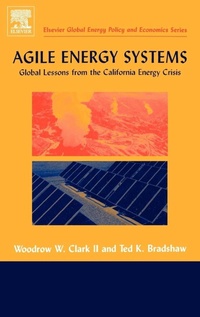
Agile Energy Systems
Global Lessons from the California Energy Crisis
Published on 27. September 2004
Book
Hardback
510 pages
978-0-08-044448-2 (ISBN)
Description
Empowering decision makers by setting the vision for a new approach to energy systems and providing the tools and plans to achieve these objectives
Provides specific and actionable public policy and programme tools
Help solve energy issues worldwide by illustrating how the lessons learned from the California energy crisis can be used to create an agile energy system for any region in a country
Due to the recent catastrophic energy system failures in California along with those in the North-Eastern US and Southern Canada, London, and Italy, the time has come to proclaim the failure of deregulation, privatization or liberalization and propose a new energy system. Agile Energy Systems shows in the first section, how five precipitating forces led to the deregulation debacle in California: (1) major technological changes and commercialization, (2) regulatory needs mismatched to societal adjustments, (3) inadequate and flawed economic models, (4) lack of vision, goals, and planning leading to energy failures, and (5) failure and lack of economic regional development.
The second half of the book examines how "civic market", new economic models, and planning for a sustainable economic environment counteracted these five forces to create an "agile energy system". This system is based on renewable energy generation, hybrid or combined and distributed generation technologies. Such an agile system can be a new paradigm for both energy efficiency and reliability for any region or country, in contrast to the brittle centralized energy grid systems created by deregulation. Furthermore, the book overviews how the future of energy systems rests in the emerging "clean" hydrogen economy.
Provides specific and actionable public policy and programme tools
Help solve energy issues worldwide by illustrating how the lessons learned from the California energy crisis can be used to create an agile energy system for any region in a country
Due to the recent catastrophic energy system failures in California along with those in the North-Eastern US and Southern Canada, London, and Italy, the time has come to proclaim the failure of deregulation, privatization or liberalization and propose a new energy system. Agile Energy Systems shows in the first section, how five precipitating forces led to the deregulation debacle in California: (1) major technological changes and commercialization, (2) regulatory needs mismatched to societal adjustments, (3) inadequate and flawed economic models, (4) lack of vision, goals, and planning leading to energy failures, and (5) failure and lack of economic regional development.
The second half of the book examines how "civic market", new economic models, and planning for a sustainable economic environment counteracted these five forces to create an "agile energy system". This system is based on renewable energy generation, hybrid or combined and distributed generation technologies. Such an agile system can be a new paradigm for both energy efficiency and reliability for any region or country, in contrast to the brittle centralized energy grid systems created by deregulation. Furthermore, the book overviews how the future of energy systems rests in the emerging "clean" hydrogen economy.
Reviews / Votes
"This book, is literature for a broad range of readers from public and private energy companies to policy makers to energy engineer who are interested particularly in the integration of energy policy with sustainable development".... "The authors are academics and researchers in renewable energy issues with international perspectives." --W.W. Clark 2, Ted Bradshaw, Elsevier Press, 2004. Agile Energy Systems: Global Lessons from the California Energy CrisisMore details
Series
Language
English
Place of publication
Oxford
United Kingdom
Publishing group
Elsevier Science & Technology
Target group
Professional and scholarly
Product notice
Laminated cover
Dimensions
Height: 231 mm
Width: 155 mm
Thickness: 26 mm
Weight
903 gr
ISBN-13
978-0-08-044448-2 (9780080444482)
Copyright in bibliographic data and cover images is held by Nielsen Book Services Limited or by the publishers or by their respective licensors: all rights reserved.
Schweitzer Classification
Other editions
New editions
Book
07/2017
2nd Edition
Elsevier
€166.50
Shipment within 15-20 days
Persons
Woodrow W. Clark, II, MA3 , PhD, is an internationally recognized scholar and expert in economics, renewable energy, sustainability, and sustainable communities. He was a contributing scientist to the United Nations Intergovernmental Panel on Climate Change (UNIPCC), which as an organization was awarded the Nobel Peace Prize in December 2007 along with Al Gore and his film "An Inconvenient Truth."
Clark is an internationally recognized, respected expert, author, lecturer, public speaker and consultant on global and local solutions to climate change. His core focus is on economics for smart green communities. During the 1990s, he was Manager of Strategic Planning for Technology Transfer at Lawrence Livermore National Laboratory (LLNL) with University of California and U.S. Department of Energy. He was one of the contributing scientists for United Nations Intergovernmental Panel Climate Change (IPCC), awarded 2007 Nobel Peace Prize and Researcher for UN FCCC.
From 2000-2003, Clark was Advisor, Renewable Energy, Emerging Technologies & Finance to California Governor Gray Davis. After the "recall? in 2004, Clark founded, and manages Clark Strategic Partners (CSP), a global environmental, policy and economics renewable energy consulting firm. Also 2015-2018, Clark taught courses at University of International Relations (UIR) in Beijing and lectured on "Environment Economics? Cheung Kong Graduate School of Business (April 2017). He was appointed (July 2016) to be a member of the Editorial Board for the Energy Review Journal (ERJ) in China. He was selected to be a member of the UN B20 Finance Task Force supported in 2016 by China. Clark teaches and lectures in the EU, especially Denmark and Italy.
Clark published 12 books by the end of 2017 and over 70 peer-reviewed articles, which reflect his concern for global sustainable green communities. He has authored and edited books are The Next Economics (Springer, 2012) and Global Sustainable Communities Handbook (Elsevier, 2014). In addition, his latest coauthored books, with Grant Cooke, are The Green Industrial Revolution (Elsevier, 2014), Green Development Paradigm (in Mandarin, 2015) and Smart Green Cities (Routledge, February 2016). In 2017, Clark had three (3) books published, 2nd Ed of his first book: Agile Energy Systems: Global Systems (Elsevier Press) and 2nd Ed of Sustainable Communities Design Handbook (Elsevier Press 2017).
Three more books are planned in 2018, including Climate Preservation (Elsevier Press); 2nd Ed of Qualitative Economics: The Next Economics (Springer Press) and Qualitative and Quantitative Economics (Q2E) for Palgrave Press, Clark created Clark Mass Media Company (CM2C) from his media company in San Francisco 3 decades ago that now distributes documentary and dramatic series on economic, political, climate, environmental and social issues. He earned three MA degrees from universities in Illinois and his Ph.D., University of California, Berkeley,
and in 2017, his PhD thesis was updated into a book on Violence in Schools, Colleges and Universities,
Contact: wwclark13@gmail.com
LinkedIn: https://www.linkedin.com/in/woodrow-w-clark-ii-b6962214
https://bschool.pepperdine.edu/about/people/faculty/woodrow-clark-economics-research-professor/
Clark is an internationally recognized, respected expert, author, lecturer, public speaker and consultant on global and local solutions to climate change. His core focus is on economics for smart green communities. During the 1990s, he was Manager of Strategic Planning for Technology Transfer at Lawrence Livermore National Laboratory (LLNL) with University of California and U.S. Department of Energy. He was one of the contributing scientists for United Nations Intergovernmental Panel Climate Change (IPCC), awarded 2007 Nobel Peace Prize and Researcher for UN FCCC.
From 2000-2003, Clark was Advisor, Renewable Energy, Emerging Technologies & Finance to California Governor Gray Davis. After the "recall? in 2004, Clark founded, and manages Clark Strategic Partners (CSP), a global environmental, policy and economics renewable energy consulting firm. Also 2015-2018, Clark taught courses at University of International Relations (UIR) in Beijing and lectured on "Environment Economics? Cheung Kong Graduate School of Business (April 2017). He was appointed (July 2016) to be a member of the Editorial Board for the Energy Review Journal (ERJ) in China. He was selected to be a member of the UN B20 Finance Task Force supported in 2016 by China. Clark teaches and lectures in the EU, especially Denmark and Italy.
Clark published 12 books by the end of 2017 and over 70 peer-reviewed articles, which reflect his concern for global sustainable green communities. He has authored and edited books are The Next Economics (Springer, 2012) and Global Sustainable Communities Handbook (Elsevier, 2014). In addition, his latest coauthored books, with Grant Cooke, are The Green Industrial Revolution (Elsevier, 2014), Green Development Paradigm (in Mandarin, 2015) and Smart Green Cities (Routledge, February 2016). In 2017, Clark had three (3) books published, 2nd Ed of his first book: Agile Energy Systems: Global Systems (Elsevier Press) and 2nd Ed of Sustainable Communities Design Handbook (Elsevier Press 2017).
Three more books are planned in 2018, including Climate Preservation (Elsevier Press); 2nd Ed of Qualitative Economics: The Next Economics (Springer Press) and Qualitative and Quantitative Economics (Q2E) for Palgrave Press, Clark created Clark Mass Media Company (CM2C) from his media company in San Francisco 3 decades ago that now distributes documentary and dramatic series on economic, political, climate, environmental and social issues. He earned three MA degrees from universities in Illinois and his Ph.D., University of California, Berkeley,
and in 2017, his PhD thesis was updated into a book on Violence in Schools, Colleges and Universities,
Contact: wwclark13@gmail.com
LinkedIn: https://www.linkedin.com/in/woodrow-w-clark-ii-b6962214
https://bschool.pepperdine.edu/about/people/faculty/woodrow-clark-economics-research-professor/
Content
The End of the Old Order: The Roots of Restructuring; Energy System Change in a Global Context; Energy System Change in a Global Context; Technological Change: From a Vertically Integrated to a Dispersed Electrical System; The Derregulation Debacle; Economic Models and Market Change; Knowing and Managing Complex Power Systems; Economic development and the Energy Crisis; Advanced Technologies for an Agile Energy System; Civic Markets: Public Oversight of an Agile Energy System; Civic Capitalism: A new economics for the public good; Planning for a Complex Infrastructure; Economic Development: Sustainability is Defined Improving Local Economies; The Hydrogen Freeway: The Road Ahead; Conclusion