

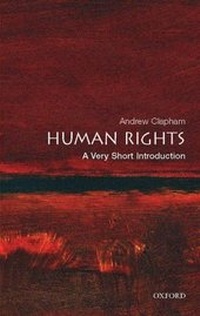
Human Rights
A Very Short Introduction
Published on 1. September 2007
Book
Paperback/Softback
216 pages
978-0-19-920552-3 (ISBN)
Description
Today it is usually not long before a problem gets expressed as a human rights issue. An appeal to human rights in the face of injustice can be a heartfelt and morally justified demand for some, while for others it remains merely an empty slogan. Taking an international perspective and focusing on highly topical issues such as torture, arbitrary detention, privacy, health and discrimination, this Very Short Introduction will help readers to understand for themselves the controversies and complexities behind this vitally relevant issue. Looking at the philosophical justification for rights, the historical origins of human rights and how they are formed in law, Andrew Clapham explains what our human rights actually are, what they might be, and where the human rights movement is heading. ABOUT THE SERIES: The Very Short Introductions series from Oxford University Press contains hundreds of titles in almost every subject area. These pocket-sized books are the perfect way to get ahead in a new subject quickly. Our expert authors combine facts, analysis, perspective, new ideas, and enthusiasm to make interesting and challenging topics highly readable.
More details
Series
Language
English
Place of publication
Oxford
United Kingdom
Illustrations
numerous halftones
Dimensions
Height: 174 mm
Width: 111 mm
Thickness: 11 mm
Weight
162 gr
ISBN-13
978-0-19-920552-3 (9780199205523)
Copyright in bibliographic data and cover images is held by Nielsen Book Services Limited or by the publishers or by their respective licensors: all rights reserved.
Schweitzer Classification
Other editions
New editions
Book
11/2015
2nd Edition
Oxford University Press
€13.00
Available immediately
Person
Andrew Clapham is Director of the Geneva Academy of International Humanitarian Law and Human Rights, and Professor of Public International Law at the Graduate Institute of International Studies, Geneva. He was the first Executive Director of the Academy of European Law at the European University Institute in Florence. He then worked as the Representative of Amnesty International at the United Nations in New York from 1991 to 1997, and has since taught human rights at the Graduate Institute of International Studies. He is an academic associate member of Matrix Chambers in London. Previous publications include: Human Rights Obligations of Non-State Actors (Oxford University Press, 2006); International Human Rights Lexicon with Susan Marks (Oxford University Press, 2005); and European Union - The Human Rights Challenge Vols I-III (Nomos, 1991, jointly edited).
Content
Preface ; 1. Looking at rights ; 2. The historical development of international human rights ; 3. Human rights foreign policy and the role of the UN ; 4. The international crime of torture ; 5. Legitimate restrictions and questions of freedom ; 6. Balancing rights - the issue of privacy ; 7. Food, education, health, housing and work ; 8. Discrimination and equality ; 9. The death penalty ; Final remarks ; References ; Further reading ; Annex: The Universal Declaration of Human Rights