

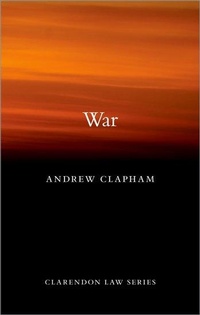
War
Published on 29. July 2021
Book
Hardback
624 pages
978-0-19-881046-9 (ISBN)
Description
This is an open access title available under the terms of a CC BY-NC-ND 4.0 International license. It is offered as a free PDF download from OUP and selected open access locations.
How relevant is the concept of war today? This book examines how notions about war continue to influence how we conceive rights and obligations in national and international law. It also considers the role international law plays in limiting what is forbidden and legitimated in times of war or armed conflict. The book highlights how, even though war has been outlawed and should be finished as an institution, states nevertheless continue to claim that they can wage necessary wars of self-defence, engage in lawful killings in war, imprison law-of-war detainees, and attack objects which are said to be part of a war-sustaining economy. The book includes an overall account of the contemporary laws of war and delves into whether states should be able to continue to claim so-called 'belligerent rights' over their enemies and those accused of breaching expectations of neutrality. A central claim in the book is as follows: while there is general agreement that war has been abolished as a legal institution for settling disputes, the time has come to admit that the belligerent rights that once accompanied states at war are no longer available. The conclusion is that claiming to be in a war or an armed conflict does not grant anyone a licence to kill people, destroy things, and acquire other people's property or territory.
How relevant is the concept of war today? This book examines how notions about war continue to influence how we conceive rights and obligations in national and international law. It also considers the role international law plays in limiting what is forbidden and legitimated in times of war or armed conflict. The book highlights how, even though war has been outlawed and should be finished as an institution, states nevertheless continue to claim that they can wage necessary wars of self-defence, engage in lawful killings in war, imprison law-of-war detainees, and attack objects which are said to be part of a war-sustaining economy. The book includes an overall account of the contemporary laws of war and delves into whether states should be able to continue to claim so-called 'belligerent rights' over their enemies and those accused of breaching expectations of neutrality. A central claim in the book is as follows: while there is general agreement that war has been abolished as a legal institution for settling disputes, the time has come to admit that the belligerent rights that once accompanied states at war are no longer available. The conclusion is that claiming to be in a war or an armed conflict does not grant anyone a licence to kill people, destroy things, and acquire other people's property or territory.
Reviews / Votes
The book offers a forensic account of what international law has to say about war, drawing on a detailed reading of national and international legal instruments and dozens of legal cases. Clapham provides a comprehensive survey of legal debates, innovations and progress in the regulation of war. He pays equal attention to the causes of war--examining war declarations, the outlawing of war, the place of force in the UN Charter and the question of war powers--and to the regulation of its conduct, including the protection of civilians and other persons, the triggering of the laws of armed conflict and the question of belligerent rights in naval operations. * Alex J. Bellamy, University of Queensland, International Affairs * The book stands out as it comprehensively focalises on the legal dimension of war, whereas previous writings on war have covered its application in terms of policy instrument, rationalising planning and conduct of hostilities. * Atul Alexander and Sanyam Jha, Journal of Indian Law and Society * Here is an oeuvre which is at one and the same time a law book (you could teach a course out of it) and a book about the law (it does so much more than simply outline the law of armed conflict both jus ad and jus in). It contextualizes it, historicizes it, makes it human in its inhumanity (wonderful chapter on victims) ... If you are new to the subject (hard to imagine among readers of EJIL and ICON...) you could not find a better introduction. If you are an old hand, you will both profit and enjoy, maybe with a tinge of jealousy. * J. H. H. Weiler, New York University School of Law, ICONnect * The book War by law professor Andrew Clapham is a flash of light. It is a flash of light not only because it reveals the oft-neglected meanings of international rules on war, but also because it organically depicts the essential logics of functioning of the modern laws of war and patiently deals with its intrinsic aporias. * Martino Tognocchi, Global Intellectual History *More details
Series
Language
English
Place of publication
Oxford
United Kingdom
Product notice
sewn/stitched
Cloth over boards
Dimensions
Height: 222 mm
Width: 146 mm
Thickness: 41 mm
Weight
898 gr
ISBN-13
978-0-19-881046-9 (9780198810469)
Copyright in bibliographic data and cover images is held by Nielsen Book Services Limited or by the publishers or by their respective licensors: all rights reserved.
Schweitzer Classification
Other editions
Person
Andrew Clapham is Professor of International Law at the Graduate Institute of International and Development Studies in Geneva, which he joined in 1997. He has been a member of the UN Commission on Human Rights in South Sudan since October 2017. He is an Honorary Member of the International Commission of Jurists. In 2003 he was an Adviser on International Humanitarian Law to Sergio Vieira de Mello, Special Representative of the UN Secretary-General in Iraq.
Content
- 1: The Multiple Meanings of War
- 2: Declarations of War and Neutrality
- 3: Outlawing War
- 4: The Use of Force after the UN Charter
- 5: War Powers in National Law
- 6: Triggering the International Law of Armed Conflict
- 7: Warfare - the Conduct of Hostilities
- 8: Belligerent Rights and the Future of Naval Economic Warfare
- 9: Victims of War
- 10: Accountability for Violations of the Laws of War
- Conclusion