

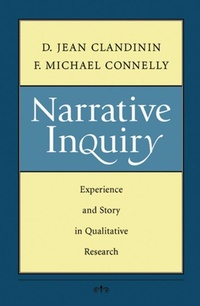
Narrative Inquiry
Experience and Story in Qualitative Research
1st Edition
Published on 3. September 2004
Book
Paperback/Softback
240 pages
978-0-7879-7276-9 (ISBN)
Description
"The literature on narrative inquiry has been, until now, widely scattered and theoretically incomplete. Clandinin and Connelly have created a major tour de force. This book is lucid, fluid, beautifully argued, and rich in examples. Students will find a wealth of arguments to support their research, and teaching faculty will find everything they need to teach narrative inquiry theory and methods."
-Yvonna S. Lincoln, professor, Department of Educational Administration, Texas A&M University
Understanding experience as lived and told stories--also known as narrative inquiry--has gained popularity and credence in qualitative research. Unlike more traditional methods, narrative inquiry successfully captures personal and human dimensions that cannot be quantified into dry facts and numerical data.
In this definitive guide, Jean Clandinin and Michael Connelly draw from more than twenty years of field experience to show how narrative inquiry can be used in educational and social science research. Tracing the origins of narrative inquiry in the social sciences, they offer new and practical ideas for conducting fieldwork, composing field notes, and conveying research results. Throughout the book, stories and examples reveal a wide range of narrative methods. Engaging and easy to read, Narrative Inquiry is a practical resource from experts who have long pioneered the use of narrative in qualitative research.
-Yvonna S. Lincoln, professor, Department of Educational Administration, Texas A&M University
Understanding experience as lived and told stories--also known as narrative inquiry--has gained popularity and credence in qualitative research. Unlike more traditional methods, narrative inquiry successfully captures personal and human dimensions that cannot be quantified into dry facts and numerical data.
In this definitive guide, Jean Clandinin and Michael Connelly draw from more than twenty years of field experience to show how narrative inquiry can be used in educational and social science research. Tracing the origins of narrative inquiry in the social sciences, they offer new and practical ideas for conducting fieldwork, composing field notes, and conveying research results. Throughout the book, stories and examples reveal a wide range of narrative methods. Engaging and easy to read, Narrative Inquiry is a practical resource from experts who have long pioneered the use of narrative in qualitative research.
More details
Language
English
Place of publication
New York
United States
Publishing group
John Wiley & Sons Inc
Target group
College/higher education
Professional and scholarly
Dimensions
Height: 225 mm
Width: 153 mm
Thickness: 17 mm
Weight
322 gr
ISBN-13
978-0-7879-7276-9 (9780787972769)
Copyright in bibliographic data and cover images is held by Nielsen Book Services Limited or by the publishers or by their respective licensors: all rights reserved.
Schweitzer Classification
Other editions
Additional editions
D. Jean Clandinin | F.Michael Connelly
Narrative Inquiry
Experience and Story in Qualitative Research
Book
12/1999
Jossey-Bass
€47.86
Article exhausted; check different version
Persons
D. Jean Clandinin is professor and director of the Centre for Research for Teacher Education and Development at the University of Alberta. F. Michael Connelly is professor and director of the Centre for Teacher Development, Ontario Institute for Studies in Education, University of Toronto.
Content
Preface xiii
Acknowledgments xvii
The Authors xix
Prologue xxi
1 Why Narrative? 1
2 Thinking Narratively: A Case at the Boundaries 21
3 Thinking Narratively: Reductionistic and Formalistic Boundaries 34
4 What Do Narrative Inquirers Do? 48
5 Being in the Field: Walking into the Midst of Stories 63
6 From Field to Field Texts: Being in a Place of Stories 80
7 Composing Field Texts 92
8 From Field Texts to Research Texts: Making Meaning of Experience 119
9 Composing Research Texts 138
10 Persistent Concerns in Narrative Inquiry 169
Epilogue 187
References 191
Index 199
Acknowledgments xvii
The Authors xix
Prologue xxi
1 Why Narrative? 1
2 Thinking Narratively: A Case at the Boundaries 21
3 Thinking Narratively: Reductionistic and Formalistic Boundaries 34
4 What Do Narrative Inquirers Do? 48
5 Being in the Field: Walking into the Midst of Stories 63
6 From Field to Field Texts: Being in a Place of Stories 80
7 Composing Field Texts 92
8 From Field Texts to Research Texts: Making Meaning of Experience 119
9 Composing Research Texts 138
10 Persistent Concerns in Narrative Inquiry 169
Epilogue 187
References 191
Index 199