

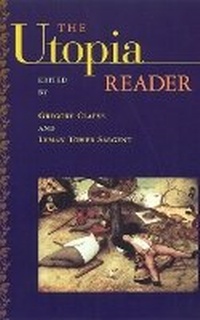
The Utopia Reader
Published on 1. November 1999
Book
Paperback/Softback
277 pages
978-0-8147-1571-0 (ISBN)
Description
Utopian literature has given voice to the hopes and fears of the human race from its earliest days to the present. The only single-volume anthology of its kind, The Utopia Reader encompasses the entire spectrum and history of utopian writing-from the Old Testament and Plato's Republic, to Sir Thomas More's Utopia and George Orwell's twentieth century dystopia, Nineteen Eighty-Four, through to the present day.
The editors of this definitive collection demonstrate the various ways in which utopias have been used throughout history as veiled criticism of existing conditions and how peoples excluded from the dominant discourse-such as women and minorities-have used the form to imagine empowering alternatives to present circumstances.
An engaging tour through the dissident, polemic, and satirical tradition of utopian writing, The Utopia Reader ultimately provides a telling portrait of civilization's persistent need to imagine and construct ideal societies.
The editors of this definitive collection demonstrate the various ways in which utopias have been used throughout history as veiled criticism of existing conditions and how peoples excluded from the dominant discourse-such as women and minorities-have used the form to imagine empowering alternatives to present circumstances.
An engaging tour through the dissident, polemic, and satirical tradition of utopian writing, The Utopia Reader ultimately provides a telling portrait of civilization's persistent need to imagine and construct ideal societies.
Reviews / Votes
"The Utopia Reader is a timely and provocative collection of utopia texts ... and an excellent introduction to the vast field of utopianism." (Moreana)More details
Language
English
Place of publication
New York
United States
Target group
College/higher education
Professional and scholarly
Product notice
Paperback (trade)
Dimensions
Height: 229 mm
Width: 152 mm
ISBN-13
978-0-8147-1571-0 (9780814715710)
Copyright in bibliographic data and cover images is held by Nielsen Book Services Limited or by the publishers or by their respective licensors: all rights reserved.
Schweitzer Classification
Other editions
New editions
Gregory Claeys | Lyman Tower Sargent
The Utopia Reader, Second Edition
Book
02/2017
2nd Edition
New York University Press
€45.00
Shipment within 10-20 days
Persons
Gregory Claeys is Professor of the History of Political Thought at the University of London, and author of several books.
Lyman Tower Sargent, Professor of Political Science at the University of Missouri, St. Louis, is author and editor of numerous books including Extremism in America and Political Thought in the United States.
Lyman Tower Sargent, Professor of Political Science at the University of Missouri, St. Louis, is author and editor of numerous books including Extremism in America and Political Thought in the United States.
Content
Preface; Acknowledgments 1. Introduction; 2. Utopianism before Thomas More; 3. The Sixteenth Century; 4. The Seventeenth Century; 5. The Eighteenth Century; 6. The Nineteenth Century; 7. The Twentieth Century About the Editors LONG CONTENTS: Preface; Acknowledgments 1. Introduction 2. Utopianism before Thomas More The Golden Age: Hesiod, Works and Days; Ovid, Metamorphosis; Vergil, Fourth Eclogue; Earthly Paradises: The Garden of Eden; Genesis; The Elysian Fields; Pindar, Fragments; Islands of the Blest; Horace, Epode 16; The Middle Ages: Eden; Dracontius; The Land of Prester John; The Lawgivers: Solon; Lycurgus; Utopias and Utopian Satires: Plato, Republic; Aristophanes, Ecclesiazusae; The Prophets: Isaiah; Hellenistic Utopias; Iambulus, Heliopolis; Saturnalia; Lucian, Saturnalia; The Millennium: The Revelation of St. John; II Baruch; Monasticism; The Rule of St. Benedict; The Rule of St. Francis The Cockaigne: Telecleides; Cockaigne 3. The Sixteenth Century Thomas More, Utopia; Francois Rabelais, The Abbey of Theleme; Michel de Montaigne, Of the Cannibals 4. The Seventeenth Century Joseph Hall, Mundus alter et idem; William Shakespeare, The Tempest; Tommaso Campanella, The City of the Sun; Francis Bacon, New Atlantis; Gerrard Winstanley, The Law of Freedom in a Platform; Margaret Cavendish, The Inventory of Judgements Commonwealth; James Harrington, The Commonwealth of Oceana 5. The Eighteenth Century Jonathan Swift, Gulliver's Travels; Louis Sebastien Mercier, Memoirs of the Year Two Thousand Five Hundred; Nicolas-Edme Restif de la Bretonne, L'andrographe; William Godwin, Enquiry Concerning Political Justice; Timothy Dwight, Greenfield Hill; Antoine-Nicolas de Condorcet, Sketch for a Historical Picture of the Progress of the Human Mind; Thomas Spence, The Constitution of Spensonia 6. The Nineteenth Century 182 Communal Societies as Utopias: Shakers: Frederick William Evans, The Shaker Compendium; The Millennial LawsShaker Covenant; Amana or the Community of True Inspiration: The Twenty-One Rules; Oneida: System of Criticism; Charles Fourier, Selections Describing the Phalanstery: American Fourierism: Albert Brisbane, Association; Charles Henri de Saint-Simon, Sketch of a NewPolitical System; John Adolphus Etzler, The Paradise within Reach of All Men; Robert Owen, The Book of the New Moral World; Etienne Cabet, Voyage to Icaria; Karl Marx and Friedrich Engels, The Communist Manifesto; Samuel Butler, Erewhon; Edward Bellamy, Looking Backward: 2000-1887; William Morris, News from Nowhere; Ignatius Donnelly, Caesar's Column; William Dean Howells, A Traveler from Altruria 7. The Twentieth Century H. G. Wells, A Modern Utopia; Charlotte Perkins Gilman, Herland; Yvgeni Zamiatin, We; Katherine Burdekin, Swastika Night; Aldous Huxley, Brave New World, Brave New World Revisited; Olaf Stapledon, Darkness and the Light; B. F. Skinner, Walden Two, "Walden Two Revisited"; George Orwell, Nineteen Eighty-Four; Ursula K. Le Guin, "The Day before the Revolution" About the Editors