

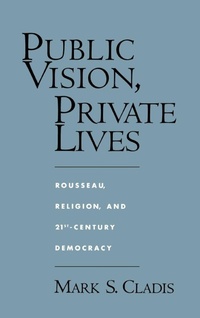
Public Vision, Private Lives
Rousseau, Religion, and 21st-Century Democracy
Published on 15. May 2003
Book
Hardback
320 pages
978-0-19-512554-2 (ISBN)
Description
In this elegantly written book, Mark S. Cladis invites us to reflect on the nature and place of the public and private in the work of Rousseau and, more generally, in democratic society. The tension between the hopes and desires of the individual and the requirements of a shared public life were at the heart, or the knot, of Rousseau's life and thought. Cladis skillfully leads the reader on an exploration of the conflicting claims with which Rousseau wrestled - prerogatives and obligations to self, friends, family, vocation, civic life, and to humanity. At the juncture of diverse theological and secular traditions, Rousseau forged a vision of human happiness found not exclusively in the public or private, but in a complex combination of the two.
Ultimately, however, Public Vision, Private Lives narrates a tragic tale. Placing Rousseau at the crossroads of Enlightenment optimism and Augustinian pessimism, Cladis elucidates Rousseau's uncomfortable, double vision. In one direction, Rousseau beheld humans able to transform their societies humanely; in the other, he perceived humans destined for immense suffering unless they dodge social involvement. At this awkward juncture, Rousseau sought to remind us of both our responsibility for ourselves and our powerlessness to radically transform ourselves.
In Part I, Cladis employs the Garden-Fall myth to narrate Rousseau's rather dismal account of the human journey into social life. Yet contrary to most interpreters of Rousseau, Cladis maintains that if we categorically identify the natural with the good and the social with evil, we fail to do justice to Rousseau's provocative account of our joy and sorrow in solitude and community. Part II explores the limits and possibilities of Rousseau's three paths to partial redemption - the public path (the reformed society), the private path (the escape into solitude), and the tense, middle way between them.
Throughout this study, Cladis listens closely to the religious pitch in Rousseau's voice. He convincingly shows that Rousseau, when attempting to portray the most characteristic aspects of the public and private, reached for a religious vocabulary. Honouring both love of self and love of that which is larger than the self - these twin poles, with all the tension between them - mark Rousseau's work, vision, and challenge - the challenge of 21st century democracy.
Ultimately, however, Public Vision, Private Lives narrates a tragic tale. Placing Rousseau at the crossroads of Enlightenment optimism and Augustinian pessimism, Cladis elucidates Rousseau's uncomfortable, double vision. In one direction, Rousseau beheld humans able to transform their societies humanely; in the other, he perceived humans destined for immense suffering unless they dodge social involvement. At this awkward juncture, Rousseau sought to remind us of both our responsibility for ourselves and our powerlessness to radically transform ourselves.
In Part I, Cladis employs the Garden-Fall myth to narrate Rousseau's rather dismal account of the human journey into social life. Yet contrary to most interpreters of Rousseau, Cladis maintains that if we categorically identify the natural with the good and the social with evil, we fail to do justice to Rousseau's provocative account of our joy and sorrow in solitude and community. Part II explores the limits and possibilities of Rousseau's three paths to partial redemption - the public path (the reformed society), the private path (the escape into solitude), and the tense, middle way between them.
Throughout this study, Cladis listens closely to the religious pitch in Rousseau's voice. He convincingly shows that Rousseau, when attempting to portray the most characteristic aspects of the public and private, reached for a religious vocabulary. Honouring both love of self and love of that which is larger than the self - these twin poles, with all the tension between them - mark Rousseau's work, vision, and challenge - the challenge of 21st century democracy.
Reviews / Votes
Elegantly organized and engagingly written, serving at once as a window into the origins of modernity and as a mirror of our present condition. . Highly Recommended. * Choice *More details
Language
English
Place of publication
New York
United States
Target group
Professional and scholarly
Dimensions
Height: 235 mm
Width: 157 mm
Thickness: 23 mm
Weight
672 gr
ISBN-13
978-0-19-512554-2 (9780195125542)
Copyright in bibliographic data and cover images is held by Nielsen Book Services Limited or by the publishers or by their respective licensors: all rights reserved.
Schweitzer Classification
Other editions
Additional editions
E-Book
03/2003
1st Edition
OUP USA
€73.99
Available for download
E-Book
03/2003
1st Edition
OUP USA
€73.99
Available for download
Person
(Professor and Chair, Department of Religion, Vassar College, New York State, USA)
Content
PART I: FROM THE GARDEN TO THE CITY: THE TRAGIC PASSAGE; PART II: PATHS TO REDEMPTION