

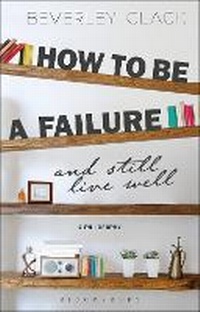
How to be a Failure and Still Live Well
A Philosophy
Published on 23. January 2020
Book
Hardback
264 pages
978-1-350-03068-8 (ISBN)
Description
In consumer economies, success has increasingly been defined in terms of material attainment and the achievement of status. This model of 'the good life' and its formulas for success ignore the haunting possibility that one may not succeed and as a result be deemed 'a failure'. How to be a Failure and Still Live Well explores that often neglected theme of failure, not just as the opposite of achievement, but also, and more importantly, how it has been conflated with loss: that which haunts all transient, mortal human experience.
Understanding loss as a form of failure affects our ability to cope with the everyday losses that permeate existence as a result of the natural processes of ageing, death, and decay. Engaging with loss and thinking about what it inevitability means for our lives and commitments, allows different values to emerge than those connected to success as attainment. Relationships, spontaneity, and generosity are explored as qualities that arise from taking seriously our vulnerability and that form the basis for richer accounts of what it might mean to 'live well'.
Understanding loss as a form of failure affects our ability to cope with the everyday losses that permeate existence as a result of the natural processes of ageing, death, and decay. Engaging with loss and thinking about what it inevitability means for our lives and commitments, allows different values to emerge than those connected to success as attainment. Relationships, spontaneity, and generosity are explored as qualities that arise from taking seriously our vulnerability and that form the basis for richer accounts of what it might mean to 'live well'.
Reviews / Votes
Nothing succeeds like success? Perhaps not. How to be a Failure and Still Live Well is a powerful rejection of the language of 'success' that dominates contemporary neo-liberal culture. Blending philosophy and personal experience Beverley Clack gives a moving defense of the necessity of loss and failure in building relationships, identity and a meaningful life. This splendid book gives us a picture of the kind of fuller existence we can aspire to as individuals who choose our own response to tragedy and as members of a community that does not rely on false optimism or selfish calculation to bind itself together. * Joshua Foa Dienstag, Professor of Political Science & Law, University of California, Los Angeles, USA * Thought-provoking and compelling, Bev Clack takes us into the heart of failure and loss, with personal depth and engaging philosophical and theological insights. Clack raises profoundly important questions and offers no easy answers - but helps the reader to engage more deeply with life, aided by failure and loss. * Alistair Ross, Associate Professor of Psychotherapy, Oxford University, UK * With characteristic wisdom, insight, humanity and wit, Clack shows us how dwelling with our failures can make genuine flourishing possible. This is philosophy at its best - philosophy that contributes to the shared human endeavour of living a good life, engaging deftly with psychology, politics, theology, feminist theory, literature and art. * Anastasia Scrutton, Associate Professor in Philosophy and Religion, University of Leeds, UK * The threat of failure is ever-present, but hardly ever openly examined. This thoughtful, honest and often moving book examines why so many of us are haunted by failure. Its erudite and detailed diagnosis of the reasons for widespread feelings of failure across modern societies makes for both fascinating and inspiring reading. * Anneliese Dodds, MP, House of Commons, UK * With characteristic wisdom, insight, humanity and wit, Clack shows us how dwelling with our failures can make genuine flourishing possible. This is philosophy at its best - philosophy that contributes to the shared human endeavour of living a good life, engaging deftly with psychology, politics, theology, feminist theory, literature and art. * Dr Anastasia Scrutton, Associate Professor in Philosophy and Religion, University of Leeds, UK *More details
Language
English
Place of publication
London
United Kingdom
Publishing group
Bloomsbury Publishing PLC
Target group
Professional and scholarly
Dimensions
Height: 198 mm
Width: 129 mm
Weight
390 gr
ISBN-13
978-1-350-03068-8 (9781350030688)
Copyright in bibliographic data and cover images is held by Nielsen Book Services Limited or by the publishers or by their respective licensors: all rights reserved.
Schweitzer Classification
Other editions
Additional editions
E-Book
01/2020
1st Edition
Bloomsbury Academic
€26.49
Available for download
Person
Beverley Clack is Professor in the Philosophy of Religion at Oxford Brookes University. Her publications include: Interrogating the Neoliberal Lifecycle: The Limits of Success, co-edited with Michele Paule (2019); Philosophy of Religion: A Critical Introduction, co-authored with Brian R Clack (3rd edition 2019); Freud on the Couch (2013); Feminist Philosophy of Religion: Critical Readings, co-edited with Pamela Sue Anderson (2004); Sex and Death: A Reappraisal of Human Mortality (2002); and Misogyny in the Western Philosophical Tradition (1999).
From 2012-16 she was City Councillor for St Clements Ward in Oxford, and from 2016-2018 she was a member of the Labour Party's National Policy Forum. She is a member of the Methodist Church's Faith and Order Committee, and a Fellow of the Royal Society of Arts.
From 2012-16 she was City Councillor for St Clements Ward in Oxford, and from 2016-2018 she was a member of the Labour Party's National Policy Forum. She is a member of the Methodist Church's Faith and Order Committee, and a Fellow of the Royal Society of Arts.
Content
Acknowledgements
Introduction: Failure: And How to Live Well
Chapter 1: Success, Failure, and the 21st Century Good Life
Chapter 2: Women, Failure, and the Fear of Loss
Chapter 3: Death and Sickness, Loss and Failure
Chapter 4: Factoring Out Failure, Factoring Out Humanity: Bureaucracy, Metrics, and the Loss of Spontaneity
Chapter 5: From Homo Economicus to Homo Religiosus: Remaking the Human
Chapter 6: Accepting Failure, Embracing Loss
Conclusion: Being a Failure and Living Well
Bibliography
Introduction: Failure: And How to Live Well
Chapter 1: Success, Failure, and the 21st Century Good Life
Chapter 2: Women, Failure, and the Fear of Loss
Chapter 3: Death and Sickness, Loss and Failure
Chapter 4: Factoring Out Failure, Factoring Out Humanity: Bureaucracy, Metrics, and the Loss of Spontaneity
Chapter 5: From Homo Economicus to Homo Religiosus: Remaking the Human
Chapter 6: Accepting Failure, Embracing Loss
Conclusion: Being a Failure and Living Well
Bibliography