

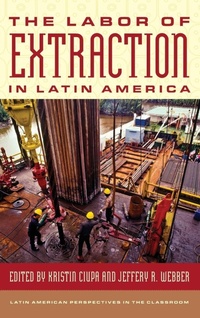
The Labor of Extraction in Latin America
Published on 9. January 2024
Book
Hardback
268 pages
978-1-5381-8754-8 (ISBN)
Description
Natural resource extraction and primary commodity export remain persistent features of the Latin American economy. This edited volume traces the power of labor in extractive sectors in Latin America starting in the 1980s and shows how labor shapes national export sectors, economies, politics, and societies more broadly.
Kristin Ciupa and Jeffery R. Webber bring together a team of international experts who look at labor in several extractive sectors-including oil and gas, mining and agriculture, and migrant labor. They present a variety of viewpoints and case studies, exploring themes of the strategic organizing potential of extractive workers, the rise of informal labor and its impact on organizing and worker solidarity, and migrant labor-power as extraction. The book analyzes relationships between workers, extractive companies, states, political parties, national social sectors, and global commodity markets. The Labor of Extraction in Latin America puts the question of labor organizing to the forefront of discussions on Latin America's ongoing history of extractive capitalism, its effects on nature, and resistance against it.
Contributions by: Fernando Cazon, Kristin Ciupa, Aleida Hernandez Cervantes, Phillip A. Hough, Christopher Little, Omar Manky, Andrea Marston, Viviana Patroni, Guido Starosta, Jeffery R. Webber, Anna Zalik
Kristin Ciupa and Jeffery R. Webber bring together a team of international experts who look at labor in several extractive sectors-including oil and gas, mining and agriculture, and migrant labor. They present a variety of viewpoints and case studies, exploring themes of the strategic organizing potential of extractive workers, the rise of informal labor and its impact on organizing and worker solidarity, and migrant labor-power as extraction. The book analyzes relationships between workers, extractive companies, states, political parties, national social sectors, and global commodity markets. The Labor of Extraction in Latin America puts the question of labor organizing to the forefront of discussions on Latin America's ongoing history of extractive capitalism, its effects on nature, and resistance against it.
Contributions by: Fernando Cazon, Kristin Ciupa, Aleida Hernandez Cervantes, Phillip A. Hough, Christopher Little, Omar Manky, Andrea Marston, Viviana Patroni, Guido Starosta, Jeffery R. Webber, Anna Zalik
Reviews / Votes
This edited collection contextualizes the current production of extractive labor in Latin America due to the political, historical, social, and economic effects of neoliberal policies and geopolitics. According to the editors, "The main objective of this edited collection is to inaugurate a research agenda aimed at filling an enormous gap concerning the question of labor in the extant literature on extractivism in Latin America" (p. 4). The editors organized this collection into five critical sections, bringing together 11 scholars. The writers challenge capitalist and neoliberal scholarship on the political status of 21st-century labor production in Latin America. Each chapter provides a strong, in-depth review and analysis, including theoretical frameworks that are critical for understanding extraction in modern Latin American labor production. This critical book will result in major contributions to future scholarship on this important subject. Every library should obtain a copy for their Latin American and labor collections. Highly recommended. Advanced undergraduates through faculty. * Choice Reviews * This book demonstrates that the expansion of natural resource extraction not only comes at a price for rural communities, the environment, and Latin American economies. It also comes at a cost for workers who labor in those extractive industries. It shows how export workers in strategic sectors occupy a crucial place for building broad-based anti-capitalist movements in Latin America. The Labor of Extraction in Latin America analyzes the very struggles that are central to the future of Latin America and the world. -- Steve Striffler, professor, University of Massachussetts, Boston This book takes on the hugely important task of bringing the workers back in to the study of extractive accumulation in Latin America. With a comprehensive theoretical framework and detailed case studies that both mobilize and extend it, this volume lays out an exciting new research agenda for the study of Latin American political economy. -- Christy Thornton, assistant professor, Johns Hopkins University In the abundant recent scholarship on Latin America's extractive export economies, the labor required to harvest those exports has been curiously overlooked. This pathbreaking volume shows how we can integrate an analysis of extractive labor with the currently more popular lenses of ecology and social reproduction. -- Kevin A. Young, associate professor, University of Massachusetts, AmherstMore details
Series
Language
English
Place of publication
United States
Publishing group
Bloomsbury Publishing Plc
Target group
College/higher education
US School Grade: From College Freshman to College Graduate Student
Illustrations
7 BW Illustrations
Dimensions
Height: 235 mm
Width: 157 mm
Thickness: 20 mm
Weight
590 gr
ISBN-13
978-1-5381-8754-8 (9781538187548)
Copyright in bibliographic data and cover images is held by Nielsen Book Services Limited or by the publishers or by their respective licensors: all rights reserved.
Schweitzer Classification
Other editions
Additional editions
Kristin Ciupa | Jeffery R. Webber
The Labor of Extraction in Latin America
E-Book
01/2024
1st Edition
Rowman & Littlefield Publishers
€32.99
Available for download
Kristin Ciupa | Jeffery R. Webber
The Labor of Extraction in Latin America
E-Book
01/2024
1st Edition
Rowman & Littlefield Publishers
€32.99
Available for download
Persons
Kristin Ciupa is an assistant professor of sociology at the University of Regina. She is the author of The Political Economy of Oil in Venezuela: Class Conflict, the State, and the World Market.
Jeffery R. Webber is a professor of politics at York University, Toronto. He is the author or co-author of five books, and co-editor of two books. Most recently, he is co-author of The Impasse of the Latin American Left.
Jeffery R. Webber is a professor of politics at York University, Toronto. He is the author or co-author of five books, and co-editor of two books. Most recently, he is co-author of The Impasse of the Latin American Left.
Content
Table of Contents
PART ONE - THEORETICAL FRAMEWORK
Chapter One - Introduction: The Labor of Extraction in Latin America
Kristin Ciupa and Jeffery R. Webber
PART TWO - REVISITING THE CLASSICAL CASES
Chapter Two - The Political Economy of the Labor Movement in Contemporary Argentina
Ruth Felder and Viviana Patroni
Chapter Three - Oil and the Dualization of Venezuela's Labor Movement
Kristin Ciupa
Chapter Four - A Labor History of Extractivism in Colombia: From Coffee to Coca and Beyond
Phillip A. Hough
Chapter Five - Reading Peru from Chile: Examining Mining Unionism in the Twentieth and Twenty-First Centuries
Omar Manky
Chapter Six - Capital Accumulation and the Forms and Potentialities of the Labor Movement in Latin America: Critical Reflections on Argentina and Chile
Guido Starosta and Fernando Javier Cazon
PART THREE - EXTENDING THE FRAMEWORK
Chapter Seven - Labor/Nature in (Late) Capitalist Mexico
Aleida Hernandez Cervantes and Anna Zalik
Chapter Eight - From Sindicalismo to Cooperativismo: The Atomization of the Bolivian Miners' Movement
Andrea Marston
Chapter Nine - Migrant Labor as Extraction
Christopher Little
PART FOUR - CONCLUSION
Chapter Ten - Conclusion and New Directions
Jeffery R. Webber
PART ONE - THEORETICAL FRAMEWORK
Chapter One - Introduction: The Labor of Extraction in Latin America
Kristin Ciupa and Jeffery R. Webber
PART TWO - REVISITING THE CLASSICAL CASES
Chapter Two - The Political Economy of the Labor Movement in Contemporary Argentina
Ruth Felder and Viviana Patroni
Chapter Three - Oil and the Dualization of Venezuela's Labor Movement
Kristin Ciupa
Chapter Four - A Labor History of Extractivism in Colombia: From Coffee to Coca and Beyond
Phillip A. Hough
Chapter Five - Reading Peru from Chile: Examining Mining Unionism in the Twentieth and Twenty-First Centuries
Omar Manky
Chapter Six - Capital Accumulation and the Forms and Potentialities of the Labor Movement in Latin America: Critical Reflections on Argentina and Chile
Guido Starosta and Fernando Javier Cazon
PART THREE - EXTENDING THE FRAMEWORK
Chapter Seven - Labor/Nature in (Late) Capitalist Mexico
Aleida Hernandez Cervantes and Anna Zalik
Chapter Eight - From Sindicalismo to Cooperativismo: The Atomization of the Bolivian Miners' Movement
Andrea Marston
Chapter Nine - Migrant Labor as Extraction
Christopher Little
PART FOUR - CONCLUSION
Chapter Ten - Conclusion and New Directions
Jeffery R. Webber