

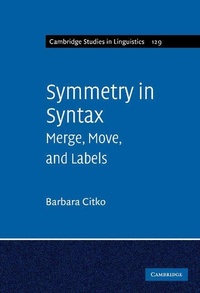
Symmetry in Syntax
Merge, Move and Labels
Published on 28. April 2011
Book
Hardback
290 pages
978-1-107-00555-6 (ISBN)
Description
While much has been written on asymmetric aspects of sentence structure, symmetric aspects have been largely ignored, or claimed to be non-existent. Does symmetry in syntax exist, and if it does, how do we account for it? In this book, Barbara Citko sets out to tackle these questions and offers a unified approach to a number of phenomena that have so far been studied only in isolation. Focusing on three core minimalist mechanisms: merge, move and labeling, she advances a new theory of these mechanisms, by showing that under certain well-defined circumstances merge can create symmetric structures, move can target either of two potentially moveable objects, and labels can be constructed symmetrically from the features of two objects. This book is aimed at researchers and graduate students interested in minimalist syntax, the structure of questions, relative clauses, coordination, double object constructions and copular sentences.
Reviews / Votes
'... highly original and illuminating.' Henk van Riemsdijk, Tilburg University '... elegant and provocative.' Norbert Hornstein, University of MarylandMore details
Series
Language
English
Place of publication
Cambridge
United Kingdom
Target group
Professional and scholarly
Illustrations
7 Tables, black and white
Dimensions
Height: 235 mm
Width: 157 mm
Thickness: 20 mm
Weight
574 gr
ISBN-13
978-1-107-00555-6 (9781107005556)
Copyright in bibliographic data and cover images is held by Nielsen Book Services Limited or by the publishers or by their respective licensors: all rights reserved.
Schweitzer Classification
Other editions
Additional editions
E-Book
05/2011
1st Edition
Cambridge University Press
€85.99
Available for download
E-Book
04/2011
Cambridge University Press
€71.49
Available for download
Person
Barbara Citko is Assistant Professor of Linguistics at the University of Washington, Seattle. Her research includes work on phrase structure, coordination, relative clauses, wh-questions and the syntax of Slavic languages.
Content
1. Rationale; 2. Asymmetry in syntax; 3. Symmetry in merge; 4. Symmetry in move; 5. Symmetric labels; 6. Conclusion.