

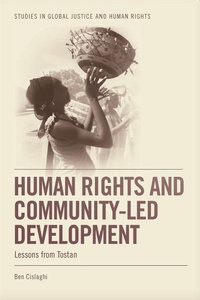
Human Rights and Community-led Development
Lessons from Tostan
Published on 22. May 2019
Book
Paperback/Softback
296 pages
978-1-4744-5303-5 (ISBN)
Description
How can we best empower people living in the most economically disadvantaged areas of the world to improve their lives in ways that matter to them? This book investigates work of the NGO Tostan as a working model of human development. The study is grounded in the ethnographic study of the actual change that happened in one West African village. The result is a powerful mix of theory and practice that questions existing approaches to development and that speaks to both development scholars and practitioners.
Divided into three parts, the book firstly assesses why top-down approaches to education and development are unhelpful and offers a theoretical understanding of what constitutes helpful development. Part two examines Tostan's community-based participatory approach as an example of a helpful development intervention, and offers qualitative evidence of its effectiveness. Part three builds a model of how community-led development works, why it is helpful, and what practitioners can do to help people at the grassroots level lead their own human development.
Divided into three parts, the book firstly assesses why top-down approaches to education and development are unhelpful and offers a theoretical understanding of what constitutes helpful development. Part two examines Tostan's community-based participatory approach as an example of a helpful development intervention, and offers qualitative evidence of its effectiveness. Part three builds a model of how community-led development works, why it is helpful, and what practitioners can do to help people at the grassroots level lead their own human development.
More details
Series
Language
English
Place of publication
Edinburgh
United Kingdom
Target group
Professional and scholarly
Product notice
Paperback (trade)
Unsewn / adhesive bound
Dimensions
Height: 226 mm
Width: 155 mm
Thickness: 18 mm
Weight
454 gr
ISBN-13
978-1-4744-5303-5 (9781474453035)
Copyright in bibliographic data and cover images is held by Nielsen Book Services Limited or by the publishers or by their respective licensors: all rights reserved.
Schweitzer Classification
Other editions
Additional editions
E-Book
11/2017
1st Edition
Edinburgh University Press
€29.49
Available for download
E-Book
11/2017
1st Edition
Edinburgh University Press
€0.00
Available for download
Person
Ben Cislaghi is Lecturer in Social Norms at the London School of Hygiene and Tropical Medicine. He previously worked as a development professional.
Content
Index of Figures and Tables
List of Abbreviations
1. Introduction
Origin of this book and research methodsThree useful things that are in this bookPart one. Some useful concepts to rethink development practicesPart two. The programme in actionPart three. Helpful development
Part I: Some Useful Tools to Rethink Development Practices
2. Rethinking development interventions: Potential and challenges of human rights education
IntroductionBringing international human rights into local contextsA nonformal problem-posing approach to human rights educationA human development framework for human rights educationCognitive and social constructions of the status quoGender roles and social changePower dynamics in social reproductionConclusion
3. Modernisation at work: Senegal, Tostan and the Ful?e
IntroductionSenegal: Gender, Decision Making and Human Rights Challenges The NGO Tostan: approach, curriculum and limitationsThe Ful?e identity: values and characteristicsConclusion
Part II: The Programme in Action
4. Galle Toubaaco before the programme
IntroductionGalle ToubaacoGender roles and relations: invisible powerPolitical structure and decision-making: visible and hidden powerOther human-rights-inconsistent social practicesConclusion
5. Human rights education in action: the programme unfolds
IntroductionThe Learning ContextThe Experiential LearningThe CurriculumResistance to and limitations of the Tostan classes in Galle ToubaacoConclusion
6. The 'now-women' and other changes: a wider horizon of possibilities?
IntroductionGalle ToubaacoGender roles and relations: invisible powerPolitical Structure and decision-making: visible and hidden powerOther Human-rights-inconsistent social practicesPossible pitfalls of the Tostan programme in Galle ToubaacoConclusion
Part III: Helpful Development
7. Dynamics of social change: a model for indirect development practitioners
IntroductionThe pedagogical approach of the HRE programmeThe substantive content of the HRE programmeThe process of coinvestigation breaking norms of gender segregationExperiencing new clues to make sense of the worldDeveloping capacity to aspireExpanding freedoms and gaining new capabilitiesThe interactive process between two communities of practiceA people-centred indirect approach to human developmentConclusion
8. Conclusion
What changed in Galle Toubaaco: gender relations, power balance, and harmful practicesA theory of change for the CEP: three steps for social changeComparing the Tostan model: three case studiesFour Contributions to Theory and Practice of International DevelopmentFuture research trajectories
References
List of Abbreviations
1. Introduction
Origin of this book and research methodsThree useful things that are in this bookPart one. Some useful concepts to rethink development practicesPart two. The programme in actionPart three. Helpful development
Part I: Some Useful Tools to Rethink Development Practices
2. Rethinking development interventions: Potential and challenges of human rights education
IntroductionBringing international human rights into local contextsA nonformal problem-posing approach to human rights educationA human development framework for human rights educationCognitive and social constructions of the status quoGender roles and social changePower dynamics in social reproductionConclusion
3. Modernisation at work: Senegal, Tostan and the Ful?e
IntroductionSenegal: Gender, Decision Making and Human Rights Challenges The NGO Tostan: approach, curriculum and limitationsThe Ful?e identity: values and characteristicsConclusion
Part II: The Programme in Action
4. Galle Toubaaco before the programme
IntroductionGalle ToubaacoGender roles and relations: invisible powerPolitical structure and decision-making: visible and hidden powerOther human-rights-inconsistent social practicesConclusion
5. Human rights education in action: the programme unfolds
IntroductionThe Learning ContextThe Experiential LearningThe CurriculumResistance to and limitations of the Tostan classes in Galle ToubaacoConclusion
6. The 'now-women' and other changes: a wider horizon of possibilities?
IntroductionGalle ToubaacoGender roles and relations: invisible powerPolitical Structure and decision-making: visible and hidden powerOther Human-rights-inconsistent social practicesPossible pitfalls of the Tostan programme in Galle ToubaacoConclusion
Part III: Helpful Development
7. Dynamics of social change: a model for indirect development practitioners
IntroductionThe pedagogical approach of the HRE programmeThe substantive content of the HRE programmeThe process of coinvestigation breaking norms of gender segregationExperiencing new clues to make sense of the worldDeveloping capacity to aspireExpanding freedoms and gaining new capabilitiesThe interactive process between two communities of practiceA people-centred indirect approach to human developmentConclusion
8. Conclusion
What changed in Galle Toubaaco: gender relations, power balance, and harmful practicesA theory of change for the CEP: three steps for social changeComparing the Tostan model: three case studiesFour Contributions to Theory and Practice of International DevelopmentFuture research trajectories
References