

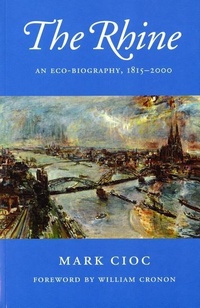
The Rhine
An Eco-Biography, 1815-2000
Published on 9. January 2006
Book
Paperback/Softback
280 pages
978-0-295-98500-8 (ISBN)
Description
The Rhine River is Europe's most important commercial waterway, channeling the flow of trade among Switzerland, France, Germany, and the Netherlands. In this innovative study, Mark Cioc focuses on the river from the moment when the Congress of Vienna established a multinational commission charged with making the river more efficient for purposes of trade and commerce in 1815. He examines the engineering and administrative decisions of the next century and a half that resulted in rapid industrial growth as well as profound environmental degradation, and highlights the partially successful restoration efforts undertaken from the 1970s to the present.
The Rhine is a classic example of a "multipurpose" river -- used simultaneously for transportation, for industry and agriculture, for urban drinking and sanitation needs, for hydroelectric production, and for recreation. It thus invites comparison with similarly over-burdened rivers such as the Mississippi, Hudson, Colorado, and Columbia. The Rhine's environmental problems are, however, even greater than those of other rivers because it is so densely populated (50 million people live along its borders), so highly industrialized (10% of global chemical production), and so short (775 miles in length).
Two centuries of nonstop hydraulic tinkering have resulted in a Rhine with a sleek and slender profile. In their quest for a perfect canal-like river, engineers have modified it more than any other large river in the world. As a consequence, between 1815 and 1975, the river lost most of its natural floodplain, riverside vegetation, migratory fish, and biodiversity. Recent efforts to restore that biodiversity, though heartening, can have only limited success because so many of the structural changes to the river are irreversible.
The Rhine: An Eco-Biography, 1815-2000 makes clear just how central the river has been to all aspects of European political, economic, and environmental life for the past two hundred years.
The Rhine is a classic example of a "multipurpose" river -- used simultaneously for transportation, for industry and agriculture, for urban drinking and sanitation needs, for hydroelectric production, and for recreation. It thus invites comparison with similarly over-burdened rivers such as the Mississippi, Hudson, Colorado, and Columbia. The Rhine's environmental problems are, however, even greater than those of other rivers because it is so densely populated (50 million people live along its borders), so highly industrialized (10% of global chemical production), and so short (775 miles in length).
Two centuries of nonstop hydraulic tinkering have resulted in a Rhine with a sleek and slender profile. In their quest for a perfect canal-like river, engineers have modified it more than any other large river in the world. As a consequence, between 1815 and 1975, the river lost most of its natural floodplain, riverside vegetation, migratory fish, and biodiversity. Recent efforts to restore that biodiversity, though heartening, can have only limited success because so many of the structural changes to the river are irreversible.
The Rhine: An Eco-Biography, 1815-2000 makes clear just how central the river has been to all aspects of European political, economic, and environmental life for the past two hundred years.
Reviews / Votes
"As demonstrated by historian Cioc, the defilement of the Rhine is a case study in the tragedy of unintended consequences. But it is also a fascinating story because the river today is the product of the complex interplay among all of the major forces that shaped modern European history- industry, technology, economy, politics, and, finally, ecology. As such, its story is similar to those that could be told about many other major rivers. . . . Impressive scholarship." * Library Journal * "This enjoyable, scholarly and well-written book is a very welcome addition to the literature in English on the environmental history of Continental Europe, and students as well as professionals will certainly read it with profit and pleasure." * Environment and History * "Sometimes ironic and humorous, consistently clear and persuasive, Cioc's 'life story' of the Rhine deftly weaves together politics, economics, and river ecology.. A compelling study." * Environmental History * "A concise and remarkably authoritative overview of the Rhine..Compelling reading." * American Historical Review * "An impressive book..It is erudite, well-written, and informatively illustrated, and it will unquestionably serve for years to come as an obligatory point of departure for further research into the environmental dimensions of the Rhine's turbulent history." * Technology and Culture * "As the first true environmental history of a major European river, Mark Cioc's stimulating new book is a sign that European environmental history is entering a period of maturation; his eco-biography will serve benchmark for future scholarly work in the field. By tackling the Rhine, the classic European river, Cioc offers an environmental history that transcends national histories." * H-German Reviews *More details
Series
Language
English
Place of publication
Seattle
United States
Target group
Professional and scholarly
US School Grade: College Graduate Student
Product notice
Paperback (trade)
Dimensions
Height: 223 mm
Width: 145 mm
Thickness: 17 mm
Weight
372 gr
ISBN-13
978-0-295-98500-8 (9780295985008)
Copyright in bibliographic data and cover images is held by Nielsen Book Services Limited or by the publishers or by their respective licensors: all rights reserved.
Schweitzer Classification
Persons
Mark Cioc is professor of history at the University of California, Santa Cruz. He is the author of Pax Atomica: The Nuclear Defense Debate in West Germany during the Adenauer Era.
Content
Foreword
Acknowledgments
Introduction
Europe's "World River"
Water Sorcery
The Carboniferous Rhine
Sacrificing a River
Biodiversity Lost
A River Restored?
Conclusion
Notes
Bibliography
Index
Acknowledgments
Introduction
Europe's "World River"
Water Sorcery
The Carboniferous Rhine
Sacrificing a River
Biodiversity Lost
A River Restored?
Conclusion
Notes
Bibliography
Index